Chapter 6: The Second Emergency
Two months passed.
The incident became neighborhood history.
People stopped talking about it every day.
Margaret no longer patrolled the street looking for violations.
She still liked things orderly.
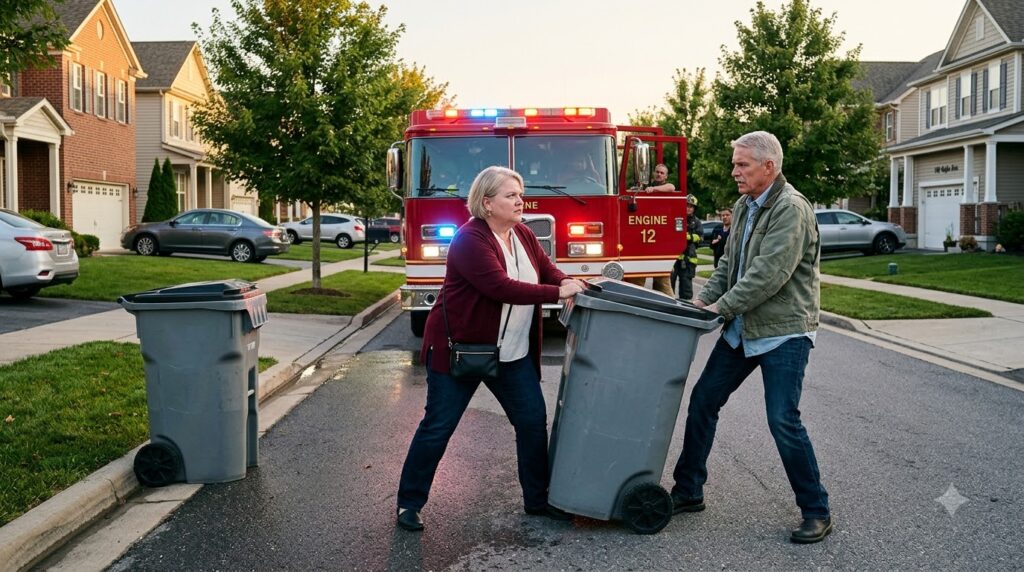
She still complained when someone left garbage cans out for three days.
Some habits didn’t disappear overnight.
But she had changed one important thing.
She stopped assuming that every inconvenience was an attack on her authority.
Then, on a rainy Tuesday evening, another emergency came.
This time it was a medical call.
An elderly resident had fallen inside a house near the center of the subdivision.
An ambulance arrived.
A delivery van was parked partially along the curb.
A neighbor’s SUV sat awkwardly across part of the lane.
Within seconds, Margaret appeared outside.
Daniel watched from his porch.
For one brief moment, he wondered whether the old Margaret was about to return.
She walked toward the vehicles.
Then she pointed toward the road.
“Move those cars.”
The owners hurried outside.
The lane opened.
The ambulance rolled through.
Margaret stepped onto the sidewalk and stayed there.
Daniel smiled.
Not because she had become a different person.
Because this time she understood what mattered.
Later, she walked past Daniel’s house.
“You saw that?”
“I did.”
She stopped.
“I almost wanted to yell at them.”
Daniel laughed.
“Almost?”
“Almost.”
She looked down the street.
“I realized something.”
“What?”
“The road isn’t mine.”
Daniel nodded.
“That’s a good realization.”
Margaret smiled faintly.
“It’s everyone’s.”
And that was the real lesson the neighborhood kept.
A community wasn’t protected by the person who shouted the loudest.
It was protected when people understood that shared spaces came with shared responsibilities.
The road belonged to everyone.
The sidewalk belonged to everyone.
The emergency access lanes belonged to everyone.
And when someone needed help, those things mattered more than pride.
Months later, Sarah’s house was fully repaired.
Evelyn returned home.
The kitchen was new.
The walls had been repainted.
A framed photograph of the firefighters who had carried Evelyn out hung near the front entrance.
At the bottom of the frame was a small plaque.
For the people who came when we needed them.
Daniel saw it one afternoon when Sarah invited several neighbors over.
Margaret was there too.
She stood quietly beside the photograph.
Then she looked at Daniel.
“I still hate those trash bins.”
Daniel laughed.
“Me too.”
“But I don’t think I’ll ever look at them the same way again.”
Neither would he.
Because a trash bin was just a trash bin.
Until someone put it in the wrong place at the wrong moment.
Then it became a test.
Not of authority.
Not of pride.
But of whether a person could recognize that someone else’s life might matter more than being right.
And on that quiet suburban street, Margaret finally learned something she had spent years trying to teach everyone else:
A community isn’t about controlling the people around you. It’s about knowing when to get out of their way.