Chapter 3: The Letter in Every Mailbox
Daniel read the letter twice.
It was titled:
EMERGENCY ACCESS AND COMMUNITY SAFETY
The letter stated that all residents were required to keep roads, fire lanes, hydrants, and emergency access points clear at all times.
That part was ordinary.
The unusual part came next.
The letter claimed that the previous night’s incident had occurred because “certain residents were unaware of community procedures concerning emergency access.”
Daniel lowered the paper.
Linda looked over his shoulder.
“That’s a polite way of saying somebody caused a problem.”
Daniel nodded.
Then he read the final paragraph.
The association was scheduling a special meeting.
Residents were invited to discuss “appropriate use of shared roads and community property.”
Daniel almost laughed.
“Community property?”
Linda took the letter.
“Who’s on the board?”
“Margaret.”
Linda’s eyebrows rose.
Margaret wasn’t the president.
She wasn’t even the vice president.
But she had been appointed to a committee that dealt with neighborhood appearance and common areas.
That apparently had been enough for her to start acting like she had authority over the road.
At the meeting that evening, the clubhouse was packed.
Sarah Bennett sat near the front.
Daniel sat beside Linda.
Margaret arrived carrying a thick folder.
She placed it on the table with deliberate confidence.
The meeting began calmly.
Then Margaret stood.
“I think it’s important that everyone understands what actually happened.”
Daniel leaned back.
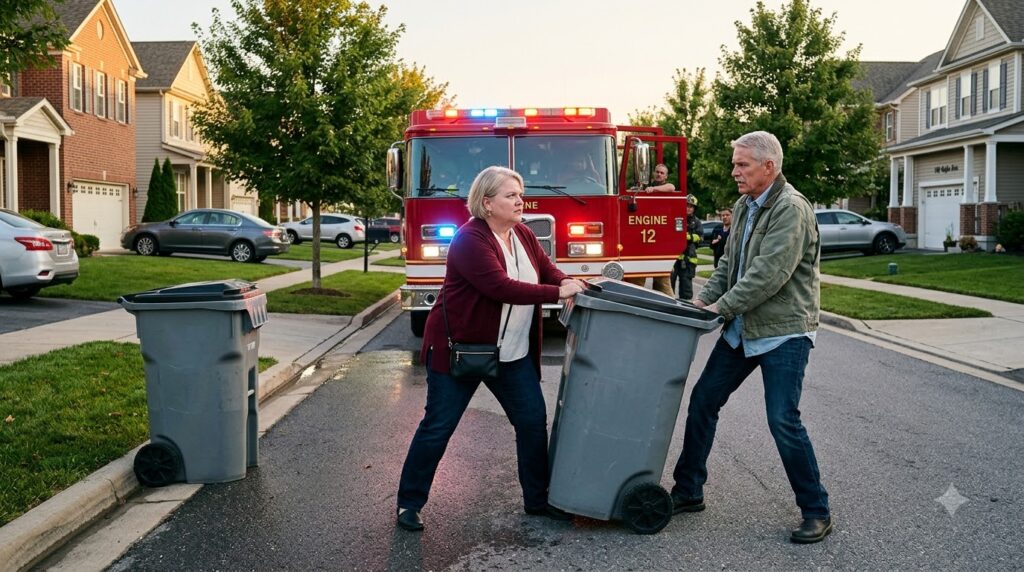
Margaret claimed the trash bins had been placed temporarily because she was concerned about vehicles speeding through the neighborhood.
She said she believed the fire truck could have approached from another direction.
Several residents exchanged looks.
Sarah stood.
“There wasn’t another direction.”
Margaret looked at her.
“I didn’t know your mother was inside.”
Sarah’s voice remained controlled.
“You didn’t know because you never asked.”
The room became silent.
Margaret opened her folder.
“I was trying to protect the neighborhood.”
Daniel finally spoke.
“Protect it from what?”
“Unauthorized traffic.”
“A fire truck isn’t unauthorized traffic.”
Margaret’s face flushed.
She insisted that residents had responsibilities too. She talked about keeping the subdivision orderly, preserving property values, and preventing outsiders from treating private roads as shortcuts.
Some of those concerns were legitimate.
But the meeting had one unavoidable fact hanging over it.
A fire truck had been delayed.
The association president finally asked Margaret whether she understood that emergency vehicles had priority access.
Margaret hesitated.
“Of course.”
“And would you move an obstruction immediately if another emergency vehicle approached?”
Margaret looked around the room.
“I would.”
Daniel said nothing.
Neither did Sarah.
The president asked for a vote on a new emergency-access rule requiring immediate removal of any movable obstruction from roads and access lanes.
The motion passed unanimously.
Margaret’s face tightened.
But that wasn’t the end.
After the meeting, the association president quietly asked Daniel and Sarah to stay behind.
“There may be more to this,” she said.
She had received a report from the fire department.
And the report contained a detail neither of them knew.
The fire crew had arrived at the subdivision sooner than the residents realized.
They had been forced to stop because the roadway had been intentionally narrowed.
The delay had been documented.
And someone had recorded it on a phone.