
Chapter 5: What Margaret Had Been Trying to Control
Margaret’s daughter, Emily, came to the neighborhood on Saturday morning.
She found Daniel while he was trimming a hedge.
“I owe you an explanation,” Emily said.
Daniel put down the clippers.
Emily told him her mother had always struggled with losing control of things.
Her husband had died three years earlier.
Afterward, Margaret had moved into the subdivision and become increasingly focused on rules, schedules, property lines, parking spaces, trash collection and neighborhood appearance.
“She thinks if everything is controlled,” Emily said, “nothing bad can happen again.”
Daniel listened.
Emily continued.
“That doesn’t excuse what she did.”
“No,” Daniel said. “It doesn’t.”
“I know.”
There was no attempt to excuse Margaret.
That made the conversation easier.
Emily told Daniel her mother had been embarrassed by the video.
Not because people had criticized her.
Because she had finally seen herself behaving in a way she hadn’t recognized.
Daniel thought about that.
Sometimes people didn’t change because someone defeated them in an argument.
Sometimes they changed because they were forced to watch their own actions from the outside.
That afternoon, Margaret came to Daniel’s porch.
She stood several feet away.
“I saw the video,” she said.
Daniel nodded.
“So did everyone else.”
“I know.”
She looked toward the street.
“I kept thinking I was protecting something.”
Daniel waited.
“I don’t know what.”
For a moment, neither spoke.
Then Margaret said, “When my husband was alive, he handled everything. Repairs. Contractors. Emergencies. All of it.”
Her voice softened.
“After he died, I started thinking that if I didn’t control everything around me, something else would go wrong.”
Daniel understood the feeling without approving the behavior.
“You can’t control everything.”
“I know.”
Margaret looked at him.
“Your wife told you to say that?”
Daniel almost smiled.
“No.”
She nodded.
Then she did something Daniel hadn’t expected.
She apologized.
Not dramatically.
Not in front of the neighborhood.
Just standing on his porch.
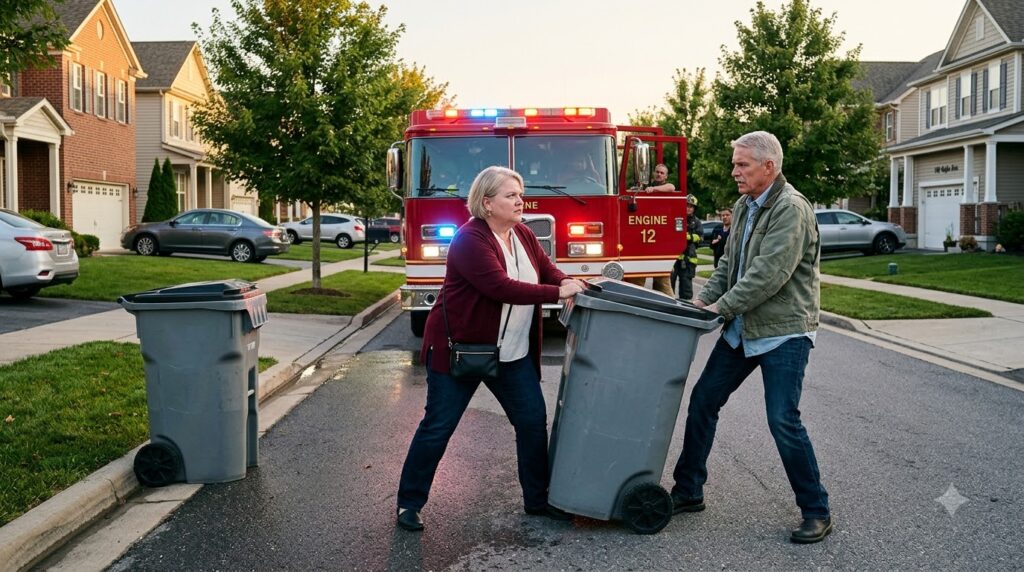
“I should have moved the bins the second I heard the siren.”
Daniel said nothing.
“I was wrong.”
That was the first time she had said it without qualification.
Daniel accepted the apology.
But the consequences didn’t disappear.
The association removed Margaret from the common-area committee.
The rule about emergency access was formally added to the neighborhood guidelines.
And Sarah’s family began repairing Evelyn’s house.
A week later, the street looked normal again.
Almost.
Then Daniel noticed something beside the curb.
Two trash bins.
But this time they were perfectly out of the roadway.
And next to them was a handwritten sign.
EMERGENCY ACCESS — KEEP CLEAR
Margaret had made it herself.








