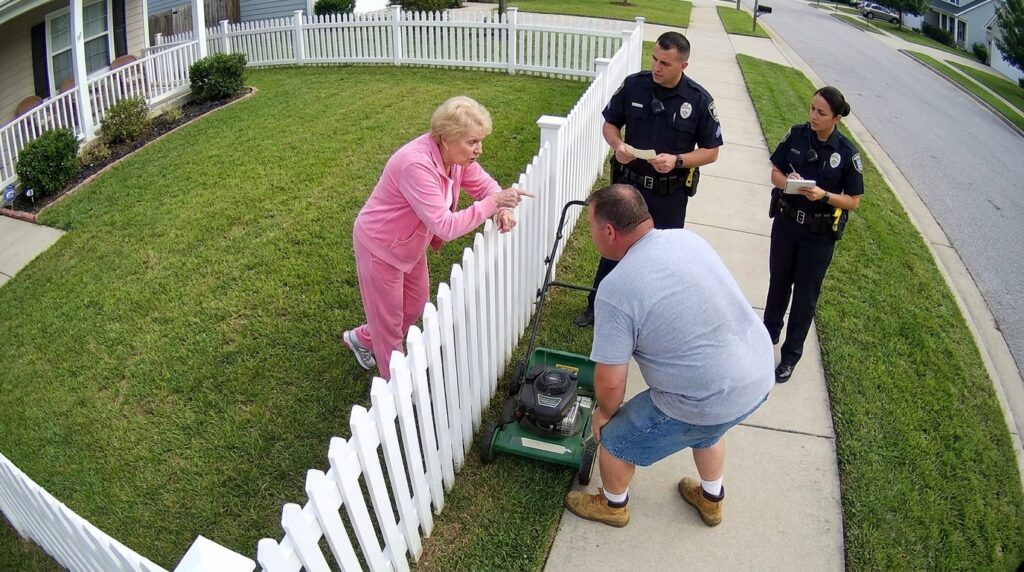
CHAPTER 5: THE BLUEPRINT IN THE TRUCK
The metal teeth of the canvas tool bag didn’t slide cleanly; they ground against three seasons of dried grass mulch and pulverized gravel before the zipper parted. David reached into the dark interior of the truck bed, his fingers bypassing the heavy iron socket wrenches until they closed around the cold cylinder of an ungalvanized tin map tube. The metal was dull, smelling of damp scale and the stale grease he used to keep his string-trimmers from binding.
“Officer Miller,” David said, his voice flat as he stepped back down to the dusty shoulder. His heavy leather work boots kicked up a small puff of dry limestone dust that settled over the mower’s green deck. He unfastened the plastic cap of the tube with his thumb. “If you’re checking the ninety-eight ledger, you need to look at the utility attachment from October of that same year. My dad didn’t just keep the billing records. He kept the engineering variance for the main water header.”
He pulled out the rolled blueprint, the thick, heavy stock uncoiling with a stiff, rhythmic snap between his grease-stained hands. The paper was sun-faded at the margins, its clean white gridlines cutting through a field of deep blueprint blue. He flattened the page against the hood of his truck, using a rusted iron coupler block to hold down the top edge while his calloused palm smoothed out the lower seam.
Officer Miller walked away from the white picket fence line, the leather casing of his utility belt creaking as his stride widened. He leaned over the truck’s rusted side panel, his eyes following David’s blunt index finger as it stopped at a small red-ink circle marked Lot 414-B.
“This is the municipal sewer tie-in line from the old construction,” David muttered, his finger tracing a heavy black line that ran completely beneath the grass strip where his push mower sat. “When Mr. Vance signed the drainage release to avoid the city’s back-conduit suit, he didn’t just give up the right-of-way. He accepted a municipal indemnity clause. The county didn’t just take the twenty-two inches outside the pickets. They took the whole structural footing path to maintain the main junction box.”
Evelyn didn’t move from the gatepost, but her short, compact frame seemed to shrink down into the bright pink collar of her tracksuit. She didn’t look at the blueprint across the road; she looked at Officer Davis, whose thumb was still tapping out commands into the blue light of the handheld terminal.
“That folder belongs to the Vance estate,” Evelyn said, her voice rising into a sharp, dry rattle that lacked its previous administrative weight. Her hand remained clutched against her yellow notepad, but the plastic folder was shaking slightly against her ribs. “My husband’s lawyers cleared that engineering attachment before the secondary subdivision was logged. It’s an extinct easement.”
“It’s not extinct, Mrs. Vance,” Davis said, her voice cutting through the flat glare of the street with a cold, professional finality. She stopped tapping the terminal screen. Her eyes lifted, tracking the vertical line of the white pine pickets where they bowed out toward the concrete gutter by the water meter box. “The system log shows the water district verified this junction three months ago during the main line pressure drop. The county’s property assessment office has this fence marked as a non-conforming temporary obstruction. The code enforcement notice was sent to your billing address in April.”
David watched the way the large, dark discs of Evelyn’s sunglasses reflected the gray shape of his truck. She didn’t answer. Her jaw worked silently, her teeth clicking together once with a small, dry sound like two pieces of flint hitting in a pocket.
Across the lane, the man in the grease-stained undershirt had crossed his driveway completely, his heavy boots resting on the asphalt as he leaned forward to see the blueprint on the hood. Two more neighbors from number 412 had stepped out onto their front lawn, their faces pale under the bright noon sun, their eyes locked onto the two black-and-white patrol cars containing the block.
Miller reached down, his fingers catching the brass grommet at the corner of David’s blueprint. He lifted the page slightly, his eyes narrowing as he cross-referenced the technical drawings with the actual layout of the white picket fence ten feet away. The truth wasn’t hidden in the documents anymore; it was written in the physical overgrowth of the grass and the four-inch encroachment of the wooden posts into the city’s right-of-way.
“So the fence isn’t just sitting on the line,” Miller said, his tone dropping into that quiet, transactional register used when an infraction transitions from a neighborhood dispute to a county code liability. He looked back over his shoulder at Evelyn, his hand dropping to his utility belt. “It’s sitting clear inside the utility path. If the district brings the service rig down here to clear the main box, this whole timber section has to come down by noon tomorrow.”
David didn’t offer a victory. He stayed silent, his palm resting on the rusted iron coupler block, the rough texture of the metal cutting into his grease-slicked skin while the heat off his truck’s engine shroud continued to bake the dry air of the block. He had the proof, but the weight of the land lines felt heavier than the machine he’d been pushing all day.