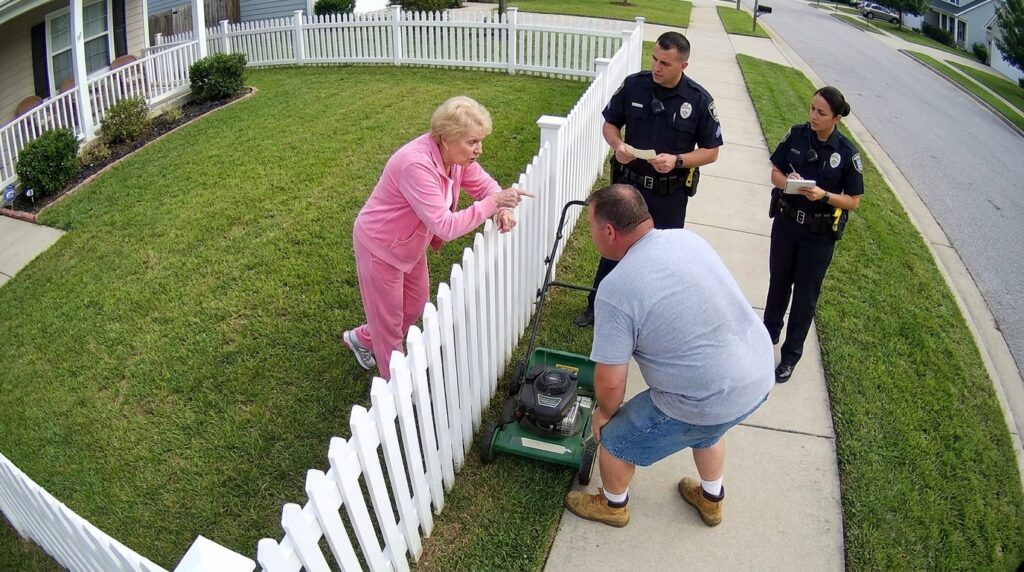
CHAPTER 2: THE SPLIT GRAIN
“The local precinct has the license plate on file, David,” Evelyn said. Her voice didn’t rise in pitch; it simply hardened, a dry rattle like gravel shifting in a chute. She stepped closer to the white pickets, her knuckles brushing against the uncalibrated tension-spring of her side gate. The spring was a coil of oxidized iron, dark and flaking with rust that left a red-brown smudge against the bright pink sleeve of her tracksuit. “They know the registration for that flatbed. They know who owns the insurance on the deck.”
David didn’t look up from the green housing of the mower. He reached down with his right hand, his fingers tracking the grease-slicked casing of the throttle cable where it met the engine block. The heat off the cooling fins was direct, a dry wave that smelled of unwashed oil and old grass. “The plate’s current, Mrs. Vance. The county clerk handled the renewal back in January.”
He could hear the rhythmic click-shirr of her sandals on the concrete walkway inside the boundary line. She wasn’t just watching him; she was measuring the distance between his work boots and the lower rail of her fence. Every movement she made had the rigid, deliberate pacing of a property owner who believed the dirt beneath her feet was an extension of her own skin. Her shadow, distorted and long under the flat afternoon sun, stretched across the dry turf and touched the front wheel of his machine.
“The county clerk doesn’t clear code violations on residential frontage,” she countered, her thumb tapping the edge of her yellow notepad. The plastic folder clicked against her ribs. “The ordinance is clear about commercial operations within four feet of a historical structure. This fence is pine, David. Selected heart-pine. Every time that deck throws a flint, it pits the grain. I have three separate gouges near the corner post from your crew’s work last month.”
“My crew hasn’t touched the north corner since April,” David said. His tone remained low, locked into the steady, unhurried cadence of a man who knew that any spike in his volume would be logged as a threat in her next call to the city. He shifted his grip on the mower handle, his calloused palm catching on the split rubber of the left grip. “And that’s not flint damage, ma’am. That’s dry rot from the gutter leak at the back of your garage. The runoff drops right into the post footings.”
Evelyn stopped. Her mouth thinned into a pale line, her chin tilting upward until the large, dark discs of her sunglasses caught the glare of his truck’s cracked windshield across the lane. “My gutters are copper, installed by Miller’s boys before the zoning changed. They don’t leak.”
“They’re backing up because the oak over the driveway drops its mast every October,” David muttered. He didn’t say it to provoke her; it was simply a structural fact, one of fifty micro-details he’d mapped over three years of working the block. He knew which porches had soft joists, which driveways were cracking from silver maple roots, and exactly which yards would flood if the storm drain at the corner took more than an inch of rain in an hour.
He reached into his back pocket, his fingers brushing the sweat-dampened edge of his layout folder. Inside, beneath the carbon copies of his billing receipts, sat a copied page from the 1998 municipal surveyor’s index—a piece of paper he’d pulled from the county records office when the first harassment notices started arriving at his house. He didn’t pull it out yet. The time wasn’t right. In his business, you didn’t show your hand while the customer was still trying to find their glasses.
Evelyn’s phone chimed once in her pocket—a sharp, digital bird-chirp that broke the low rumble of a distant cement mixer three streets over. She didn’t look at the screen. She kept her eyes on the narrow strip of grass, her face tightening as she watched a tiny line of black ants swarm over a split section of the lower fence rail.
“The police cruiser just cleared the bypass on Route 4,” she said, her voice dropping into a flat, satisfied register. She adjusted the collar of her pink tracksuit, the synthetic fabric whispering against her throat. “Officer Miller knows this block. He knows what happens to the property values when independent rigs start treating the easement like a commercial staging area.”
David finally let go of the throttle. The engine died with a wet, heavy cough, the blade spinning down until the silence of Elm Lane rushed back into the gap. The metal shroud of the mower began to tick as the heat expanded against the steel casing. He stood up straight, his spine popping twice under his gray shirt.
“Let ’em come,” David said, his boots settling into the dry crabgrass right at the edge of the concrete curb. “The line’s exactly where it was last Tuesday, Mrs. Vance. It hasn’t moved an inch toward your house.”
Across the street, the front door of number 417 clicked open. A heavy-set man in an grease-stained undershirt stepped out onto the porch, a cold can of soda in his hand, his eyes locked onto the pink tracksuit standing at the white picket fence line. The neighborhood audience was setting its anchors.