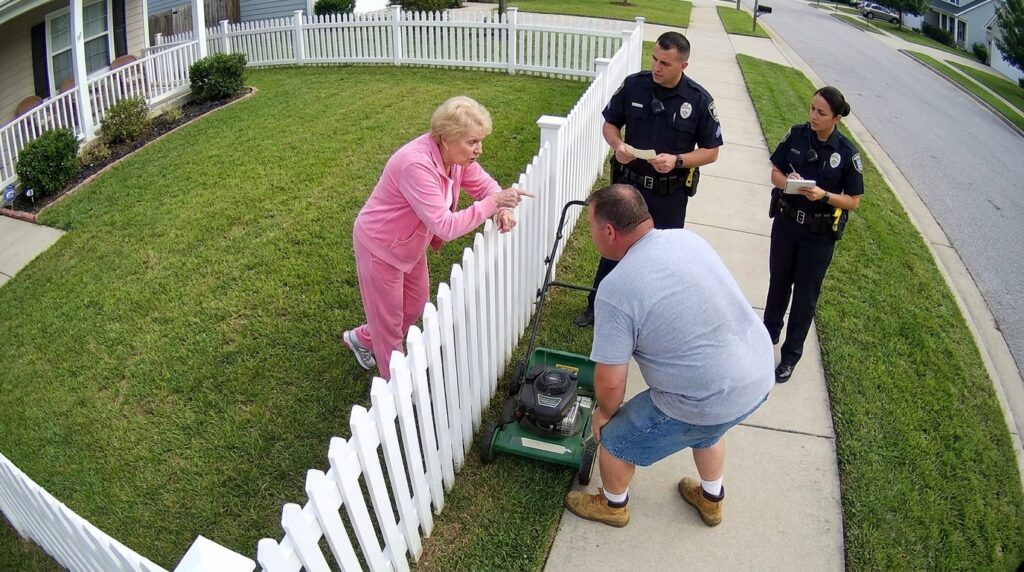
CHAPTER 4: THE MEASURED BOUNDARY
The heat didn’t dissipate; it seemed to collect in the four-inch gap between the bottom rail of the picket fence and the hard-packed gravel of the shoulder. David didn’t shift his weight from the mower grips, but his right hand dropped away from the rubber sleeve, his fingers catching on the metal corner of his work folder. The plastic skin of the binder was slick with sweat and ground-in lawn dust, smelling of stale diesel and ancient leather.
“Davis,” Miller called out again, his eyes remaining fixed on the line of undisturbed dandelions. “What’s the ledger showing for the frontage on four-fourteen?”
Officer Davis didn’t look up immediately from the blue terminal screen. Her thumb hit a plastic key with a dry, rhythmic click that echoed against the white pine pickets of Evelyn’s fence. “Ledger shows a modification entry from June of ninety-eight, Miller. There’s a three-foot right-of-way easement from the center crown of Elm Lane for municipal utilities and drainage maintenance. It overrides the original deed description.”
Evelyn’s frame went perfectly rigid inside the bright pink tracksuit. The synthetic fabric didn’t rustle this time; it stayed taut over her shoulders as she leaned further across the pointed wooden pickets, her hand tightening around the flaking coil of the gate’s tension spring until a small line of red iron rust smeared into her skin. “That entry was for the culvert expansion, Officer. It didn’t authorize commercial machinery to tear up the sod. My husband paid the county assessment fee to clear that title back before the turn of the century.”
“The assessment paid for the concrete curb-cut, ma’am, not the dirt,” David said. His voice was low, flat, matching the steady, indifferent rhythm of his boots against the parched grass. He pulled the layout folder from his pocket, the gray carbon paper crinkling between his calloused fingers. He didn’t offer it to Evelyn; he held it out horizontally toward Miller’s clipboard. “This is the ninety-eight plot index from the county recorder’s office. Look at the western anchor. The Vance property line doesn’t terminate at the grass edge. It stops four inches inside the fence frame.”
Miller took the sheet, his heavy thumb leaving a gray smudge across the edge of the photocopied layout. He squinted against the glare of the noon sun, his boots shifting slightly until his heel hit a small, iron surveyor’s tack buried under three seasons of rotting leaf mold at the base of the corner post. The metal tack was pitted, dark with corrosion, its square head stamped with the county’s identification mark.
Evelyn looked down at the paper in Miller’s hand, her large, dark sunglasses slipping another notch down her nose. Her mouth worked silently for a second, her chin twitching as she glanced across the lane at number 417. The man in the grease-stained undershirt had stepped off his porch now, his work boots clearing the gravel of his own driveway as he moved closer to the road to hear the exchange.
“That paper is twenty-eight years old,” Evelyn said, her voice thinning into a sharp, whistling register that cut through the low rumble of the distant cement truck. “It’s a draft. It doesn’t have the final seal from the district engineer.”
“It’s got the digital locator stamp from the county surveyor, Mrs. Vance,” Davis said, her voice flat and professional as she stepped closer to the gatepost. She adjusted her grip on her carbon-fiber clipboard, the heavy zinc clip rattling once against the edge of her notepad. “And according to the terminal’s tax map, the easement isn’t just for drainage. The county has an active infrastructure hold on this entire three-foot strip. The push mower isn’t the problem here.”
David watched Miller’s face. The deputy wasn’t looking at the dandelions anymore; he was looking at the actual posts of the white picket fence, tracing the way the weathered pine frames bowed outward toward the concrete curb by an extra two inches near the water meter box. The structural reality of the block was shifting under their feet, the clean geometry of Evelyn’s private sanctuary dissolving into a mess of public utility codes and old county giveaways.
“Hold on,” Miller muttered, his fingers tracing the edge of the surveyor’s tack at his boot heel. He didn’t look at Evelyn; he looked at David’s stained gray shirt, his eyes narrowing as he calculated the physical space between the mower’s left tire and the wooden pickets. “If the ninety-eight map holds, this whole barrier isn’t just on the easement line. It’s sitting over the legal boundary by a solid four inches.”
David kept his jaw locked. He knew what was on page two of that folder—the part he hadn’t mentioned yet, the layer of municipal logic that his dad had warned him never to use unless the county was already on-site with a backhoe. He didn’t push the point. He let the silence settle back over the narrow strip of grass, the heat from his dead engine still rising in greasy waves against the white latex paint of the pickets.
Evelyn didn’t move, but her fingers slowly slipped off the rusted tension spring of the gate, leaving a dirty, dark orange outline on the bright pink cuff of her sleeve. Her eyes stayed locked on the photocopied map, her expression freezing as she realized the officers weren’t looking for tire tracks anymore—they were looking at her house.