
The Iron Root and the Cold Line of the Soil
CHAPTER 1: THE FIRST BONE OF THE OAK
The metal edge of the clip snapped down onto the loose pages with a sharp, dry crack that carried over the low rumble of the diesel exhaust.
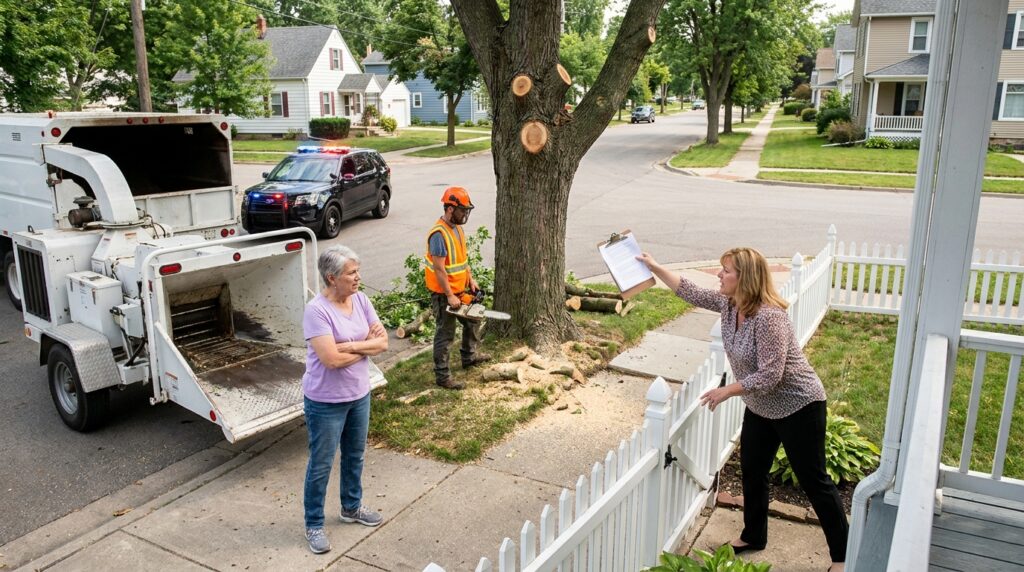
Eleanor didn’t flinch. She kept her work sneakers planted exactly three inches behind the concrete lip of the curb, where the asphalt was dark with the leak of hydraulic fluid from the tree truck. The scent of pine was too thick, heavy and wet with sap, rising from the small pile of branches already dropped into the gutter.
“Turn it off,” the voice came from behind the sunglasses. It was a flat, tight command, thin from years of shouting over lawnmowers but carrying the heavy weight of someone who spent her mornings measuring the height of her grass with a plastic ruler. “Turn the engine off right now. You’re violating the municipal easement.”
The contractor, a younger man whose orange hard hat was scuffed down to the gray fiberglass, held his chainsaw against his hip. The chain was still spinning slowly, a dull metallic hum against the louder vibration of the wood chipper’s feed chute. He looked between them, his eyes moving from the clipboard to Eleanor’s faded lavender shirt, looking for the person who signed his check.
Eleanor didn’t look at the paper. She looked at the neighbor’s shoes—black, flat-soled slip-ons that were already gathering the fine, yellow dust of fresh sawdust.
“The permit is green, Evelyn,” Eleanor said. Her voice had the gravelly dryness of sixty winters in the valley, unhurried, lacking the high pitch of panic. “The city arborist spent forty minutes out here on Tuesday. He marked the limb. The one hanging six feet over my driveway. The one dropping rot onto my roof.”
“The city arborist doesn’t have the 1994 plot amendment,” Evelyn replied, her arm tightening until the aluminum board caught the direct glare of the nine o’clock sun, throwing a hot, white reflection across Eleanor’s lined face. She took a half-step forward, her blouse rustling like dry corn husks. Her fingers, tipped with short, unpolished nails, pressed hard into the paper stack. “This street is common ground for four feet from the centerline of the ditch. You touch that wood, and I’m filing for structural endangerment before the noon whistle.”
The wood chipper gave a sudden, guttural burp as a small branch caught the teeth of the roller, chewing it down into a spray of pale chips that peppered the white picket fence behind them. The friction smelled of hot iron and dry earth.
Eleanor reached into her back pocket, her fingers brushing the stiff, cold plastic of the utility folder. She didn’t pull it out yet. In the dirt at the base of the oak, half-buried under thirty years of packed mulch and rotted leaves, the old zinc surveyor’s tag was turning gray-white with oxidation, its stamped numbers hidden from anyone who didn’t want to dig. She knew exactly where it was. She had found it with her bare fingers three nights ago while the cul-de-sac slept under the yellow streetlights.
“The crew stays,” Eleanor said softly. She didn’t raise her hands. She left them flat against her thighs, feeling the rough denim of her jeans. “Cut the low one first, son. The one with the split near the fork.”
The contractor didn’t move. He looked down at the paper forced into his line of sight, where a red ink stamp from a dead county office sat like an old scar.

CHAPTER 2: THE PAPER RAIN
“The split near the fork,” Eleanor repeated, her voice cutting beneath the low, wet rattle of the chipper’s diesel cylinders. She did not look at Evelyn. She kept her eyes fixed on the contractor’s thumb, which was hooked into his heavy leather tool belt just above a tarnished brass buckle. “He’s on my clock, Evelyn. Every five minutes he spends reading your recycling pile is twenty dollars out of my maintenance fund.”
The contractor, whose safety vest was greyed with fine layers of pulverized oak bark, shifted his weight from one thick sole to the other. His boots left deep, distinct prints in the damp sawdust that was beginning to carpet the curb line. He pulled the paper closer to his face, his eyes narrowing under the plastic brim of his hard hat. “Ma’am,” he began, his tone carrying the careful, flat neutrality of a tradesman caught between two property taxes, “this stamp here… it’s got the county clerk’s seal from ninety-four. Says ‘Right of Way Restriction—Section Four.'”
Evelyn thrust the aluminum clipboard an inch higher, the metal corner catching a stray beam of morning sun and throwing a sharp white point against Eleanor’s chin. “It’s not recycling, Eleanor. It’s a legal encumbrance. It runs with the land. Your arborist can stamp whatever green cardboard he wants, but he doesn’t have the authority to override a recorded civil covenant. You touch that timber, and you’re cutting into county-controlled infrastructure.”
Eleanor took a slow, deep breath, her nostrils filling with the bitter, iron smell of dry earth and the exhaust fumes settling in the humid cul-de-sac air. Her fingers remained flat against the denim of her thighs, but her mind was already calculating the distance. Three feet to her left, the zinc surveyor’s tag lay beneath the black loam, its cold metal edges completely invisible under the leaves she had deliberately left undisturbed. She knew the numbers stamped into that zinc—they didn’t match the numbers on Evelyn’s clipboard, but they didn’t match her own public deed either. There was a discrepancy in the original platting, an ancient error that had slept in the dark for three decades. If Evelyn kept digging into the archives, she wouldn’t just stop the tree-trimming; she would uncover the line that sat three feet deep inside her own flowerbeds.
“That stamp is from the old drainage district,” Eleanor said, keeping her voice even, letting the gravel in her throat steady the contractor’s hand. “The one dissolved when they put the concrete culverts in back in ninety-eight. Look at the lower margin, son. There’s no secondary validation.”
The contractor turned the paper sideways, his rough thumb tracking down the yellowed margin where the ink had faded to a dry, rusty brown. A faint line of sweat was beginning to trace through the dust on his neck. He looked at Evelyn’s sunglasses, then down at the white picket fence that ran parallel to the work lane. The fence was old, its pine slats showing the gray rot of forgotten winters, but it sat precisely where everyone believed the world ended and began.
“It doesn’t need secondary validation,” Evelyn snapped, her flats clicking against a stray piece of limestone as she crowded the curb. Her patterned blouse shook with every breath, the fabric dry and loud. “The easement remains active until a formal quiet title action is filed in the district court. I’ve already sent the digital filing to code enforcement. If that blade touches the bark before the investigator gets here, I’m personally holding your company liable for triple damages under the state timber-theft statute.”
The contractor’s finger twitched away from the chainsaw’s pull-cord. He looked up into the canopy of the oak, where a massive, split limb hung like a broken shoulder over Eleanor’s gravel driveway. The wood there was dark, weeping a thin, black sap that smelled of rot and old iron. It was dangerous; a forty-mile-an-hour gust from the north would drop five hundred pounds of dead weight directly onto Eleanor’s porch roof. But the legal threat was a different kind of rot—one that could eat a small business’s insurance policy before the weekend.
“We need to be sure,” the contractor muttered, his voice dropping into his chest as he took a step away from the trunk. He reached up, wiping his brow with the back of a canvas work glove that left a smudge of dark grease across his temple. “I can’t have my guys operating if there’s an active stop-work notice pending with the city. We’ll hold here until the clerk verifies the docket.”
“There is no notice,” Eleanor said, her voice dropping into a register that was almost cold. She stepped off the concrete, her sneakers sinking into the loose soil right where the oak roots rose like iron pipes through the grass. “Look at the ink, son. Look at the signature at the bottom of that restriction page. That’s not a city clerk. That’s a private title surveyor from the development company that went belly-up during the mortgage squeeze.”
The contractor paused, his eyes dropping back to the paper. Evelyn didn’t pull the clipboard back, but her arm went rigid, the tendons in her wrist tightening until the skin over her knuckles turned the color of dry bone.
A sharp, metallic chirp sounded from the end of the block—the distinctive, short tap of a municipal siren clearing an intersection. Eleanor didn’t turn her head, but she felt the small vibration through the soles of her shoes as a dark blue utility vehicle rounded the corner of the lane, its rooftop strobes throwing a rhythmic, silent red flash against the gray undersides of the neighborhood leaves.
CHAPTER 3: THE INK IN THE SILENT SOIL
The rhythmic, silent red flash of the utility vehicle’s strobes caught the edges of the lower oak limbs, turning the weeping black sap into a sequence of dark, viscous beads that looked like old iron rivets. Eleanor did not turn her head toward the sound of the tires grinding against the loose gravel at the edge of the cul-de-sac. She was looking at the bottom margin of Evelyn’s third page, where the fibers of the paper had split and frayed from being flattened inside a rusted metal strongbox.
“The name at the seal isn’t the county registrar,” Eleanor said, her voice dry, carrying the flat weight of an anchor dropping into soft silt. She pointed a short, thick finger toward a blurred line of purple typewriter ink. “It’s Vanguard Estates LLC. Registered in ninety-three, dissolved by court receiver in ninety-seven. They didn’t leave a quiet title behind, Evelyn. They left five hundred thousand dollars in unrecorded mechanics’ liens and a surveyor who lost his license for moving iron pins over by the county creek.”
Evelyn’s knuckles didn’t loosen their grip on the aluminum board, but her flat black shoes made a small, grinding noise against the pavement as she tried to shift her silhouette, blocking the glare of the approaching strobe lights. “The corporation is gone, but the filing was cross-indexed to the municipal water extension,” she said, her chest rising rapidly beneath the floral pattern of her blouse. “The easement doesn’t vanish just because the developer went under, Eleanor. It’s an active asset. If your contractor cuts through the root system, he’s altering a designated utility path that services three other houses on this run.”
The contractor had entirely let go of the pull-cord now. He took three paces back, his scuffed leather boots leaving pale, dual tracks through the sawdust until his shoulder brushed against the cold, metal frame of the idling white wood chipper. The machine gave a heavy, mechanical shudder, a raw puff of diesel smoke curling from the square mouth of the chute and settling across the white slats of the boundary fence.
“Look at the date stamp on the extension application,” Eleanor murmured, her eyes remaining fixed on the paper, ignoring the sudden metallic clink of a heavy vehicle door latching shut forty feet behind them. “It says October eleventh, nineteen ninety-four. The water main wasn’t even buried until November. Someone backdated that form by three weeks to pass an inspection before the winter freeze hit the inspectors’ office.”
The micro-discrepancy was a small thing—a smudge of dried ink over a standard municipal filing code—but to Eleanor, it was the first cracked bone of the entire block’s history. For ten years, she had kept her desk drawer filled with the faded yellow envelopes of anonymous complaints Evelyn had channeled through code enforcement. Every letter had been typed on the same old ribbon, demanding her lawn be edged, her gutters cleared, her trash bins dragged back within twenty-four hours of collection. Eleanor had filed them all chronologically, never replying, never shouting across the lawn. She had simply waited, knowing that people who spend their lives polishing the surface of a boundary line are almost always trying to hide the fact that the foundation beneath it is completely hollow.
“It’s an official record,” Evelyn insisted, though her shoulder-length blonde hair shook slightly as she checked the perimeter of the work zone over the rims of her oversized sunglasses. The white sheets of her document rustled against the aluminum clip like dead leaves in a dry wind. “The city doesn’t ignore thirty years of continuous civil usage because of an administrative error on a date line. This work zone is unsegregated. It’s a public hazard.”
The heavy heel of a service boot struck the gravel behind them, loud and singular. The sound carried the slow, unhurried cadence of institutional authority, the distinct clink of a leather utility belt and metal handcuffs shifting against a dark wool uniform.
Eleanor took her hand off her hip, her fingers sliding down the outer seam of her jeans until they touched the rough, square corner of the green municipal folder tucked into her pocket. The plastic sleeve was warm from her skin, sticky with the humidity of the mid-morning heat. She knew what the responding officer would see when he looked at her map—he would see a bright green city arborist’s seal, fresh and damp from Tuesday morning’s inspection. But she also knew what he wouldn’t see unless he knelt in the dirt with an iron spade and began clearing the packed mulch away from the base of the oak. He wouldn’t see the zinc surveyor’s tag, oxidized down to a dull, leaden gray, sitting precisely three feet north of where Evelyn’s white picket fence terminated in the grass.
“Is there a problem with the right-of-way here, ladies?” the officer asked. His voice was a flat, mid-valley drawl, completely empty of drama, accustomed to the low-stakes territorial warfare of suburban cul-de-sacs where neighbors used local ordinances to settle scores older than the asphalt they parked on.
Evelyn didn’t wait for Eleanor to turn. She stepped directly into the officer’s path, the clipboard raised like a small silver shield between her patterned blouse and the dark fabric of his uniform. “Officer, I called twenty minutes ago,” she said, her arm rigid. “This crew is executing an unauthorized modification of a protected boundary tree. They’re working without an verified city engineer present on the easement.”
The officer didn’t look at the paper she forced into his space. He looked at the contractor’s orange hard hat, then at the massive, split limb hanging over Eleanor’s driveway, its weeping gray bark throwing a deep, cool shadow across the front tire of the police SUV.
CHAPTER 4: THE ACCORDION LINE
“The problem isn’t the tree, Officer,” Eleanor said, before Evelyn’s arm could extend any further into the space between them. She reached into her back pocket, the stiff plastic edges of her green city sleeve clicking against a copper rivet on her jeans as she pulled it free. “The problem is the arithmetic.”
The officer took a slow step forward, his leather utility belt creaking under the weight of his sidearm and heavy flashlight. He didn’t take Evelyn’s clipboard. Instead, his eyes went to the ground, tracing the neat line of orange cones that separated the massive white wood chipper truck from the weathered pine slats of Evelyn’s fence. A fine layer of yellow pulp was still falling through the air, settling across the dark wool of his shoulders like pollen.
“She doesn’t have a valid work order,” Evelyn said, her voice rising an octave, sharpening against the mechanical thrum of the diesel engine. She tapped the aluminum frame of her board with a short, pale fingernail. “Look at the registration index. Vanguard Estates filed this right-of-way restriction thirty-two years ago. It’s a dedicated path for the municipal water extension. If those roots are severed, the structural integrity of the main line is compromised. The entire cul-de-sac loses pressure.”
The contractor shifted his weight against the fender of the truck, his canvas gloves tucked under his armpits. He looked at the officer with the exhausted, neutral tolerance of a working man who had spent his morning watching forty dollars an hour evaporate into a neighborhood dispute. “We checked the utility flags before we dug the truck tires in, Chief,” he muttered, pointing his chin toward three small, neon-pink plastic markers stuck in the turf near Eleanor’s mailbox. “Locates came back clear forty-eight hours ago. Nothing on this side of the ditch line but old gravel and oak roots.”
“The flags are based on the current public database, which hasn’t been corrected to reflect the ninety-four amendment,” Evelyn countered, her sunglasses sliding down the bridge of her nose as she leaned into the officer’s space. She thrust the white sheets toward his chest, the paper rustling like dry corn husks. “Look at the signature. That’s an official recorder’s mark.”
Eleanor watched the officer’s face as he finally reached out, taking the clipboard by its lower edge. His thumb, thick and calloused from years on the county beat, pressed against the frayed margin of the paper. He didn’t look at the text; he looked at the purple ink of the stamp, his eyes narrowing slightly as he noticed the way the corporate logo of Vanguard Estates sat slightly askew over the county clerk’s circular seal.
“This looks like an old developer’s proposal,” the officer said, his drawl low and level. He turned the board over, checking the blank back of the sheet. “Evelyn, the city hasn’t used this filing prefix since the township consolidation back in ninety-eight. If this easement isn’t recorded on the current county GIS map, it doesn’t exist for a field unit.”
“It exists because the infrastructure is physically in the ground,” Evelyn snapped. Her blouse shook with a short, tight breath, the bright floral patterns blurring against the gray background of her house. “The water district took over the Vanguard assets after the liquidation. They didn’t re-file every individual easement because the physical presence of the main constitutes public notice under state law. You can’t just cut through thirty years of continuous utility usage because someone forgot to transfer a folder during a merger.”
Eleanor took two steps to her right, her worn sneakers sinking into the soft, sawdust-coated turf near the base of the tree. Her heel brushed against a thick, knotted root that grew out from the trunk like an iron pipe, disappearing straight beneath the bottom rail of Evelyn’s white picket fence. She could feel the subtle, deep vibration of the earth under her feet—not from the idling truck, but from the massive, hidden pressure of the water main that ran somewhere beneath the grass. Except it didn’t run down the center of the ditch line. She knew from the private surveyor she had paid five hundred dollars in cash to three months ago that the pipe had been laid four feet off-center to avoid a limestone ledge that the Vanguard crew couldn’t blast through without shattering the neighbor’s foundation.
“The Vanguard crew didn’t lay the pipe where the paper says it is, Evelyn,” Eleanor said quietly. She held out her own green plastic sleeve, the municipal arborist’s seal bright and clean under the high sun. “The city arborist brought the utility locator out on Tuesday afternoon because I asked him to run a deep acoustic scan. The water main isn’t under my oak. It’s three feet inside your garden bed, running directly under your prize hydrangeas.”
Evelyn froze, her hand dropping off the top edge of her clipboard. The sunglasses stayed low on her nose, her eyes wide and motionless behind the dark glass as she looked from Eleanor down to the base of the fence line where the fresh saw-cut limbs lay piled like old bones.
The contractor let out a short, dry whistle, his hand moving back to the pull-cord of the chainsaw. “Well, now,” he said, looking at the officer. “That changes the liability framework just a bit, doesn’t it?”
The officer didn’t answer. He held both documents now—Evelyn’s yellowed corporate filing and Eleanor’s crisp municipal arborist report—his eyes tracking the two separate sets of numbers that claimed ownership over the same six feet of suburban dirt.
CHAPTER 5: THE COLD ROT IN THE RUN
“The scan is over three days old, Officer,” Evelyn said, her voice dropping into a hard, desperate register that scraped against the idling rattle of the diesel truck. She didn’t take off her sunglasses, but her fingers clawed into the edge of the aluminum board until the metal bowed slightly. “A deep acoustic read doesn’t override an index deed. If Eleanor has a private map showing a pipe deviation, it means she’s been holding onto unverified county data to bypass her liability for this oak.”
The officer turned Eleanor’s digital printout sheet over, his thumb dragging across the gloss finish of the paper where the municipal arborist’s layout was cross-referenced with the county coordinates. The red lightbar from his cruiser continued its slow, heavy sweep across the white slats of the boundary fence, painting every rotting pine knot in a momentary stain of dark rust. “The arborist’s report doesn’t list a deviation code, Eleanor,” he muttered, his voice carrying the flat, pragmatic indifference of a county unit who had spent thirty years watching neighbors use civil maps like brickbats. “It just says ‘Clear for Maintenance under Section Twelve.’ If there’s a water main three feet off-center, it’s not noted on the current field voucher.”
Eleanor didn’t move her feet from the turf. She felt the heavy, rhythmic vibration of the wood chipper through the thick rubber of her sneakers, the coarse powder of fresh sawdust settling on her skin like fine sand. “The field voucher only covers the canopy, Officer,” she said. She didn’t pull her hands from her pockets. She kept her eyes fixed on the low rail of Evelyn’s fence, where the gray wood met the packed, damp black mulch of the garden bed. “Look at the corner index on page two. The arborist didn’t run the acoustic line from the street center. He ran it from the old zinc tag behind my mailbox. The one Vanguard put down before they backdated the easement.”
The contractor let out a short, wet cough and stepped away from the white utility truck. He pulled a yellow-handled grease pencil from behind his ear and pointed it at the base of the tree trunk where the thickest root disappeared into the lawn. “Chief, if I run the blade through this lateral and the city main is actually sitting under the hydrangeas, the back-pressure is going to lift four hundred feet of asphalt before your dispatch can find the shut-off valve. I’m not dropping the saw into this ditch until someone from public works signs a hard indemnity waiver.”
“There is no waiver,” Evelyn snapped. She took two rapid steps forward, her flat black shoes sinking into the loose wood shavings until she was standing within three inches of the concrete curb. Her patterned blouse caught the direct heat of the high sun, the fabric smelling faintly of laundry starch and dry basement air. “The infrastructure is public property. If this contractor shuts down his equipment because of a hypothetical plumbing deviation, he’s in breach of his municipal clean-up mandate. I’ll have the district supervisor pull his commercial license before the office closes for lunch.”
The officer didn’t reply to Evelyn. He stepped past both women, his heavy boots crunching through the wood debris until he reached the edge of the fence line. He knelt down slowly, the leather of his utility belt popping as his weight shifted, his calloused fingers reaching down into the dark loam at the very base of the oak’s root flare. He cleared away a handful of rotted oak leaves and dry twigs, his knuckles brushing against a hard, flat piece of metal that sat wedged between two stones.
Eleanor watched his shoulder drop. She knew exactly what his hand was touching. It wasn’t the clean, round top of a standard city surveyor’s pin. It was a square, hand-stamped zinc plate, heavily pitted with three decades of ground oxidation and gray-white zinc crust. The stamped numbers were barely legible under the grease of the leaf mold, but the prefix didn’t match the city’s standard code. It was the old Vanguard identifier—the one used by a company that had changed its corporate name three times in eighteen months to hide an eight-inch main deviation that had been laid through private property without a legal title transfer.
“This pin isn’t in the GIS registry,” the officer said, his voice dropping into a lower, flatter tone as he stood back up, wiping his dirt-streaked palm against the side of his dark trousers. He looked at Evelyn, then back at Eleanor’s green plastic sleeve. “Evelyn, this tag says ‘V-Ninety-Three.’ That’s the old private platting code from the subdivision company. If the main was laid relative to this marker, then the utility run isn’t under the ditch at all. It’s sitting entirely inside your front yard.”
Evelyn’s chin twitched. She pulled her clipboard down against her chest, holding the loose sheets against her patterned blouse like an apron. “The fence has been in this exact position since ninety-six,” she said, her voice thinning until the text of her words lost their aggressive edge. “The property line is established by continuous adverse occupancy, Officer. Even if the original pipe was laid off-center, the boundary follows the wood slats. Eleanor can’t claim three feet of my lawn just because some developer used the wrong surveyor thirty years ago.”
“I don’t want your lawn, Evelyn,” Eleanor said quietly. She took her left hand out of her pocket and pointed down at the fresh saw-cut wood lying in the gutter. “I want the limb off my roof. But if we’re going by the ninety-four document you’ve got clamped to that aluminum, the city didn’t just take over the pipe. They took over the maintenance liability for every root that touches it. If that main cracks because of the oak, the county isn’t going to bill me for the repair. They’re going to look at the name on the original easement application.”
The contractor froze, his yellow grease pencil remaining suspended in the hot air between them. The officer turned the page of Eleanor’s report, his thumb stopping at an unshaded diagram at the very bottom of the municipal data run—a set of engineering coordinates that had been stamped with a red ‘HOLD’ notice from the water district clerk’s office three days prior.
CHAPTER 6: THE MEASURE OF THE GRIT
The red ‘HOLD’ notice on Eleanor’s digital report map caught the direct glare of the mid-morning sun, the ink appearing less like an administrative marker and more like a fresh, wet line of grease pencil drawn over old slate. The officer stayed on one knee for a long moment, his heavy uniform trousers soaking up the dampness of the mulch-covered earth, his thumb tracing the square edge of the oxidized zinc plate he had cleared at the base of the oak.
“This code,” the officer said, his voice level and flat as he looked up at Evelyn over his shoulder. His leather belt creaked with the movement, the heavy handcuffs jingling softly against his side. “It’s signed by a man named Arlan Vance. He was the field supervisor for Vanguard back in ninety-four. He’s the same surveyor who got pulled into the county registry hearing three years later for overlapping the ditch coordinates by thirty-six inches to clear the limestone shelf.”
Evelyn didn’t move her flats off the loose soil of the curb lane, but her hand dropped away from the upper margin of her clipboard. The white sheets of her printed bylaws rustled against her patterned blouse like dry husk leaves in an August wind. “Arlan Vance’s estate settled those boundary variances with the township before the corporate liquidation,” she said, though the speed of her words was slowing down, the rhythm breaking against the solid presence of the officer’s dirt-stained hands. “The water main was accepted by the district as an operational system, Officer. The physical line is what dictates the easement, not the old field logs.”
The contractor spat a dark stream of tobacco juice into the fresh pile of coarse sawdust near the wood chipper chute. He rubbed his palms together, the thick leather of his gloves making a rasping sound like a iron file on wood. “If Arlan Vance laid this main without a legal county variance, Chief, then that pipe isn’t a public utility run at all. It’s an unpermitted private encroachment on whatever land it’s sitting on. If my crew punctures that line, the city’s utility insurance won’t even answer the phone.”
Eleanor watched a single red strobe from the police SUV sweep across the weathered pine slats of Evelyn’s white fence. Every knot hole and split in the wood stood out under the light, silvered by decades of rain and sun, completely unaligned with the actual zinc coordinates sitting under the root flare. She didn’t feel the triumph she had expected when she spent those five hundred dollars on the private surveyor three months ago. She only felt the cold, hard weight of the labor—the forty years she had spent watching the soil move, watching the trees grow, knowing that the lines people draw on paper have very little to do with where the roots actually dig for water.
“Let me see that green folder, Eleanor,” the officer said, rising to his full height with a slow, deliberate grunt. He reached out his right hand, the skin grayed with the powder of oxidized zinc and dried leaf mold.
Eleanor pulled the plastic sleeve from her pocket and handed it over without speaking. Her fingers were steady, but the texture of the plastic felt uncomfortably smooth against her calloused skin, a clean piece of city documentation that was about to strip the last bit of certainty away from the cul-de-sac.
The officer laid Eleanor’s municipal arborist report flat against the hood of his cruiser, right where the paint was hot from the idling engine. He placed Evelyn’s aluminum clipboard directly beside it, his thick finger cross-referencing the ninety-four date stamp with the fresh engineering coordinates of the acoustic scan. He didn’t speak for two full minutes. The only noise on the street was the heavy, rhythmic vibration of the white wood chipper truck and the distant bark of a dog two blocks over.
“Evelyn,” the officer said finally, his voice dropping into that quiet, mid-valley drawl that meant a decision had already been indexed by the precinct clerk. “The city arborist didn’t just check the limbs. He checked the original plat map from before Vanguard ever dropped their first bucket into the dirt. This green sheet has a municipal correction attached to it. The city water department officially abandoned the Vanguard easement on this specific lot back in two thousand four when they ran the bypass down the main road.”
Evelyn took a half-step backward, her black shoes sliding off the concrete lip of the curb and onto the grass of her own lawn. The aluminum board tipped down until it was resting against her thigh, the loose pages fluttering as if they wanted to pull free from the clip. “They couldn’t abandon it,” she whispered, her sunglasses slipping down to the middle of her nose, revealing her eyes—pale, squinted, and entirely stripped of the authority she had carried off her porch ten minutes ago. “The pressure runs through this line. It services my house.”
“It services your house through a three-inch lateral that connects to the main road, not this main,” the officer replied, his eyes remaining fixed on the documents. He tapped the red ‘HOLD’ notice on Eleanor’s printout. “This old eight-inch line under the oak… it’s been dry since the county water project was completed twelve years ago. It’s not an active main, Evelyn. It’s an abandoned iron conduit that Vanguard left in the ground because it was cheaper than digging it out of the limestone.”
The contractor looked down at the chainsaw at his hip, a slow, greasy grin spreading across his weathered face. He looked at Eleanor, then at the massive, split limb that hung like a broken arm over the gravel driveway. “So,” he said, his thumb flicking the ignition switch back to the ‘RUN’ position. “There’s no utility run to compromise. There’s just six hundred pounds of rotten oak that needs to come down before it takes out a porch.”
Eleanor didn’t smile. She looked past the officer’s shoulder toward the white picket fence. Three feet behind those rotting pine slats, hidden under the green leaves of Evelyn’s manicured garden beds, the actual water pipe sat in the dark soil, still carrying the live pressure for the rest of the block—and it was sitting on land that Eleanor’s deed had claimed since nineteen eighty-six. The decoy secret of the abandoned Vanguard line had satisfied the officer and the crew, but the deep, absolute truth of the boundary layout remained locked in the dirt, a live wire that neither woman could touch without bringing the entire neighborhood down around them.
“Cut the split one first,” Eleanor told the contractor, her voice flat, matching the gray iron of the surveyor’s tag beneath her heel. “And keep the sawdust off her side of the fence.”
CHAPTER 7: THE RECKONING OF THE GRAIN
The aluminum lip of the clipboard did not strike the fence rail. It simply slid down against the faded blue denim of Evelyn’s slacks, the loose white sheets of thirty-year-old bylaws trembling once before flattening into a dead weight against her leg. The sun had climbed high enough now to erase the long shadows of the oak limbs, casting a white, merciless glare over the entire cul-de-sac that made the red strobes of the cruiser look pale and spent.
“The line is dead, Evelyn,” Eleanor said. She did not say it with the sharp edge of a woman who had won a civil war; her voice was just the low, gravelly rasp of an old tool that had spent too many decades clearing ditches. “It’s been cold iron since before you put the new shingles on your porch. There’s nothing running through it but old river sediment and air.”
Evelyn didn’t take off her sunglasses. If she did, she would have to look directly at the patch of cleared turf where the officer’s boots had tracked dark loam over her manicured clover. Her jaw remained fixed, a thin white line showing at the corner of her mouth where the skin had dried out from the heat radiating off the police cruiser’s hood. “The district records were never corrected,” she whispered, her words barely carrying over the sudden, high-pitched scream of the contractor’s saw as the steel teeth bit into the heart of the split limb. “They left the entry on the ledger. It was signed by the registrar. It had the seal.”
“A seal doesn’t keep the water moving,” the officer said, his voice level as he lifted Eleanor’s green folder from the hot metal of his vehicle and closed it with a soft, plastic snap. He didn’t look at Evelyn as he reached down to adjust the heavy leather strap of his holster, his utility belt giving off one final, stiff creak. “Ma’am, the city has this area marked as a completed municipal easement vacation. The current plat map is the only one my unit can enforce out here. If you’re going to block this work crew, you’re going to need a current civil injunction from a district judge, not a corporate receipt from ninety-four.”
The contractor didn’t look up as the first six-foot segment of the rotten oak branch dropped into the gutter. The impact was heavy and dead, a solid thud that sent a small shockwave through the concrete curb and into the soles of Eleanor’s sneakers. A dense spray of yellow sawdust exploded from the cut, filling the narrow space between the houses with a fine, aromatic mist of pulverized timber and sweet sap. The ground crew moved in immediately with their iron hooks, lifting the timber with practiced, rhythmic swings and sliding the raw wood into the open feed chute of the white chipper truck.
The engine gave a deep, guttural growl as the internal rollers caught the bark, chewing the massive branch into a millions of pale flakes that poured from the top chute, raining down onto the floor of Eleanor’s driveway like dry winter wheat. The noise was absolute—a mechanical roar that swallowed the distant barking dogs, the sound of passing traffic on the main road, and the tiny, frantic rustle of Evelyn’s loose papers.
Eleanor stood her ground by the curb, her arms remaining loose at her sides. She watched the sawdust settle over the white picket fence, every gray, rotting slat receiving its layer of golden powder. Through the haze of the pulp, she could see the precise alignment of the old zinc surveyor’s tag under her heel. The officer had verified the abandoned Vanguard line, and the crew was clearing the hazard from her roof, but her eyes traced the true line—the one that extended three feet deeper, directly under Evelyn’s prized hydrangeas where the live eight-inch main actually slept in the limestone.
If she spoke that truth out loud, the city would have to return with their heavy yellow excavators. They would tear through the manicured lawns, rip up the white fences, and open a thirty-year-old corporate litigation that would bleed both properties dry before the first pipe could be legally re-mapped. Evelyn didn’t know how close she had come to shattering her own world with that aluminum clipboard. She thought she was defending a boundary, completely blind to the fact that the line she was fighting for was the only thing keeping her foundation from falling into a trench.
“We’re done here, ladies,” the officer said, pulling his aviator glasses down over his eyes as he stepped back toward the blue utility vehicle. He didn’t issue a citation; he didn’t hand back the old yellowed sheets. He simply left the two women standing at the curb line while the red strobes on his roof gave one final, slow flash and died.
Evelyn turned without speaking. Her flat black shoes didn’t click against the stone this time; they dragged softly through the loose sawdust as she walked back up her concrete path, her shoulders narrow and rigid under the floral pattern of her blouse. She didn’t look back when she reached her screen door. The wood frame slammed shut with a dull, hollow thud that was instantly lost beneath the roar of the wood chipper.
Eleanor took a deep breath, her lungs filling with the hot, iron-tainted air and the bitter scent of fresh sap. She looked up at the oak canopy, where the high sky was now wide and clear above her house, the gray rot gone, leaving only the ancient, hard-grained wood of the trunk standing firm against the valley line. She reached down, her calloused fingers brushing the rough green plastic of the city folder in her pocket, then turned her back on the fence, walking back toward her own porch through the golden rain of the sawdust.







