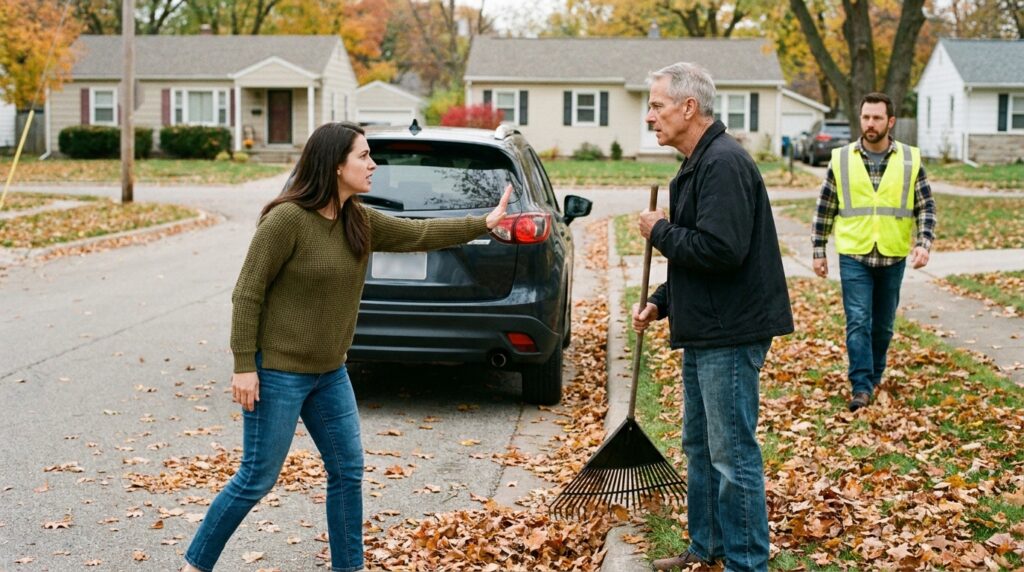
CHAPTER 4: THE ARRIVAL OF THE HIGHVIS VEST
The steel tires of a triple-axle commercial flatbed ground a deep, black trench through the roadside turf, spitting wet clay against the silver quarter-panels of Arthur’s parked SUV. A sharp, metallic ping echoed off the chassis as the driver threw the rig into reverse, the air brakes releasing with a high-volume hiss that smelled of hot oil and scorched lining.
Arthur slammed his truck door shut before the engine had fully died, his work boots sinking four inches into the churned mud of his own front yard. Rain was falling now—not a clean pour, but a cold, heavy drizzle that clung like grease to the stiff canvas of his utility jacket.
“Unhook the chains,” a man shouted from the back of the flatbed. He wasn’t a city worker. He wore the black-and-gold jacket of a private security fence contractor, his high-visibility vest pulled taut over a thick, insulated canvas coat. He was already unbolting the binders on a stack of ten-foot steel privacy barriers. “We got forty rods of perimeter layout to drop before the ground goes entirely soft. Get the anchor posts into the drainage line first.”
“Get that rig off my grass,” Arthur said. He didn’t raise his voice to a scream, but his tone had the iron weight of an ancient joist settling into place. He walked directly toward the rear of the trailer, his old ash-handled leaf rake gripped low in his right hand like an extended measuring rod. He planted the orange plastic tines exactly where the grass ended and the asphalt began. “You’re three feet over the original county pin.”
The contractor didn’t check his stride. He dragged a heavy, zinc-plated steel post across the diamond-plate deck, the metal shrieking until it hit the mud with a hollow, concussive thud. “I got a signed easement enforcement order from the home association board and a civil flow-line map stamped three months ago by the municipal clerk. We’re fencing the designated runoff zone. Step back from the rig, mister.”
Across the property line, the front door of the modern house swung wide. Chloe didn’t hurry down the steps, but she had her digital folder held high against her chest like an armor plate. She wore a heavy Gore-Tex shell over her olive sweater now, the hood pulled low over her dark, unmoving eyes. Two other neighbors—the younger couple from lot fourteen—had walked down to their driveway edge, their phones already up, their screens glowing white through the gray October mist.
“It’s a civil boundary order, Arthur,” Chloe called out, her voice clear and level over the rhythmic thrum of the flatbed’s diesel engine. “The contractor has the updated GIS registry sheets. The fence lines follow the active municipal drainage vector AM-84-X. You’re obstructing a certified water management corridor.”
Arthur didn’t look at her folder. He looked at the contractor who was lifting a heavy, gas-powered post-driver off the trailer bed. The machine’s small two-stroke engine started with a high, buzzing whine that tore the quiet of the street into shreds. If that steel post went through the turf right here, it wouldn’t just block his lawn; it would pierce the old concrete casing of the primary culvert line he had spent forty years maintaining with his own hands.
“Stop the engine,” a new voice commanded from the road lane.
The sound was quiet, but it had the flat, dry authority of an official seal.
A white city sedan had pulled up behind the flatbed, its roof-mounted amber strobe light spinning silently through the mist. Mark, the vest-wearing city code enforcement inspector, stepped out of the driver’s seat. He didn’t carry a shovel or a rod. He held a long, cylindrical aluminum blueprint tube under his left arm and a ruggedized digital tablet in his right hand. His orange safety vest was clean, the silver retroreflective bands gleaming with municipal authority against the mud-splattered landscape.
The fence contractor hesitated, his thumb lingering on the throttle of the post-driver, the engine idling down to a low, metallic chatter. “We’re working a private board order, inspector. Enforcing the updated runoff easement.”
Mark walked down the center of the asphalt, his eyes never leaving the tire tracks in the grass. He stopped exactly between Arthur and the flatbed, his boots planted on the cold concrete of the curb. He didn’t look at Chloe’s digital folder, and he didn’t look at Arthur’s leaf rake. He unlatched the cap of the aluminum tube with a sharp, plastic pop.
“I don’t care about your board order,” Mark said, his voice level and entirely empty of emotion. He pulled out a large, heavy sheet of waterproof Mylar—a master county survey map dated September 14, 1984, bearing the deep, pressed indentation of the original state surveyor’s seal. He unrolled it across the wet hood of Arthur’s SUV, weighting the corners down with a heavy iron hitch pin. “And I don’t care about code AM-84-X. That was a developer’s construction amendment, not a legal property conveyance. It was never ratified by the county commissioners.”
Chloe took two sharp steps forward, her boot heels crunching into the soft sod at her lawn’s edge. Her face didn’t break, but the skin around her eyes went tight as wire. “The digital portal accepted the updated vector filing three months ago. The drainage liability sits on lot eleven.”
Mark didn’t look up from the Mylar map. He drew a long, heavy steel tape measure from his belt, the metal ribbon extending with a loud, rhythmic clack-clack-clack. “The digital portal accepts whatever data a title company uploads until an inspector comes out with the chain. Arthur, give me a hand with the zero-anchor.”
Arthur dropped his rake onto the grass. He stepped forward, his cold fingers gripping the rusted metal loop at the end of the steel tape, pinning it exactly against the center of the chipped orange paint on the buried iron pin by the curb.
Mark walked twenty feet back toward Chloe’s foundation, the steel tape singing as it pulled taut against the damp earth. As the numbers on the tape clicked past thirty feet, the metal line didn’t settle on the grass. It cut straight through the center of Chloe’s gravel landscape bed, passing four inches inside the lower wooden timber of her retaining wall.
The inspector stopped. He looked at his tablet, then at the Mylar map, then down at the ground beneath his boots. The mud there wasn’t just wet; it was vibrating. A tiny, steady stream of gray, silty water was bubbling up from a small fissure right beneath the foundation block of Chloe’s porch—not runoff from Arthur’s roof, but a deep, pressurized leak from a main line that wasn’t even marked on the neighborhood plat.
Mark’s face changed then. The dry, bureaucratic indifference vanished, replaced by the cold stillness of an engineer looking at a failing bridge. He looked up at Chloe, then down at the bubbling gray silt.
“This isn’t an easement dispute,” Mark said softly, his voice barely rising over the low rattle of the fence contractor’s truck. He reached down and stuck a single yellow utility flag directly into the gray mud. “The main storm culvert isn’t shifted onto Arthur’s lot. It’s sitting directly under your living room, Chloe. And it’s been collapsing for five years.”