
CHAPTER 2: THE SURVEILLANCE FROM THE GLASS
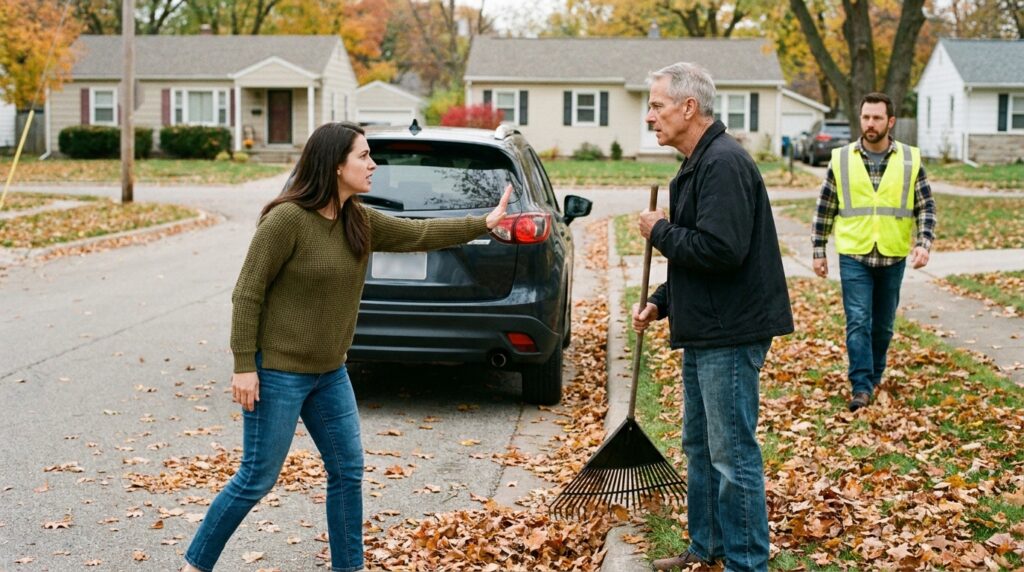
The heavy orange strobe of the city utility truck cut through the low-hanging mist, painting the wet flank of Arthur’s SUV in rhythmic, greasy flashes. The diesel engine idled with a wet, gravelly rattle that shook the dead oak leaves still clinging to the curb. Chloe didn’t drop her hand immediately; her fingers remained stiffly upright for three more beats, a frozen monument to her own claimed perimeter, before she slowly let her arm fall against the dark fabric of her jeans. Her eyes didn’t leave Arthur’s face, but her chin tilted toward the arriving yellow cab of the municipal truck.
Arthur didn’t give her the satisfaction of a retreat. He lifted the ash handle of the rake just enough to clear the heavy mulch, his boots grinding into the soft, unpaved easement strip that separated his gravel driveway from her sod line. The iron pin beneath the leaves stayed buried, but his heel remained two inches to the left of it—his side of the ledger.
“We’ll talk,” Chloe said, her voice dropping below the rattle of the diesel cylinders, losing none of its sharp, clinical edge. “But we’ll do it with the county logs open. You’ve been encroaching on the eastern drainage vector for seven seasons, Arthur. The water doesn’t lie.”
She turned on the heel of her leather boot, the movement clean and practiced, and walked toward her front porch without looking back. Her silhouette passed through the beam of her own garage floodlight, casting a long, blocky shadow that stretched across the asphalt like a black finger pointing straight at Arthur’s foundation.
Arthur watched her go, his jaw set until the bone ached. He didn’t answer. He turned his back to her house and looked at the utility truck. The driver’s side door creaked open with the scream of ungreased hinges, and a pair of heavy, mud-caked work boots hit the pavement with a flat thud. It wasn’t the inspector yet. It was a younger man in a faded neon vest, carrying a bundle of slender fiberglass rods tipped with bright pink plastic flags.
The worker didn’t look at Arthur. He walked with the heavy, indifferent stride of a man paid by the hour, stopping at the edge of the ditch where Chloe’s property met the public right-of-way. With a rhythmic, metallic thunk, he began driving the fiberglass rods into the damp earth, spacing them exactly four feet apart, directly inside the swale Arthur had spent twenty years clearing of silt and branches.
“Who ordered the markers?” Arthur asked, his voice flat against the roar of the idling engine.
The worker didn’t look up from his bundle. “Work order came down from county civil engineering this morning. Dispute resolution and flow-line assessment. Just setting the sight lines for the surveyor.”
Arthur stepped closer, the wooden handle of his rake cold against his palm. He looked at the pink flags. They weren’t aligned with the rusted iron pin buried by the curb; they were biased three feet onto his turf, cutting a straight, jagged line through his established perennial bed. The plastic flags fluttered in the cold wind, screaming high-visibility pink against the muted grays and browns of the suburban rot.
“That line’s wrong,” Arthur said. “The original plat pins are down by the concrete. I drove them with the county surveyor back in eighty-four.”
The worker stopped, one rod held mid-air. He looked at Arthur then, his eyes small and bloodshot under the brim of a grease-stained cap. He didn’t look angry; he looked tired. “I don’t map ’em, mister. I just stick ’em where the tablet tells me. If you got a problem with the alignment, you take it up with the clerk at the municipal records office. Box forty-two. They updated the vector maps three months ago.”
The man turned back to his labor, driving the final flag into the mud with a hard, crunching blow from his heel. He climbed back into the yellow cab, slammed the door, and the truck groaned as it pulled away, leaving a blue cloud of exhaust that smelled of unburnt fuel and old oil hanging over the wet grass.
Arthur stood alone in the darkening lane. The street had gone completely silent again, but the silence was heavy now, full of hidden weight. He looked up at Chloe’s house. The windows were dark, but behind the double-paned glass of her second-story sunroom, a tiny, blue-white light pulsed twice. It was the digital eye of her data terminal, sync-linking her external camera footage with the city’s online reporting portal. She wasn’t just watching him through the glass; she was building a digital fence, line by line, filing data points like bricks to wall him out of his own front yard.
He walked back to his porch, his boots heavy with the grey clay of the easement. He didn’t put the rake away in the shed. He stood it up against the peeling white pillar of his porch, the orange tines resting against the old wood like a warning flag.
Inside his kitchen, the air was cold and smelled of old coffee. He didn’t turn on the overhead light. He moved through the shadows to the front window, pulling back the faded lace curtain just enough to see across the driveway.
In the dim light of the streetlamp, something caught his eye—a strange, unnatural glint down in the drainage ditch, exactly halfway between the new pink flags and his foundation. It wasn’t a leaf, and it wasn’t water. It was a long, thin strip of silver metal, half-buried in the mud, reflecting the pale light of the moon like a silver wire drawn tight across the earth. Someone had been digging in his ditch while he was inside, and they hadn’t used a shovel. They had used a core-drill.








