
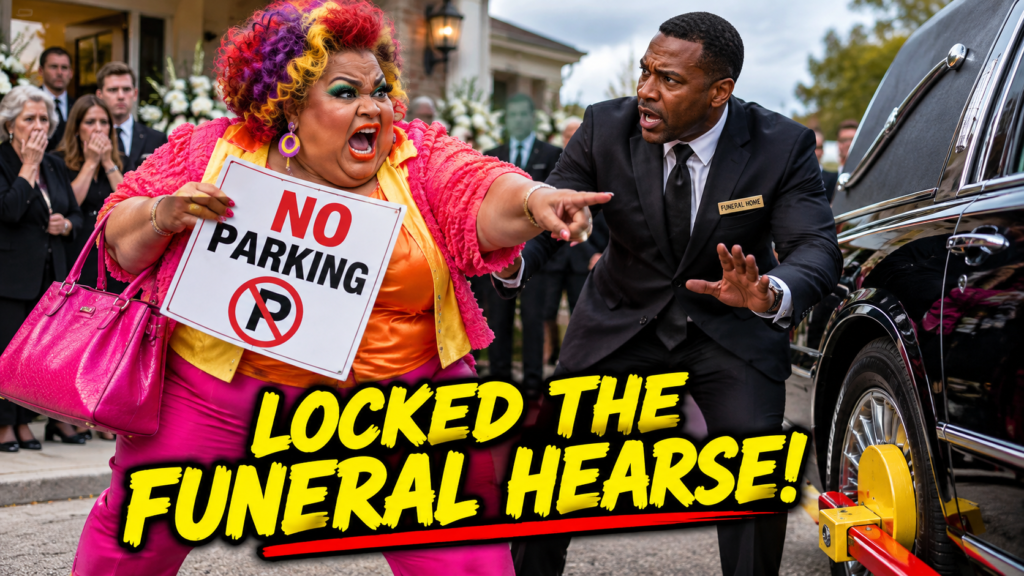
Chapter 6: A Different Way to Be Heard
Two weeks later, the funeral home held a neighborhood meeting about parking and access.
The manager had invited nearby residents, property representatives, and several local business owners.
Karen came too.
She sat near the back.
There were no bright signs.
No wheel lock.
No phone held up like a courtroom exhibit.
The manager presented the actual parking plan.
During funerals, the loading area would remain reserved. Visitor parking would be marked more clearly. Temporary signs would be placed before large services. Residents with concerns could contact the property office rather than confronting vehicles themselves.
Karen listened.
Then she raised her hand.
“I made the situation worse,” she said.
The room became quiet.
She did not describe herself as a hero.
She did not claim everyone else had been wrong.
She explained that she had seen a sign, assumed what it meant, and decided she had the right to enforce her interpretation.
“I was certain I was protecting the neighborhood,” she said. “But I never stopped to ask who was actually responsible for the property.”
The manager nodded.
That was enough.
After the meeting, Karen stayed behind.
She noticed the widow from the funeral standing near the entrance with her daughter.
Karen hesitated before approaching.
“I owe you an apology,” she said.
The widow looked at her.
Karen continued.
“I made a difficult day harder.”
The widow did not respond immediately.
Then she nodded.
“Thank you for saying that.”
It was not dramatic.
There was no applause.
No one declared Karen forgiven.
But something had changed.
Karen had finally confronted the difference between having a concern and having authority.
The next morning, the funeral home replaced the confusing temporary notices with larger, clearer signs.
The property office added a phone number for residents to report parking problems.
And Karen kept one thing from that morning.
She did not throw away the homemade sign.
She folded it carefully and placed it in a drawer.
Not as a symbol of victory.
As a reminder of what happened when she confused being certain with being right.
Months later, when a new neighbor complained about funeral traffic, Karen heard herself say something very different from what she once would have said.
“Let’s find out who actually handles it.”
The neighbor looked surprised.
Karen smiled.
“I learned that part the hard way.”
The funeral home driveway remained a place for grieving families, service vehicles, and quiet departures.
The rules were clearer.
The boundaries were clearer.
And Karen finally understood something that her homemade sign never could have taught her:
A community does not become orderly because the loudest person creates the most rules.
It becomes orderly when people know which rules are real, who has the authority to enforce them, and when to step aside for the people who simply need a peaceful place to say goodbye.








