
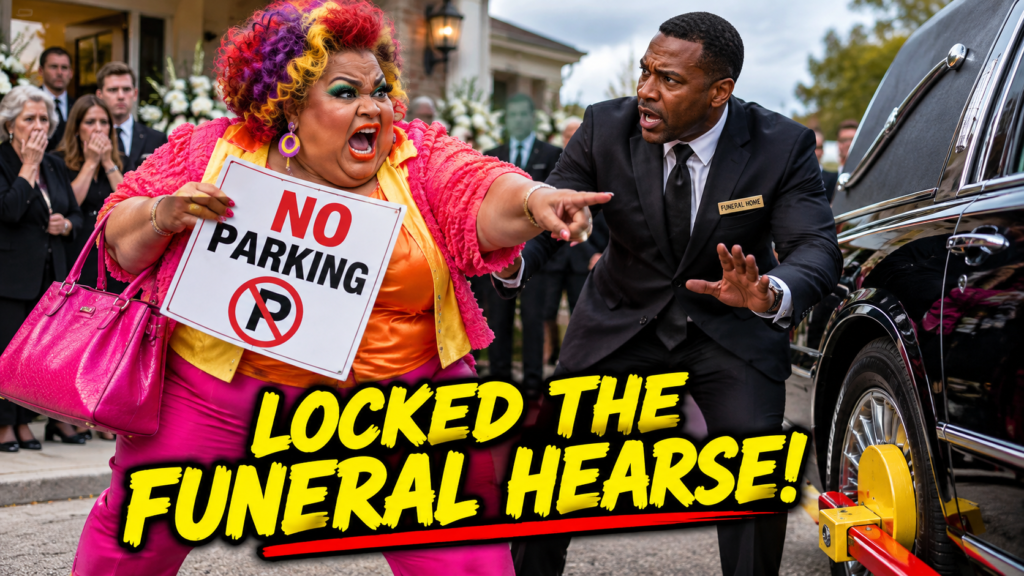
Chapter 3: The Photograph That Changed the Argument
A property supervisor arrived carrying a folder and a calm expression.
Karen immediately approached him.
“Finally. Someone responsible.”
The supervisor looked at the hearse first.
Then he looked at the lock.
Then at Karen’s sign.
He did not touch anything.
“Did you place this lock on the vehicle?”
“Yes.”
“Did anyone from the funeral home authorize you to do that?”
“No, because I don’t need permission to enforce a parking rule.”
The supervisor paused.
“Who issued the rule?”
Karen held up the sign.
“I did.”
The supervisor glanced at the manager.
The manager said nothing.
Karen’s confidence returned.
“There. That’s exactly what I’ve been saying.”
The supervisor opened his folder.
Inside was a property diagram showing the driveway and designated service area. He compared it with the scene outside.
“This section is reserved for funeral operations during services,” he said.
Karen shook her head.
“That doesn’t give them the right to ignore parking restrictions.”
“No one is ignoring a parking restriction.”
“They parked here.”
“Yes. Because this is the designated area for the hearse.”
Karen’s jaw tightened.
She pointed at the homemade sign.
“Then why does this say no parking?”
“Because you printed it.”
The answer was so simple that several mourners looked away to hide their reactions.
Karen’s face reddened.
The supervisor continued.
“And you placed it over the existing notice.”
That detail mattered.
The manager stepped closer to the curb.
The temporary official sign had been partially covered by Karen’s homemade sheet. She had not merely misunderstood the area. She had positioned her own notice in a way that made the legitimate instructions harder to see.
Karen’s phone was still recording.
“You’re twisting this,” she said.
“No,” the supervisor replied. “We’re documenting it.”
He photographed the signs from several angles.
Karen stopped smiling.
“What are you doing?”
“Creating a record of what happened.”
She stepped between him and the hearse.
“You’re making this bigger than it needs to be.”
The supervisor looked at the mourners.
“It became bigger when a funeral vehicle was locked during a service.”
That was the first moment Karen had no immediate answer.
The widow’s daughter finally spoke to her mother instead of Karen.
“Mom, let’s go inside.”
They turned away.
Karen watched them.
The consequence was no longer theoretical. People who had come to say goodbye were now being forced to navigate a confrontation they had never asked for.
The supervisor held out his hand.
“Give me the key to the lock.”
Karen’s expression changed.
“No.”
The supervisor lowered his hand.
“All right.”
His tone remained calm.
But the balance of the confrontation had shifted.
Karen still had the lock.
What she did not have anymore was control over what the lock meant.








