Chapter 9: What a Home Is Worth
One year after the confrontation, Evelyn Parker stood in her kitchen preparing Sunday dinner.
The windows were open.
A warm breeze carried the smell of freshly cut grass through the house.
Her grandchildren were playing in the backyard.
Laura was setting the table.
A roast chicken rested in the oven, and the familiar sound of family conversation filled the rooms.
Nothing about the afternoon seemed extraordinary.
That was what made it precious.
A year earlier, Evelyn had feared losing everything.
She had been living under the weight of threatening letters, unexplained fines, and the constant worry that her home was becoming too difficult to maintain.
She had begun to question whether she should sell.
Whether she was too old to stand up for herself.
Whether peace was worth surrendering the place where she had spent most of her adult life.
Now those doubts felt distant.
The house was safe.
The disputed fines were gone.
Her finances were manageable.
And the neighborhood had changed.
Evelyn still attended board meetings.
She had discovered that leadership was not about being the loudest person in the room.
Sometimes it meant asking a difficult question.
Sometimes it meant admitting that a rule was unfair.
Sometimes it meant listening to someone whose experience was different from your own.
She had also learned that kindness did not require surrender.
A person could be gentle and still insist on being treated fairly.
That lesson had changed her.
After dinner, Laura found her mother standing beside the living room mantel.
Evelyn was holding an old photograph.
It showed Thomas standing on the front lawn in 1992, smiling proudly beside a newly planted maple tree.
The tree was now taller than the house.
Laura stepped beside her.
“Thinking about Dad?”
Evelyn nodded.
“He would have loved what happened here.”
“The garden?”
“All of it.”
She looked toward the window.
“He always said a good neighborhood isn’t measured by how perfect the houses look. It’s measured by what people do when somebody needs help.”
Laura smiled.
“He was right.”
Evelyn returned the photograph to the mantel.
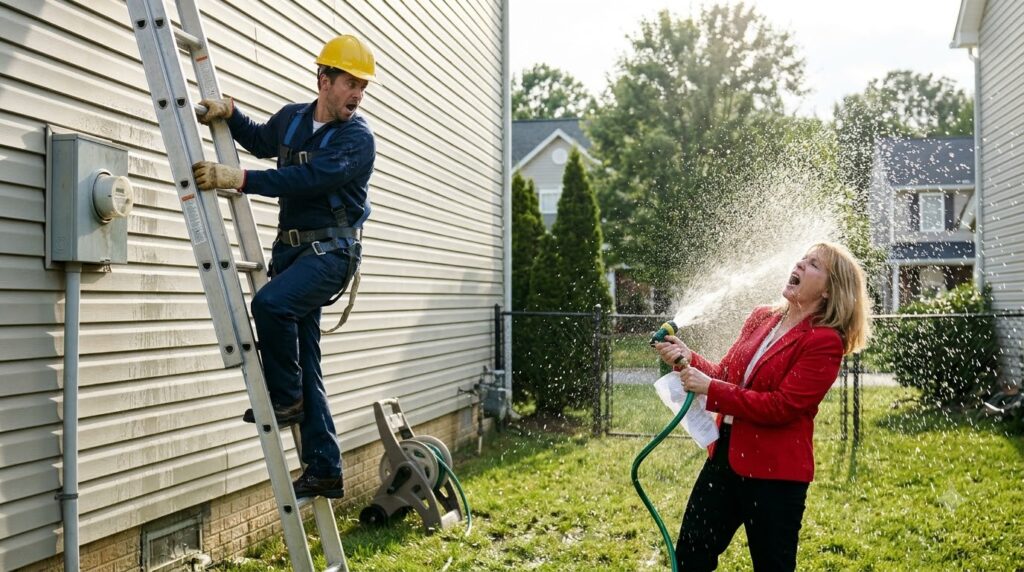
For a moment, she remembered the day Margaret had sprayed Daniel from the ladder.
The sound of rushing water.
The fear in his voice.
The sight of that ridiculous red blazer becoming soaked.
At the time, it had seemed like one more frightening confrontation in a long series of problems.
She could never have imagined that it would expose years of questionable practices and inspire so many neighbors to speak up.
But the real change had not come from Margaret’s humiliation.
It had come afterward.
From Ruth preserving the video.
From Frank keeping records.
From Daniel refusing to abandon a dangerous repair.
From Susan finding the courage to challenge a powerful board president.
From neighbors deciding that silence was no longer the easiest choice.
And from Evelyn herself, finally accepting that she deserved to feel safe in her own home.
That evening, after her family left, Evelyn walked onto the front porch.
The sun was setting behind the houses.
Across the street, Ruth waved from her garden.
A young couple pushed a stroller along the sidewalk.
Farther down the block, Harold Simmons sat beside his wife on their accessible front porch, enjoying the cool evening air.
Everything looked ordinary.
Yet Evelyn knew how much effort had gone into restoring that ordinary peace.
She sat in the rocking chair Thomas had built for her.
The wood creaked softly beneath her.
For years, she had thought of home as a place that needed to be protected from the world outside.
Now she understood something more.
A home was also protected by the people willing to stand beside you when someone tried to take away your dignity.
She looked toward the maple tree.
Its branches moved gently in the evening breeze.
Then she smiled.
Margaret Whitcomb had once stood in that very yard and declared that Willow Creek was her neighborhood.
She had believed authority meant controlling who could work, who could speak, and who deserved to stay.
But the neighborhood had never belonged to her.
It belonged to the families who lived there.
To the workers who kept their homes safe.
To the elderly residents who had spent decades building their lives.
To the children who would one day inherit the community.
And to every person who believed that rules should protect people rather than frighten them.
Evelyn watched the last sunlight disappear behind the rooftops.
Tomorrow, there would be ordinary problems.
A broken sprinkler.
A disagreement about parking.
Perhaps another debate over landscaping.
That was part of living among other people.
But those problems no longer frightened her.
Because Willow Creek had learned something important.
Respect cannot be demanded through fear. Authority does not excuse cruelty. And no title, no matter how impressive it sounds, gives anyone the right to treat another human being as though their safety and dignity do not matter.
Evelyn rose from her chair and went inside.
She turned on the porch light.
Then she closed the door of the home she had never stopped loving.
And for the first time in years, she did so without fear.