Chapter 8: The Neighborhood Belongs to Everyone
Evelyn Parker had never imagined herself serving on a homeowners association board.
At seventy-two, she preferred gardening, reading mysteries, and Sunday dinners with her family.
She did not enjoy confrontation.
She disliked public speaking.
And after everything that had happened, she wanted nothing more than a quiet life.
But when Ruth Collins asked her to consider running, Evelyn listened.
Ruth explained that the neighborhood needed people who understood what it meant to live under unfair rules.
Not people who wanted power.
People who understood responsibility.
Evelyn thought about Thomas.
He had always believed that communities were built through ordinary acts of decency.
Helping a neighbor carry groceries.
Checking on someone after a storm.
Respecting the fact that every house contained a life more complicated than its appearance from the sidewalk.
She agreed to run.
Not for president.
Just for a seat on the board.
The election drew the largest turnout Willow Creek had seen in more than a decade.
Residents filled the clubhouse.
Some were longtime homeowners.
Others were young families who had recently moved into the neighborhood.
There were retired teachers, nurses, veterans, business owners, and parents carrying toddlers.
They did not agree about everything.
Some wanted stricter landscaping standards.
Others wanted fewer restrictions.
Several worried about the association’s finances.
But nearly everyone agreed that the board needed transparency.
The election results reflected that mood.
Susan Hale was elected president.
Frank Delaney agreed to serve on a volunteer financial oversight committee.
Ruth joined a communications committee.
And Evelyn won a seat on the board.
When her name was announced, she looked genuinely surprised.
Laura stood beside her, smiling through tears.
Evelyn accepted the position with a short statement.
She promised to listen before judging and to remember that every homeowner deserved respect.
That was all.
It was enough.
Over the following months, the new board introduced changes.
Financial statements became easier for members to review.
Contracts above a defined threshold required competitive bids or documented exceptions.
Board members were required to disclose potential conflicts of interest.
Violation notices were revised to explain the relevant rules, response deadlines, and appeal procedures.
The association also clarified that emergency services, authorized utility work, and legally protected accommodations could not be obstructed by arbitrary HOA demands.
These reforms did not eliminate every disagreement.
Residents still argued about fences, paint colors, and landscaping.
But disputes were handled through documented procedures rather than personal threats.
The neighborhood began to feel different.
People attended meetings without expecting humiliation.
Questions were answered.
Minutes were published.
Decisions were explained.
The independent financial review continued to produce consequences.
The board pursued recovery of certain disputed payments through counsel.
Some funds were recovered through negotiated settlements, while other claims remained contested.
The association established stronger financial controls to prevent similar problems.
Margaret no longer held office.
She continued living in Willow Creek for several months.
At first, she avoided neighborhood gatherings.
Then her house went on the market.
She eventually moved to another community.
There was no farewell party.
No public celebration of her departure.
Most residents simply wanted to move forward.
One Saturday in early spring, Daniel returned to Willow Creek for a routine utility inspection.
The weather was mild.
Dogwood trees were beginning to bloom.
As he parked his truck near Evelyn’s house, he noticed something different.
A small wooden sign stood beside the community garden.
It read:
WILLOW CREEK COMMUNITY GARDEN — GROWN TOGETHER, SHARED BY ALL.
Evelyn was working among the flower beds.
She wore gardening gloves and a wide-brimmed straw hat.
When she saw Daniel, she waved.
He walked over.
The garden had been created on an unused patch of common land.
Residents had built raised beds, planted flowers, and added benches.
Children helped water the vegetables.
Retirees shared gardening advice.
Families donated tools and supplies.
It was not a large project.
But it had brought people together in a way that expensive entrance signs never had.
Evelyn showed Daniel a row of newly planted tomatoes.
Then she pointed toward a bench beneath a maple tree.
A small plaque honored Thomas Parker and other longtime residents who had helped establish the neighborhood.
Daniel read the inscription.
He thought about the day he had first arrived.
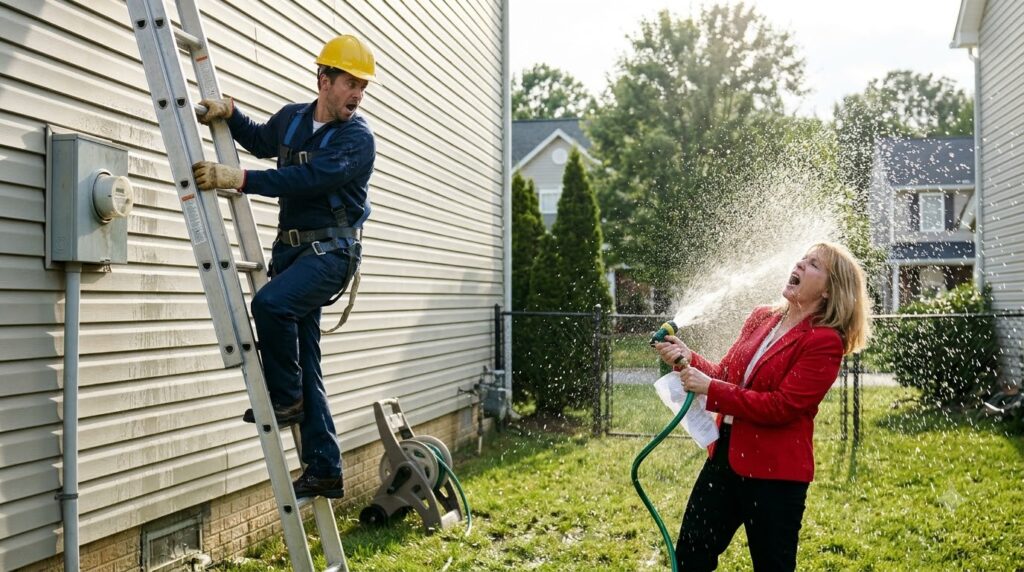
The water.
The shouting.
The fear of falling.
He remembered Margaret standing below him, insisting that Willow Creek belonged to her.
Now he looked around at the garden.
A grandfather was helping his granddaughter plant marigolds.
Two neighbors were repairing a fence.
Ruth Collins was carrying a tray of lemonade toward a group of volunteers.
The neighborhood was still imperfect.
But it belonged to its residents again.
Evelyn smiled.
“Would you like some lemonade?”
Daniel laughed.
“As long as nobody sprays me with it.”
Evelyn laughed too.
It was the kind of easy laughter that had been missing from her life for months.
They sat on the bench and watched the afternoon unfold.
For the first time in a long while, Evelyn felt completely at home.