Chapter 3: The Neighborhood Karen Built on Fear
By Sunday morning, the video had spread throughout Ocean Crest Estates.
Tyler Bennett had shared the recording with the police and his parents. A shorter copy, posted with permission, appeared in a neighborhood discussion group.
By breakfast, hundreds of people had watched it.
By lunchtime, thousands.
The footage was impossible to misunderstand.
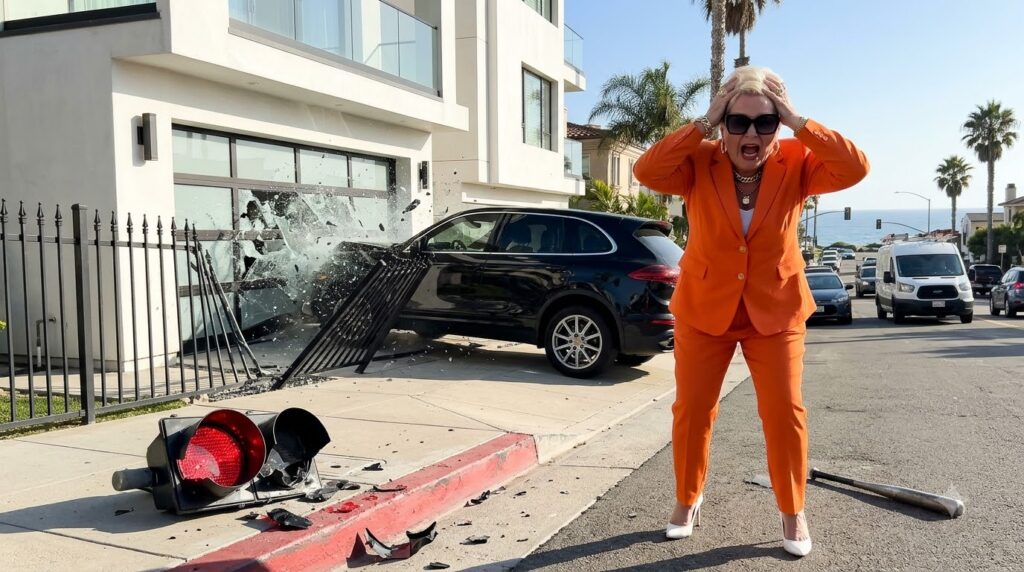
Karen, dressed in her bright orange suit, destroyed a traffic signal while declaring that she owned the neighborhood.
Seconds later, a black SUV crashed into her own mansion.
Some viewers found the irony hilarious.
But longtime residents of Ocean Crest Estates saw something more serious.
They saw the consequences of a woman who had spent years treating an entire community as her personal kingdom.
Eleanor Hayes understood that better than most.
She and her late husband, Thomas, had purchased their modest blue house in 1989.
Back then, Ocean Crest Estates was filled with working families, retirees, teachers, firefighters, and small-business owners.
Neighbors borrowed lawn equipment, watched one another’s children, and brought casseroles to families facing illness.
Thomas had served in the Navy for twenty-seven years.
After retiring, he spent his mornings tending roses and his afternoons repairing old furniture in the garage.
He died three years before the traffic-light incident.
Eleanor had never fully adjusted to the silence he left behind.
Then Karen became HOA president.
At first, Karen promised improvements.
She wanted cleaner landscaping, better security, and stronger property values.
Many residents supported her.
But gradually, her leadership changed.
Small disagreements became official violations.
Residents received fines for leaving trash containers visible fifteen minutes too long.
An elderly widower was threatened with legal action because his porch railing was painted the wrong shade of white.
A young couple received repeated warnings about their children’s basketball hoop.
Eleanor’s problems began with Thomas’s roses.
The bushes grew along the front walkway, where Thomas had planted them more than twenty years earlier.
One spring morning, Eleanor received a violation notice.
The roses, Karen claimed, were inconsistent with the neighborhood’s approved landscaping standards.
Eleanor explained that the bushes were a memorial to her husband.
Karen’s written response was brief.
Personal circumstances did not exempt homeowners from association rules.
Eleanor paid a fine rather than risk additional penalties.
But she refused to remove the roses.
Karen continued sending notices.
By the time the traffic light was destroyed, Eleanor had accumulated nearly $1,200 in disputed fines and administrative fees.
For a retired teacher living on a fixed income, the amount mattered.
She had quietly reduced her grocery spending and postponed repairs to her air-conditioning system.
Her daughter, Susan, repeatedly urged her to challenge the association.
Eleanor resisted.
She didn’t want conflict.
She wanted peace in the home she had shared with Thomas.
But the accident changed something.
That Sunday afternoon, Eleanor invited three neighbors to her kitchen table.
One was retired electrician Frank Delaney, seventy-four, who had received fines for parking his pickup truck in his own driveway.
Another was sixty-eight-year-old widow Patricia Gomez, whose small garden fountain Karen had ordered removed.
The third was Marcus Bell’s mother, Denise, who lived in the neighborhood and had been fighting the HOA over accessibility improvements for her elderly father.
Eleanor served iced tea and homemade lemon cookies.
For nearly two hours, they compared experiences.
What emerged was troubling.
Several homeowners had received fines without proper hearings.
Others claimed that association records were difficult to obtain.
Some had been threatened with collection action after questioning Karen’s decisions.
Frank brought copies of HOA meeting notices.
Patricia brought letters.
Denise brought photographs and correspondence.
Eleanor spread everything across the table.
At first, the documents appeared unrelated.
Then Frank noticed something.
Several fines had been approved during board meetings that residents couldn’t remember taking place.
According to the minutes, votes had been unanimous.
Yet two listed board members had resigned months earlier.
Eleanor examined the dates.
“That can’t be right.”
Frank shook his head.
“No, it can’t.”
The room grew quiet.
Until that moment, they had believed Karen was simply an unreasonable HOA president.
Now they wondered whether she had been exercising authority she no longer legally possessed.
Eleanor reached for her reading glasses.
“Then we need the real records.”
She opened a notebook and wrote down the names of every homeowner willing to help.
Outside, the afternoon sun settled over the neighborhood.
Across town, Karen was already contacting an attorney.
She intended to fight the traffic charges, blame the Cadillac driver, and regain control of her reputation.
But while she prepared her defense, Eleanor and her neighbors had begun investigating something much larger.
The question was no longer whether Karen had abused her authority.
It was how far that abuse had gone.