Chapter 10: The Red Light at Ocean Crest Drive
One year after the accident, the intersection of Ocean Crest Drive and Magnolia Avenue was quiet.
The traffic signal stood exactly where it had before.
Its red, yellow, and green lights operated normally.
The city had improved the pedestrian markings and adjusted the signal timing after a formal engineering review.
Additional warning signs helped approaching drivers recognize the intersection.
The improvements were based on traffic data and safety recommendations, not on the demands of a single homeowner.
The luxury mansion on the corner had a new owner.
A retired couple from North Carolina had purchased it after Karen moved away.
They planted sea oats along the fence and installed a small bench overlooking the street.
The garage had been fully restored.
The iron fence stood straight.
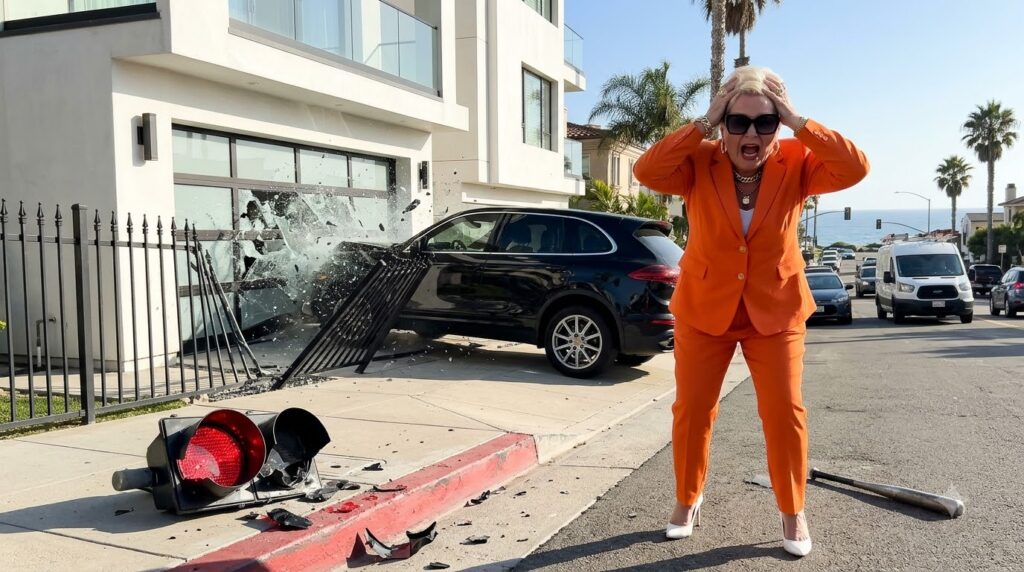
From the outside, little evidence remained of the violent collision.
But the neighborhood remembered.
Tyler Bennett, now preparing for college, had used his video as part of a school presentation about civic responsibility and the importance of documenting public events accurately.
He emphasized that recordings could provide evidence, but that investigations still required context, verification, and due process.
His teacher praised the project.
Marcus Bell continued working as a delivery driver.
He passed through the intersection several times each week.
Whenever he stopped at the red light, he remembered the afternoon when a moment of reckless anger had nearly changed several lives forever.
Daniel Brooks eventually replaced his damaged Cadillac with a smaller SUV.
He and Laura celebrated their twenty-fifth wedding anniversary that summer.
They invited Eleanor and several neighbors to a backyard barbecue.
What had begun as a frightening accident had created friendships that otherwise might never have existed.
Eleanor remained in the blue house she and Thomas had purchased decades earlier.
Her roses bloomed more beautifully than ever.
The disputed fines were gone.
The neighborhood had established clearer protections for homeowners.
And Eleanor no longer felt afraid when an HOA envelope appeared in her mailbox.
One Saturday morning, she received a call from Caroline Whitmore.
Caroline explained that Karen had completed her court-ordered obligations and was continuing counseling voluntarily.
She had also begun volunteering at a community food pantry near her new home.
The work was ordinary.
Sorting canned goods.
Carrying boxes.
Helping older residents load groceries into their cars.
There was no title attached to it.
No special authority.
No audience waiting to applaud.
Caroline said her mother was still learning patience.
Some days were better than others.
But she was making an effort.
Eleanor listened.
She was glad to hear it.
She did not need Karen to suffer forever.
She needed the harm to stop, the consequences to be faced, and the community to be protected.
Those things had finally happened.
Later that afternoon, Eleanor walked to the intersection.
The sun was beginning to descend over the coastal neighborhood.
A warm breeze moved through the palm trees.
She waited beside the crosswalk as the traffic signal turned red.
Cars slowed and stopped.
A father pushed a stroller across the street.
Two teenagers followed on bicycles.
An elderly man carrying a grocery bag crossed carefully behind them.
Nobody shouted.
Nobody demanded special treatment.
Nobody claimed to own the road.
The signal changed, and traffic moved forward.
Eleanor smiled.
She thought about Thomas and the countless ordinary days they had spent together.
She remembered how he used to say that a good neighborhood wasn’t measured by the size of its houses.
It was measured by how people treated one another when nobody was watching.
For years, Karen had believed that respect came from authority.
She had mistaken fear for admiration and control for leadership.
When she destroyed the traffic light, she believed she was demonstrating her power.
Instead, she exposed the danger of believing that personal anger could outweigh everyone else’s safety.
The SUV crashing into her mansion had been an extraordinary consequence.
But the greater damage had already been happening for years.
It existed in the frightened homeowners, the broken friendships, the unfair penalties, and the community that had slowly stopped trusting itself.
Repairing the garage had taken months.
Repairing the neighborhood had required something more difficult.
People had to speak honestly.
They had to examine evidence.
They had to stand beside neighbors who were being treated unfairly.
And they had to remember that no title, no bank account, and no expensive home placed anyone above the rules.
Eleanor returned to her garden as the afternoon light softened.
She knelt beside Thomas’s favorite rosebush and gently removed a few dead leaves.
A new bud had opened that morning.
Its petals were deep red, bright against the green foliage.
She touched it carefully.
Then she stood and looked toward the quiet street.
For the first time in a long while, Ocean Crest Estates felt like home again.
Not because every disagreement had disappeared.
Not because every resident had become a friend.
And certainly not because one woman had finally lost her power.
It felt like home because people had rediscovered something they should never have forgotten.
A community belongs to everyone who lives in it.
A home deserves protection.
A neighbor deserves dignity.
And the rules that keep people safe must apply equally, whether someone lives in a modest cottage or a three-story waterfront mansion.
As evening approached, the streetlights flickered on.
At the intersection, the traffic signal turned red once more.
This time, everyone stopped.
And life moved forward exactly as it should.
THE END