
Chapter 8: What Home Meant
The repairs were finished before winter.
The drainage system worked better than it had in years.
The trench disappeared beneath fresh soil.
The hydrangeas along Mara’s side of the fence were replanted.
One Saturday morning, Mara stood outside with a cup of coffee while Daniel packed his tools.
The old metal stake remained in the ground.
This time, it had been marked properly.
Mara looked at it for a long moment.
A year earlier, Robert had been alive.
He would have insisted on measuring everything twice.
She could almost hear him making some dry joke about never trusting a fence that hadn’t been surveyed.
The memory made her smile.
Daniel noticed.
“You okay?”
Mara nodded.
“Yeah.”
She looked at the house.
For weeks, the dispute had made her feel as though someone had tried to take something from her.
But in the end, she hadn’t lost her home.
She had gained something else.
Certainty.
She knew exactly where her property ended.
She knew what rights the easement granted.
She knew who to call when something seemed wrong.
And, perhaps most unexpectedly, she had learned that not every stranger who crossed her path was an enemy.
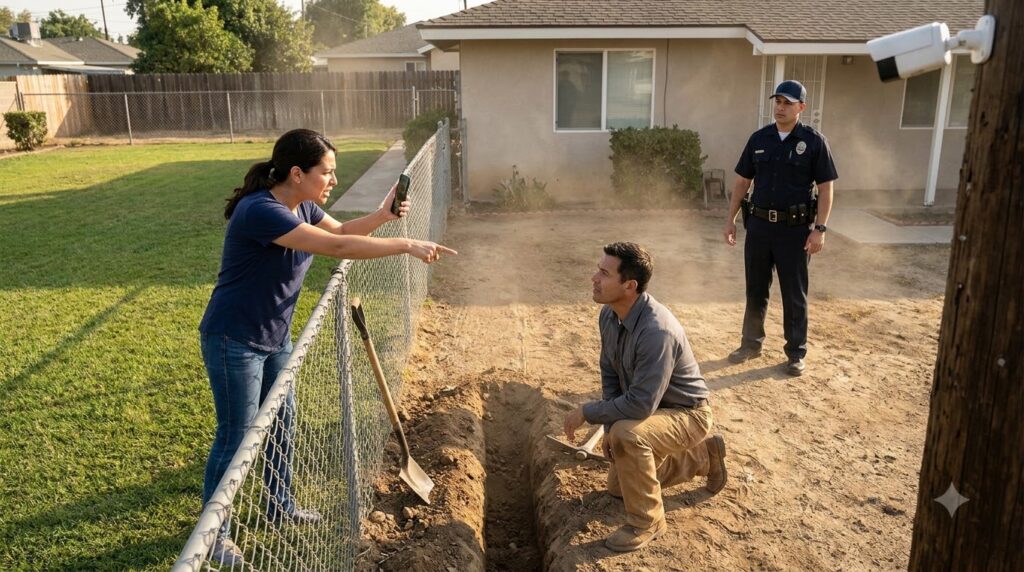
Daniel had been the man behind the shovel when she first saw the trench.
He had looked like the problem.
He wasn’t.
The real problem had been assumptions—about boundaries, paperwork, ownership, and what people were allowed to do when nobody stopped to check.
Mara walked back toward the house.
Behind her, the fence stood where it had stood for years.
But it no longer represented an uncertain dividing line.
It was simply a fence.
The true boundary was marked clearly now.
And so were the responsibilities that came with it.
Mara paused at the kitchen window and looked outside.
The yard was quiet.
The trench was gone.
The flowers were beginning to recover.
For the first time in weeks, the place felt peaceful again.
She understood then that protecting a home wasn’t always about standing behind a fence and refusing to move.
Sometimes it meant asking questions.
Sometimes it meant demanding proof.
And sometimes it meant recognizing the difference between defending what belonged to you and treating everyone else as the enemy.
That afternoon, Mara put the old survey back in its folder.
Then she added a copy of the new one.
She closed the drawer and smiled.
The line had finally been settled.
And with it came something more valuable than winning an argument:
the quiet confidence of knowing exactly where home began—and where it ended.








