
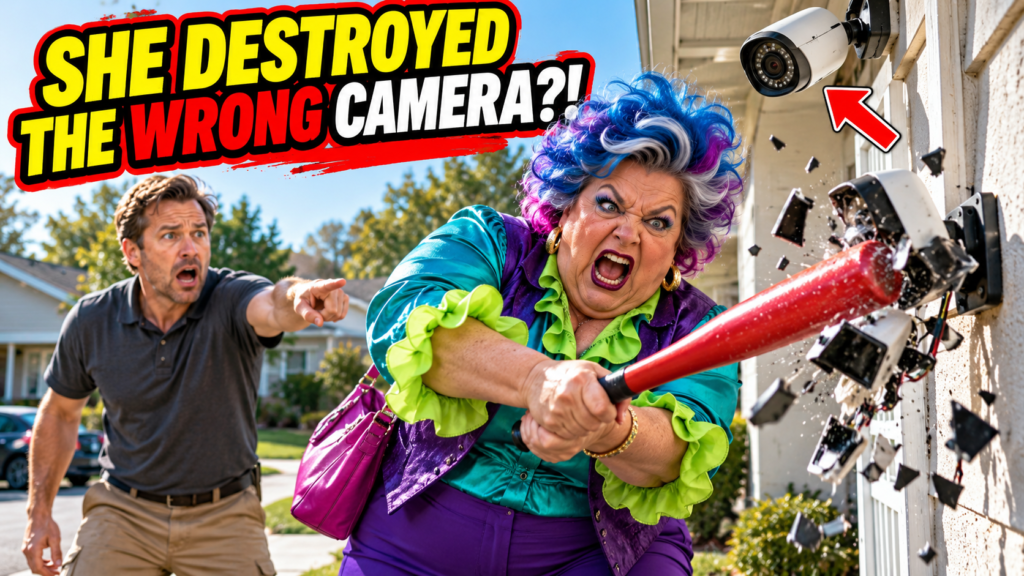
Chapter 3: The Woman Behind the Anger
The post spread faster than anyone expected.
By morning, strangers were laughing about the woman with the foam bat.
David hated that.
He had never wanted Linda humiliated.
He had wanted the truth documented.
There was a difference.
Rebecca called before breakfast.
“There’s another part of this,” she said.
She had noticed something David had missed.
The camera had not been installed because of Linda.
It had been installed months earlier after a package theft on the block. The footage had already helped identify the vehicle involved.
David checked his records.
The camera was positioned toward the sidewalk and driveway, not Linda’s house.
He pulled up several weeks of recordings.
Most of them were boring.
Delivery drivers.
Joggers.
Children riding bicycles.
People walking dogs.
Cars coming and going.
Linda appeared occasionally, but so did nearly everyone else.
Then David found a recording from three weeks earlier.
Linda was standing at the edge of the sidewalk late at night.
She was not yelling.
She was crying.
She looked around as if hoping nobody had seen her.
Then she sat on the curb.
David paused the footage.
He felt uncomfortable watching.
Rebecca looked at him.
“Maybe this isn’t really about the camera.”
David knew that already.
The next afternoon, he went to Linda’s house.
She opened the door only a few inches.
He told her he had seen the recording.
Her expression changed instantly.
“You watched me?”
“It was recorded automatically.”
“That doesn’t make it better.”
“No,” David said. “It doesn’t.”
For once, neither of them raised their voice.
Linda admitted that her husband, Tom, had died the previous winter.
Since then, she had become increasingly convinced that people were watching her, judging her, discussing her.
She had stopped going to the neighborhood gatherings she once enjoyed.
Every camera seemed personal.
Every glance seemed deliberate.
But there was something else.
Tom had been the one who handled nearly everything around the house.
Bills.
Repairs.
Technology.
Security.
After he died, Linda felt as if the world had become a place where everyone knew how things worked except her.
The camera became a symbol of that helplessness.
David did not tell her she was imagining everything.
He also did not tell her the camera was guilty.
Instead, he offered to show her exactly what it could and could not see.
Linda hesitated.
Then she opened the door wider.
That decision would change the argument completely.








