
CHAPTER 7: THE PROOF ON THE HOOD
“What do you mean, it doesn’t?” Arthur snapped, his voice cracking as he took a quick, aggressive step off the curb pan. “I bought this property in two-thousand-four! I have the deed in my safe! Thirty-five feet of road frontage, straight from the center line to my front porch foundation!”
Mark reached into the back sleeve of his clipboard, pulling out a folded piece of heavy blue-line paper. The creases were worn soft from handling, yellowed around the margins where thumb pressure had flattened the paper a dozen times on hood tops and tailgate beds across the county. He unfolded it smoothly, spreading the county plat map over the warm, white hood of Deputy Miller’s patrol car right beside the permit folder.
“Deputy,” Mark said, his voice quiet, devoid of drama or grandstanding. “Run the serial tag on that zinc plate through county GIS. Benchmark number Four-Eight-Nine-C.”
Deputy Miller leaned over the hood, resting his gloved forearms on the metal. He tapped the radio on his shoulder, his eyes scanning the technical grid lines on the blue-line sheet while he spoke to the regional dispatcher. “Dispatch, unit four-seven. Run a property plat verification on Elmwood parcel forty-two. Reference benchmark Four-Eight-Nine-C.”
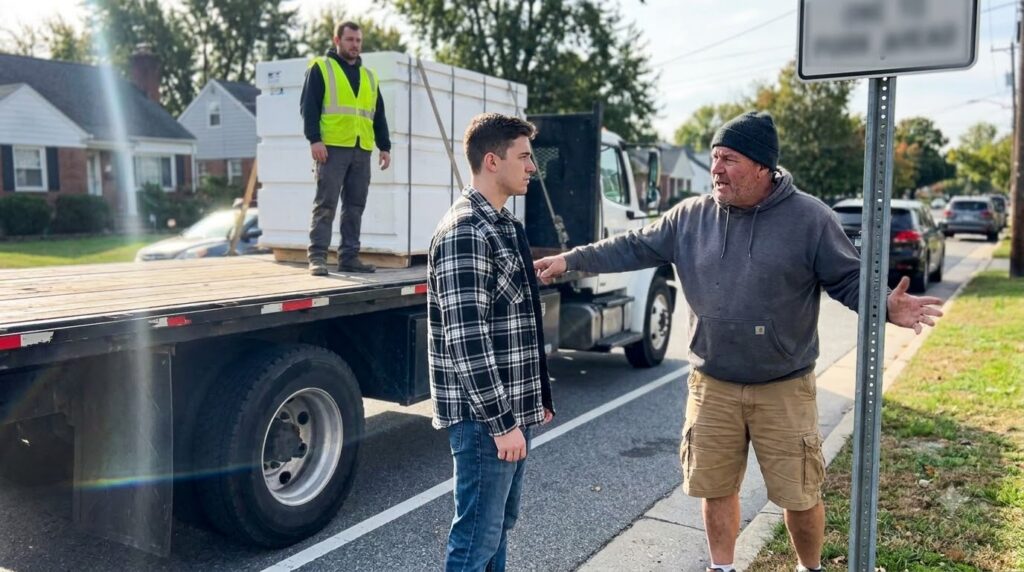
Arthur stood rooted to the street shoulder, his fists clenched tight in the pockets of his gray hoodie. Sweat was dark along his collar, glistening on his stubbled cheeks despite the dry morning breeze. “This is nonsense! A surveyor’s benchmark from thirty years ago doesn’t overturn a recorded residential boundary!”
The radio on the deputy’s shoulder crackled to life, breaking the quiet with a burst of static before the dispatcher’s voice came through, crisp and flat. “Unit four-seven, GIS confirms benchmark Four-Eight-Nine-C. Annexation ordinance ninety-eight-fourteen established a ten-foot public utility and drainage easement extending inland from the flow line of the concrete curb along the entire south side of Elmwood Drive.”
Deputy Miller didn’t look up from the map. He pulled a brass pocket rule from his vest, laying it flat across the scale line at the bottom of the page. “Ten feet from the curb pan, Art,” the deputy said softly.
Mark pointed a calloused finger at the hand-drawn red line marking the physical features of the lot. “And here’s your stone retaining wall, Mr. Vance. And your decorative brick border.”
Arthur’s mouth opened, but no sound came out. His eyes darted frantically between the plat map, the deputy’s calm face, and the neat row of stacked stone he had spent fifteen years mortaring and edging along the lawn.
“Your actual deeded property line doesn’t start at the curb,” Mark said, his voice entirely factual, devoid of victory or gloating. “It starts four feet behind your stone wall. That turf strip, the gutter pan, the ditch line, and the first four feet of what you call your front lawn belong to the county public right-of-way.”
Gary, standing on the edge of the driveway, let out a low, breathless whistle, looking down at the stone wall beneath his boots as if the earth had suddenly shifted six inches to the left. Across the street, Mrs. Gable leaned forward over her porch rail, her hand cupped behind her ear to catch every word coming off the patrol car’s hood.
“Which means,” Deputy Miller said, turning his head slowly to look Arthur straight in the eye, “Mr. Miller’s flatbed isn’t parked on your frontage, Art. It’s parked in the public utility corridor. They don’t even need a secondary municipal staging permit to occupy this shoulder for utility work, because county right-of-way clearance supersedes city light-residential parking codes.”
The silence that settled over Elmwood Drive was thick, heavy, and absolute, broken only by the steady, unyielding thrum of the flatbed’s idling diesel engine.
Arthur looked down at his own work shoes resting in the gutter pan, his face draining of color until the stubble on his cheeks looked gray and hollow in the harsh sunlight.
“The clerk’s typo on the city paper doesn’t matter, Arthur,” Mark said softly, folding the blue-line map back into its neat, worn squares. “Because you’ve been standing in the county’s driveway the whole time.”
Deputy Miller tapped his gloves against the hood, the sound flat and final. “Art,” the deputy said, his tone leaving no room for argument. “Step back onto your porch.”








