
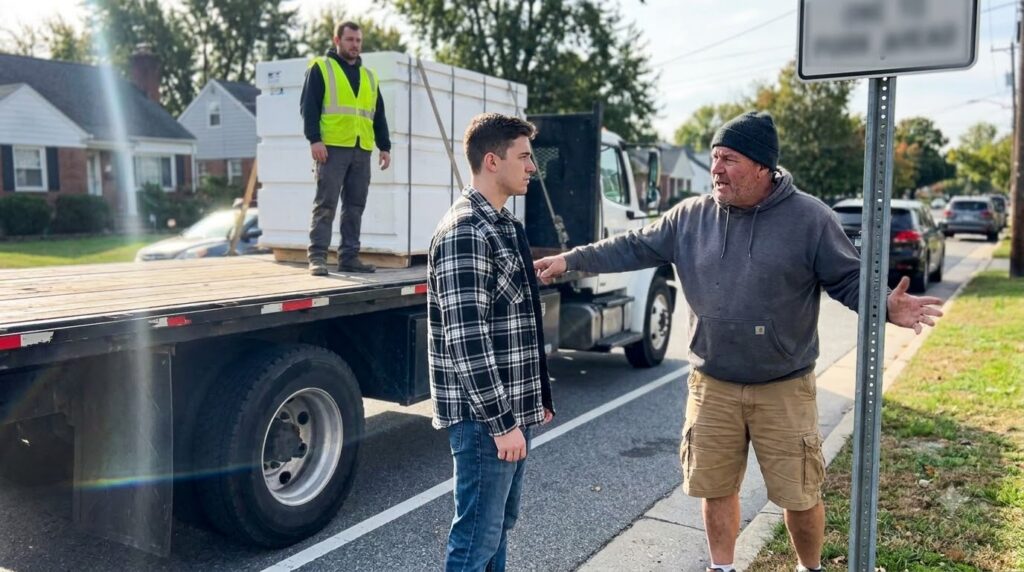
CHAPTER 2: STAGING THE LOAD
“Keep the straps tight until we get the outriggers down, Dan,” Mark called up, his voice barely cutting over the rattling cadence of the idling diesel.
Dan didn’t answer with words. He gave a sharp, single tug on the heavy yellow webbing, anchoring the ratcheting assembly to the flatbed’s steel frame before tossing the excess strap over the aluminum ramp sections. Up on the bed, six hundred pounds of high-grade modular aluminum sat bolted into transport crates, casting long, sharp shadows across the sun-bleached asphalt.
Mark stepped away from the curb, his boots crunching over tiny pebbles and dry leaf litter scattered along the gutter line. He kept his shoulder turned slightly away from Arthur Vance, maintaining a clear six-foot buffer while he unclipped the heavy fiberboard clipboard from the driver’s side door. The metal clip was rusted around the rivets, leaving a faint orange smudge on his thumb as he flipped through the laminated sheets.
Arthur hadn’t moved an inch from the curb line. His stocky frame remained planted like a wedge driven into the street, his gray hoodie damp with sweat along the collar despite the early morning chill. “You think having a clipboard makes you immune to city code, son?” Arthur shouted, the leather notebook in his palm thudding against his thigh with every word. “I know the district commissioner. I know the zoning supervisor. This whole street is designated C-1 light residential flow. You can’t stage a commercial rig for three hours without a dedicated traffic safety escort!”
“We’re not altering traffic flow, Mr. Vance,” Mark replied smoothly, his eyes scanning the header of the top document. “We’re parked flush with the curb. Six feet from the center line. Leaves fifteen feet of clear roadway for emergency vehicles and local passage.”
“Look at that tire!” Arthur jabbed his finger violently down toward the rear duals of the flatbed. “The sidewall is resting on the concrete gutter pan! That pan belongs to the property owner’s frontage responsibility under Section Fourteen of the municipal code! You’re crushing the drainage seam!”
“Section Fourteen covers structural alterations and unpermitted trenching,” Mark said, not looking up. “A pneumatic tire resting on a municipal gutter isn’t a structural alteration.”
He paused, his thumb stopping at the bottom of the second page. The city-issued right-of-way permit—stamped by the municipal clerk’s office three weeks ago—lay flat beneath the clear plastic sleeve. But where the digital authorization code was printed near the margin, a tiny offset misalignment in the ink caught his eye. The date stamp read July 21, 2026, while the secondary inspector signature line carried a manual pen-stroke date of July 19. A two-day clerical discrepancy. On a standard residential job site, it was a harmless administrative typo. On Elmwood Drive, with a man like Arthur looking for any loose thread to pull, it was an open tear.
Mark folded his reading glasses, tucking them back into his flannel shirt pocket before Arthur could track the direction of his gaze. He slid the clipboard under his arm, the hard fiberboard pressing firm against his ribs.
Across the street, a window blind twitched in the white ranch house with the overgrown hydrangeas. Old Mrs. Gable was standing behind the glass, her phone raised to her chest, recording the interaction with a slow, steady hand. Down the block, a riding mower engine sputtered and died as another neighbor, a guy in an oil-stained gray tank top, rested his hands on the steering wheel to watch the standoff.
“You’re real confident, aren’t you?” Arthur sneered, stepping off the curb and into the street shoulder, placing himself less than two feet from the flatbed’s rear bumper. He crossed his arms over his broad chest, his dark beanie pulled down so low his eyebrows were completely hidden. “You think because you’re installing something for old Clara, everyone on this block is just going to bow down and let you tear up the street. She hasn’t paid her HOA drainage dues in three years!”
“Mrs. Mercer’s personal finances aren’t part of my work order,” Mark said quietly. He walked toward the front of the truck, checking the distance between the front bumper and the neighbor’s low brick retaining wall.
As he passed the rusted parking sign, Mark’s knee brushed against the steel post. Near the base, buried beneath a clump of crabgrass and dried clay, a second metal plate was riveted to the post—an old, unpainted zinc tag stamped with a series of tiny numbers. It sat three inches lower than the standard municipal markers, almost hidden from view. Mark caught the glint of the zinc in the morning light, but he didn’t stop to clear the dirt away.
“You’re not dropping a single piece of metal on this street,” Arthur declared, taking two heavy steps to stay parallel with Mark, his voice booming down the quiet residential block. “I’m standing right here until the tow truck arrives. If your driver throws a lever, he’s operating heavy machinery with a civilian directly in the drop zone. Go ahead. Try it.”
Up on the truck bed, Dan looked down at Mark, his gloved hands pausing on the ratchet handle. The silence between the three men stretched taut, broken only by the steady, heavy thrum of the idling diesel.








