
CHAPTER 1: THE CURB LINE
“You can’t block my spot and jam up everything here!”
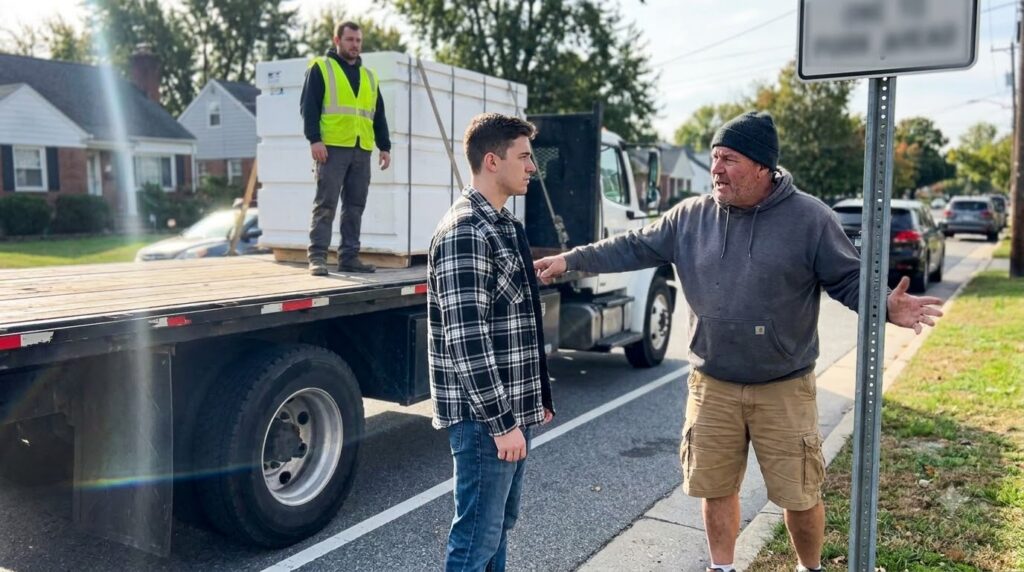
Arthur Vance planted his work shoes right against the cracked concrete of the curb, his stocky frame leaning forward like a fence post driven into bad soil. His dark knit cap was pulled low over his forehead, short gray stubble glinting in the harsh morning sun. One hand jabbed rhythmically toward the heavy rear duals of the flatbed, his gray hoodie bunched around his elbows from the force of the motion.
Mark Miller didn’t step back. He stood near the edge of the asphalt in his black-and-white plaid flannel, his work boots caked in dry yellow clay from the last job site. The diesel engine of the medium-duty rig idled behind him with a low, hydraulic thrum, sending tiny heat shimmers across the white powder-coated aluminum ramp sections secured on the bed.
Up on the flatbed, Dan stayed motionless. He held a ratcheting strap in one gloved hand, his high-vis vest a sharp orange wedge against the pale sky. He didn’t say a word. He knew better than to jump into a street fight before the paperwork came out of the cab.
“It’s a public street, Mr. Vance,” Mark said. His voice was flat, carrying the gravelly calm of a man who spent forty hours a week explaining municipal codes to angry homeowners. “We’re staging for three hours. The ramp has to be up before the transport van brings Mrs. Mercer back from the rehab center at two.”
“I don’t give a damn about the transport van,” Arthur snapped, stepping closer until his chest almost brushed the rusted steel post of the parking restriction sign. “This is my frontage. I maintain the turf strip. I mow it. I edge it. You park a ten-ton flatbed over my root systems, you compact the soil. You’re blocking the sightline for my driveway.”
Mark reached slowly into the chest pocket of his flannel, pulling out his reading glasses and unfolding them with one hand. He pointed toward the metal sign mounted on the post between them. The paint was faded, the red lettering chipped away by decades of road salt and summer heat, but the non-overnight restriction was clear enough.
“Sign says no parking two to six AM,” Mark noted, keeping his posture squared and arms loose. “It’s eight-fifteen in the morning.”
“That sign is for residents,” Arthur said, his jaw working under the stubble. He pulled a heavy leather-bound notebook from his hoodie pocket and slapped it against his palm. “I’ve logged every commercial vehicle that’s idling on this block since April. I’ve got the code enforcement officer on speed dial. You turn that key off and start unchaining that load, and I’m having the city hook this rig before your boots hit the grass.”
Mark didn’t reach for the truck door. He looked past Arthur’s shoulder, noticing the edge of a fresh white plastic binder poking out from the pocket of Arthur’s gray hoodie—a binder marked with the crest of the Elmwood Homeowners Association. But Mark knew for a fact that Elmwood Drive hadn’t operated an active HOA since the county annexed the road shoulder in ninety-eight.
Mark turned his eyes back to the signpost, catching the fresh silver glint of an unpainted hex bolt anchoring the steel to the concrete base—a bolt that hadn’t been stamped by the county road crew.








