
Chapter 7: What Evan Took Home
A week later, Evan parked his sports car at the edge of another construction site.
He stopped before entering.
He looked for signs.
He looked for barriers.
Then he waited for someone to tell him where he could safely park.
It took less than a minute.
But he never forgot it.
At home that evening, Evan told his father about what had happened.
His father listened without interrupting.
When Evan finished, the older man smiled.
“You learned something expensive without having to pay the full price.”
Evan laughed.
“That’s one way to put it.”
His father leaned back.
“Did you apologize?”
“Yes.”
“To the worker?”
“Yes.”
“Did he apologize?”
Evan nodded.
His father smiled.
“Then you both got something right.”
Evan thought about that.
For days, he had replayed the confrontation in his mind.
The anger.
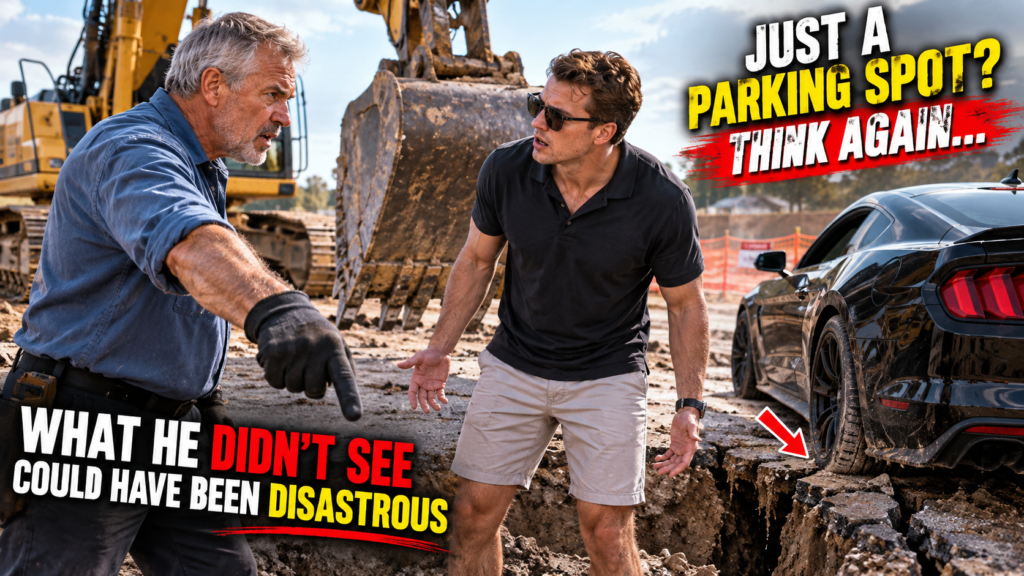
The pointing finger.
The raised hand.
The excavator behind Mike.
The black car sitting in the wrong place.
But now he remembered something else.
Mike had never tried to embarrass him.
He had tried to stop him.
And Evan had asked a legitimate question too.
Why had the entrance been open?
The answer was uncomfortable.
Because several people had made small assumptions.
Someone thought the barrier would be replaced.
Someone thought the inspection had been completed.
Someone thought the open entrance meant access was permitted.
Evan thought the construction worker was simply being difficult.
None of those assumptions, by themselves, looked like a disaster.
Together, they almost became one.
Months later, Evan received a message from Dana.
The company had changed its site-access procedures after the incident.
Temporary barriers were now checked twice each shift.
Inspection reports required photographic verification.
Restricted areas were marked more clearly.
Workers were encouraged to stop operations when something didn’t look right, even if doing so caused delays.
Mike had helped design part of the new procedure.
Evan wasn’t surprised.
He sent Mike a short message.
You were right to stop me.
Mike replied several minutes later.
You were right to ask questions. Keep doing both.
Evan smiled.
That was all.
No dramatic reunion.
No long speech.
Just two men who had once stood several feet apart, angry and convinced the other was the problem.
They had both learned something different that day.
Mike learned that even experienced workers had to verify what they thought they knew.
Evan learned that confidence wasn’t the same as awareness.
And everyone involved learned something more important:
When something feels unsafe, stopping to ask questions isn’t weakness.
It isn’t disrespect.
And it isn’t always about being right.
Sometimes it is simply about making sure everyone gets to go home.
The yellow excavator eventually moved on to another section of the project.
The underground line was protected.
The construction schedule recovered.
And Evan’s black sports car never again crossed a worksite barrier without permission.
But whenever he saw a heavy machine working near a road, he remembered Mike’s words.
Not the angry ones.
The quiet ones.
Better one lost day than one injured person.
For a man who had once been furious about where he could park his car, it was a lesson he carried much farther than the construction site.








