
CHAPTER 4: THE PAVEMENT LINE
The rusted metal of the surveyor’s iron bar screeched as Aaron’s weight slammed into the shaft. The vibration traveled up the iron tool, throwing a spray of wet, orange-tinted silt across Miller’s work boots. For a micro-second, the only sound in the narrow space between the two houses was the ragged, localized rasp of Aaron’s breathing and the low, heavy idle of the county diesel truck behind them.
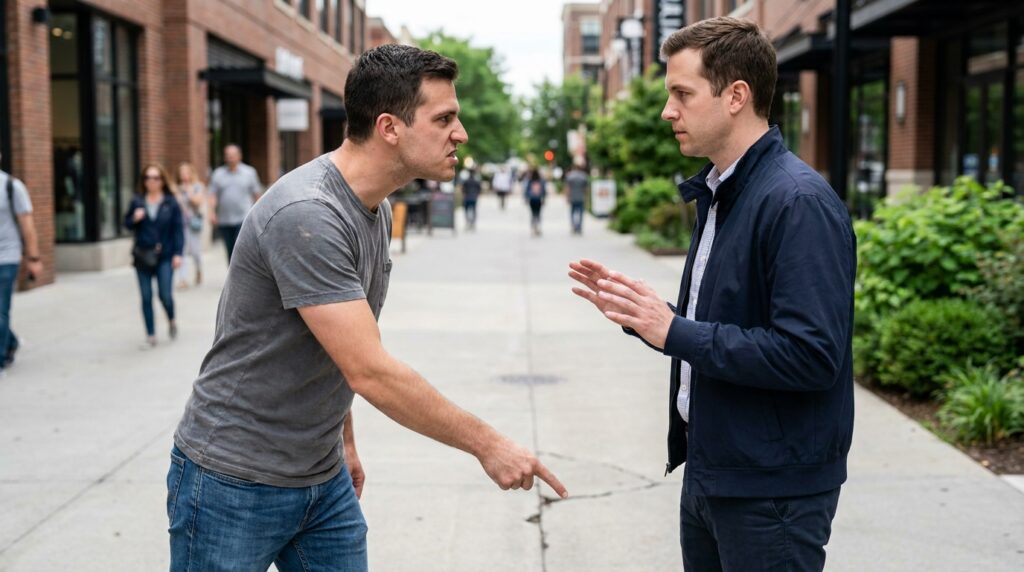
Aaron didn’t release his grip. He lurched half a pace forward, his shoulders bunching beneath his damp t-shirt as he jammed his own boots directly into the wet gravel seam. He was leaning into Miller’s personal space now, his chest a mere few inches from Miller’s jacket zipper, his entire posture twisted into an aggressive, unyielding block over the orange survey marker flag.
“You don’t just step into my space like that, you don’t get it,” Aaron spat. His jaw was a hard, tight knot, his eyes wide and bloodshot from the cold drizzle. He lifted a single, mud-streaked hand and jabbed a finger sharply down at the cracked concrete between their feet, pinning his claim to the pavement like an iron stake. “This is old ground, Miller. My family laid this driveway before your deed was even printed at the county house. You don’t bring town trucks onto my side of the line.”
Miller stood his ground squarely. His heels remained planted on his own undisputed slab, his square shoulders forming an immovable barrier against Aaron’s forward lean. He didn’t drop his stance, nor did he ball his hands into fists. Instead, he kept his hands raised chest-level, fingers loose and slightly curved inward in a calm, controlled, defensive posture that offered no target for escalation while keeping his balance perfectly centered over his boots.
“I’m not taking anything from you, Aaron,” Miller said, his voice flat, steady, and unhurried against the dry rattle of the neighbor’s side gate latch. “I’m just trying to help.”
Aaron’s chin dipped forward, his teeth grinding together until a thin line of white foam appeared at the corner of his split lip. He looked down at the brass surveyor pin, then back up at Miller’s steady, unblinking eyes, his voice dropping into a tight, frustrated hiss. “Then stop acting like you know everything.”
The words had barely left Aaron’s mouth when a sharp, hollow crack echoed from underneath the rear axle of the flatbed trailer.
The weight of the unmapped water main pressure, combined with the heavy iron bar driven into the concrete blocks, had finally sheared the sub-surface clay. The grey slurry beneath the trailer erupted in a sudden, violent surge, bubbling up through the broken asphalt like oil. The water didn’t drain away toward the street; it rushed directly into the narrow trench the surveyor had cleared, exposing the top of a corroded six-inch iron line that ran parallel to the boundary.
But it wasn’t a standard utility line. Spliced into the side of the main county valve was a rough, unauthorized copper sleeve—a buried bypass pipe that was illegally anchored with heavy steel bands, extending directly from the water main toward the foundation wall of Aaron’s basement.
The surveyor let go of the pry-bar, his canvas coat slick with the gray mud slurry. He wiped his face with the back of his hand, his eyes wide as he looked at the exposed connection. “What the hell is that?”
Miller didn’t answer right away. He let his gaze track the path of the illegal copper splice. The pipe didn’t just cross under the walkway; it was drawing continuous, unmetered pressure directly from the township side of the line. The old brass key in Miller’s pocket seemed to hum against his thigh, the handwritten red cross-key icon from the 1954 blueprint suddenly snapping into sharp, terrifying focus. This wasn’t a standard neighborhood drainage issue. This was a deliberate, subterranean overreach that had been hidden under the concrete for decades.
Aaron backed up half a step, his boots slipping on the slick, silt-covered blacktop. The deep red flush in his face vanished instantly, leaving his skin a pale, pasty grey under the flat light of the overcast sky. He looked at the bubbling water, then at the surveyor’s leather map case, his hands dropping to his sides as his aggressive posture completely deflated.
“That’s… that was there when we bought the property,” Aaron muttered, his voice cracking as his eyes darted toward the blue light of the security camera humming beneath Miller’s eaves. “That’s an old agricultural line. It’s grandfathered in under the original development charter.”
“The county doesn’t grandfather unmetered main splices, son,” the surveyor said, his voice dropping into a cold, transactional register as he pulled out a heavy field notepad. “That’s a tier-one infrastructure breach. The fine alone starts at five grand, before they calculate the back-usage bills.”
Miller turned his head slightly, his eyes locking onto the small screen of his phone as a fresh notification blinked. The camera had recorded the entire incident—every gesture, every accusation, and the exact moment the illegal line was exposed in front of the surveyor and the distant porch watchers. But as Miller looked closer at the exposed iron main in the mud, he noticed something else: the massive county pipe wasn’t just sitting near the boundary line. It was situated entirely inside the legal footprint of his own deeded soil, which meant the entire corner of Aaron’s garage was sitting on ground it had no right to occupy. The paradigm was shifting again, and the true depth of the historical grid error was about to surface.








