CHAPTER 2: THE CURB OVERRUN
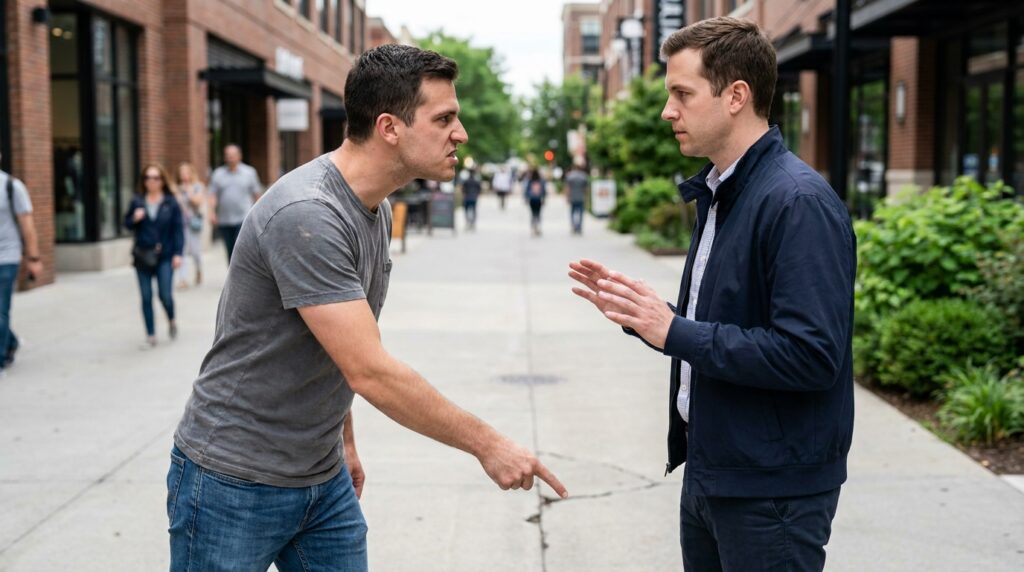
“Keep your fingers off the brass, Aaron.”
Miller’s words didn’t carry weight because they were loud; they carried weight because they didn’t move. The tarnish on the old key pressed into the meat of his thumb through the worn denim of his pocket, a cold, distinct ridge against his skin. Aaron’s hand remained suspended an inch away, his knuckles white, the dry wind from the street whipping a spray of yellow limestone dust right across the space between their chests. Aaron didn’t pull back. He simply tilted his chin up, his gaze sliding from Miller’s eyes down to the bright orange survey flags driven into the gravel.
“You think a piece of wire and some paint makes this yours?” Aaron asked. His voice had dropped into a rough, scratchy register, the tone of a man who spent too many hours counting the tires on every vehicle that pulled into the cul-de-sac. “The township records don’t say anything about a re-survey on this block. My uncle built that patio deck in ninety-eight, and he didn’t ask for a brass pin to tell him where the soil stops.”
“Your uncle didn’t clear the easement with the water authority either,” Miller said. He stepped back—not away from Aaron, but out of the narrow track of the walkway, redirecting his momentum toward the edge of the street where a low, heavy rumble was beginning to shake the storm grate.
The sound grew thicker, a mechanical thrum that vibrated through the soles of Miller’s work boots long before the shape cleared the corner. A dual-axle flatbed truck, its yellow cab splattered with dried river mud, slowed to a crawl at the mouth of the lane. On the back, three pallets of interlocking hydraulic gravel sat strapped under heavy nylon webbing, their weight causing the truck’s rear leaf springs to groan with every dip in the asphalt. The driver, a stocky man wearing a high-visibility vest that had faded to a dusty yellow, rolled down his window and looked at the curb.
He couldn’t pull in.
Aaron’s three-quarter-ton flatbed trailer was parked parallel to the curb lane, its rusted iron hitch extended six inches past the legal parking line, the heavy jack-foot sunk deep into a soft patch of municipal tar. The trailer was empty except for a pile of broken concrete blocks and three lengths of corroded iron pipe, but it took up twenty feet of the only clear access route to Miller’s driveway.
The driver leaned out, his forearm resting on the dirty door panel. “Hey, chief. I can’t drop these pallets here if that rig stays locked to the curb. My crane arms won’t clear those overhanging telephone wires with the trailer in the way.”
Miller walked down the slope of his lawn, his boots crunching against the dry clover. He didn’t look back to see if Aaron was following, but the rhythmic, metallic scrape of the side gate latch told him the neighbor was already moving down the parallel concrete path, keeping pace behind the hedge line like a dog tracking a fence.
“The trailer moves,” Miller said to the driver, his hand coming down onto the cold, oxidized steel rail of Aaron’s rig. The rust was rough under his palm, flaking off in dry, red scales that left an orange smudge across his fingers. “Give it five minutes.”
“It doesn’t move an inch,” Aaron shouted from behind the privet hedge. He broke through the gap in the branches, his casual t-shirt catching on a twig that snapped with a sharp, dry report. He didn’t look at the truck driver; he went straight for the trailer hitch, planting his boots right where the asphalt met the concrete curb strip. “That trailer is registered, it’s tagged, and it’s on my side of the drainage seam. You want your gravel, Miller? Tell him to dump it in the middle of the street and haul it up yourself with a wheelbarrow.”
The delivery driver looked between the two men, his engine idling with a wet, rhythmic cough that sent puffs of black diesel smoke into the low overcast sky. “Look, guys, I’ve got four more drops before three o’clock. I don’t care who owns the asphalt, but my slip says ‘curbside delivery.’ If I can’t drop the jacks, I’m taking the load back to the yard and charging the account for a dry run.”
Miller didn’t raise his voice. He looked at the trailer’s rusted hitch, then down at the wet spot forming beneath the frame. The street had been dry for three hours, but a steady, grey trickle of water was weeping out from underneath the trailer’s left tire, bubbling out from a tiny crack in the municipal blacktop. It wasn’t storm runoff. It smelled faintly of iron and subterranean rust—the exact signature of the water currently undermining his own foundation sill.
He reached into his pocket, his fingers sliding past the old brass key until they touched the hard plastic corner of his phone. He didn’t look at the screen as he pulled it out. He simply pointed the lens toward the base of the trailer hitch, where the water was beginning to cut a miniature channel through the road salt.
“You’ve got an active leak coming from the service side of your property line, Aaron,” Miller said, his voice flat, his gaze locked on the small pool gathering around the neighbor’s boots. “The township code says any obstruction over a municipal water line during an unverified discharge carries a four-hundred-dollar daily assessment if the utility crew can’t clear the access cap.”
Aaron froze, his hand still clamped onto the iron crank of the trailer jack. His jaw worked silently for three seconds, his eyes darting toward the security camera hum under Miller’s eaves, then down at the gray folder resting on the work crate fifty feet away. The heat in his face had turned a deep, mottled red, but he didn’t drop his hand. He knew the utility cap was exactly three feet behind his trailer’s rear axle—buried under six inches of the broken concrete blocks he had dumped there last Tuesday.
“You don’t know what’s under this road, Miller,” Aaron muttered, his voice dropping into a tight, transactional hiss that the delivery driver couldn’t catch over the thrum of the diesel engine. “You think you’re fixing a lawn, but you’re digging into things that have been settled since before your house was framed.”
Miller didn’t answer. He simply watched the water line rise against the rubber of Aaron’s boots, waiting for the first sign of the county surveyor’s vehicle to round the lower corner of the development.