
CHAPTER 8: THE DIGITAL RECORD AND THE MAP
The high-definition video played back on the phone’s glowing glass screen with unyielding, merciless clarity.
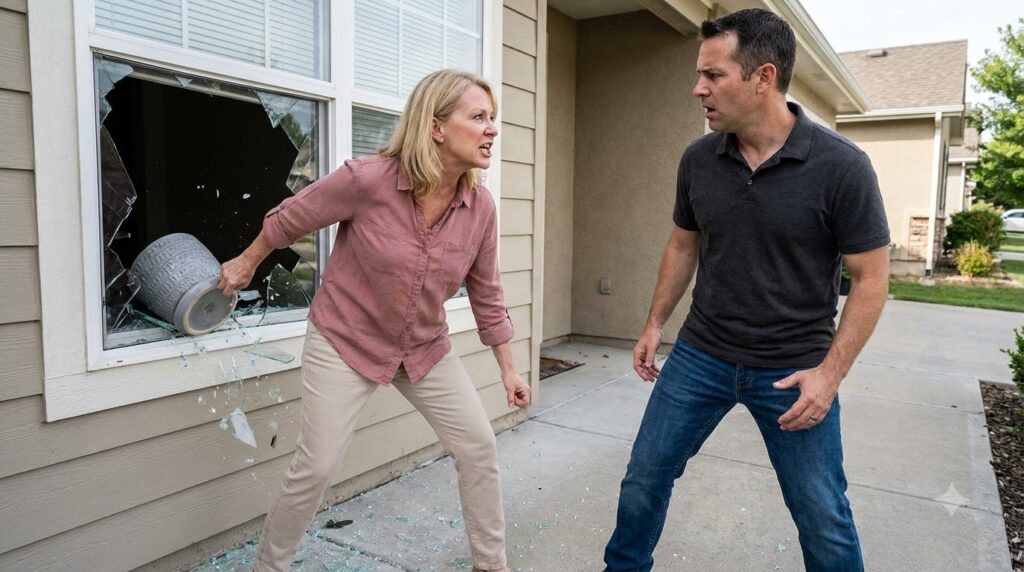
Deputy Miller held the smartphone in his thick, gloved hand, the blue ambient light from his cruiser’s roof rack washing over his broad face every three seconds. He didn’t scrub forward. He watched the full three-minute sequence in complete, heavy silence: the wide-angle camera capturing Evelyn stepping squarely over the concrete boundary seam, her yellow clipboard gripped in her left hand, her face twisting as she reached down to hoist the thirty-pound ceramic planter. He watched her pivot, her body hurling the heavy planter straight through the double-pane glass wall, followed instantly by her lunging into Mark’s space with her finger pointed directly at his chest.
Mark reached down to his phone screen, swiped right, and brought up the second open document—a certified digital copy of the county GIS land record.
Red vector boundary lines framed the property lot down to the fraction of an inch. A prominent, highlighted text box on the margin read: COUNTY SURVEY DIVISION: ALL PRIOR INFORMAL EASEMENTS, NOTES, AND UNRECORDED COVENANTS NULLIFIED AND EXTINCTION CONFIRMED VIA SECTION 12 FORMAL PLAT RE-RECORDING.
Miller’s thumb traced the digital plat line. He looked down at the exact physical spot where he stood on the concrete walkway, then up at the yellow plastic clipboard Evelyn held pinned against her dusty-pink shirt.
“Ma’am,” Miller said, his voice dropping into a low, metallic baritone that carried straight to the curb where four neighbors now stood watching. “You told me you were standing on shared access ground when an altercation occurred.”
Evelyn didn’t move. Her posture had gone rigid as stone, her face pale and sunken under the flashing blue lights. She gripped the yellow clipboard so tightly that the plastic back frame flexed. “Deputy… there is an agreement from nineteen ninety-eight—”
“The agreement was legally extinguished eight years ago,” Miller interrupted cleanly, his tone flat, bureaucratic, and utterly final. He pointed a finger toward the torn, wet piece of paper sticking out from the broken soil on Mark’s path. “And according to the county registry seal on the plat map you pulled from the clerk’s office last week, you were formally notified of that nullification when you filed your tax assessment protest.”
The air on the walkway went completely dead.
Mark didn’t utter a word. He stood beside the gaping, shattered window frame, his charcoal polo dark, his eyes fixed on Evelyn’s face. The full, cold reality of what she had done hung in the summer air like thick smoke: she hadn’t just made a mistake about a property line. She had known the ancient paper in her hand was legally void, yet she had used it to harass, trespass, and destroy private property anyway.
“You knew,” Mark said softly, his voice cutting through the quiet like a cold chisel on iron. “You knew the paper meant nothing, and you threw the planter anyway.”
Evelyn’s lower lip trembled once—a tiny, involuntary break in her manufactured authority. Her eyes flicked toward the gathered neighbors on the sidewalk, who were staring at her in stunned, silent disgust. The man in the gray sweatshirt shook his head slowly, turning his back to her and walking back up his driveway.
“Deputy Miller,” Mark said, his voice calm, steady, and unyielding as the concrete beneath his boots. “Check the camera on the eave, Officer. She threw it while standing three feet onto my deeded land.”
Miller nodded once. He reached to his belt, unclipped a heavy, carbon-copy citation book, and pulled a heavy black pen from his chest pocket. The metallic click of the pen mechanism sounded like a hammer dropping into place.
“Ms. Higgins,” Miller said, turning his back to Mark and stepping squarely over the property boundary toward her. “Keep your hands where I can see them and step to the front bumper of my patrol car. You are being cited for criminal property destruction and intentional trespass.”








