CHAPTER 7: THE BADGE ON THE CURB
The patrol car door shut with a heavy, double-latch thunk that cut through the low hum of the neighborhood.
Deputy Miller didn’t hurry. He walked up the driveway apron with the measured, rolling stride of a county officer who spent eight hours a day stepping between angry people on hot asphalt. His dark navy uniform shirt was crisp, stiffened by starch, the brass buttons glinting under the harsh glare of his cruiser’s roof lights. A heavy leather duty belt creaked against his hips with every step, the black metal casing of his radio emitting a faint, intermittent crackle of static.
Evelyn didn’t wait for him to reach the walkway. She met him three paces out from the curb, her beige slacks stepping over the grass verge, her yellow clipboard raised in both hands as if offering a formal report.
“Deputy,” she began, her voice carrying a breathless, calculated tremor—a sudden, manufactured frailty that contrasted sharply with the screeching rage of three minutes ago. “Thank God you were in the sector. I was conducting a routine inspection of the easement line when Mr. Vance became physically aggressive.”
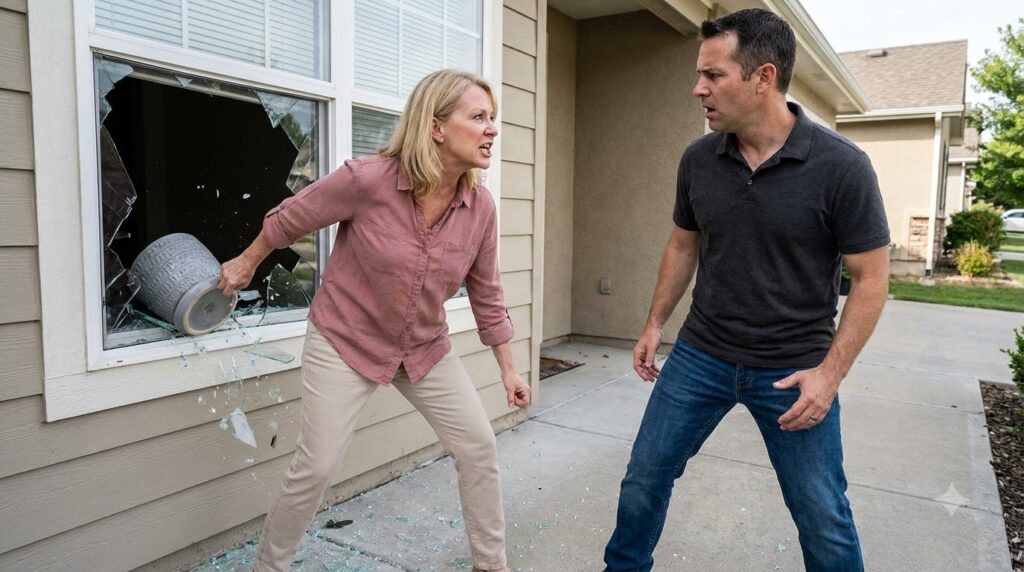
Miller stopped at the junction of the lawn and the concrete path. His eyes—pale gray, shaded by the brim of his campaign hat—didn’t lock onto her face. They swept past her shoulder, scanning the ground: the spilled black dirt, the shattered gray clay fragments, and the glittering field of broken window glass spread across Mark’s walkway.
“Ma’am, step back to the curb line, please,” Miller said. His voice was flat, low, trained to strip emotion out of a driveway argument.
“He cornered me against the foundation wall,” Evelyn pressed on, her fingers tightening around the clipboard until the yellow plastic bowed. She gestured toward Mark, who remained planted five feet away beside the jagged hole in his side wall. “He blocked my exit path along the shared corridor. I felt threatened, Deputy. I reached out to create space and the ceramic planter slipped.”
“Slipped,” Mark repeated quietly. He didn’t raise his voice. He stood with his arms relaxed at his sides, his boots planted squarely on his deeded concrete, his charcoal polo dark against the pale siding.
Miller turned his head toward Mark, his hand resting casually on his leather belt line, right beside a stiff carbon-copy field notepad secured by a silver clip. “Mr. Vance. Are you the homeowner?”
“I am,” Mark said. “Four-twelve Elmridge. The woman standing on my lawn is Evelyn Higgins from four-fourteen. She crossed my lot line, demanded I remove my property, grabbed a thirty-pound planter, and threw it through my double-pane side window.”
“That is a complete fabrication!” Evelyn snapped, her voice spiking into the high, raspy register. She turned to Miller, her face flushed red. “He altered the grade of the access path! He has been systematically encroaching on parcel Four-B’s drainage rights for six months! I brought the original nineteen ninety-eight covenant to show him—”
“Ma’am,” Miller interrupted, his hand lifting two inches from his belt—a single, unyielding boundary gesture. “I asked you to step back to the curb.”
“I am a member of the street oversight committee—”
“There is no street oversight committee recognized by the county, ma’am,” Miller said, his tone dropping half an octave into absolute, routine authority. “Step to the cruiser.”
Evelyn froze. Her mouth stayed open, her blonde bob stiff in the afternoon breeze. She looked from Miller’s unblinking gray eyes down to his shiny leather boots, then back to Mark, who stood unmoving beside the ruined window.
Two neighbors—a man in a faded gray sweatshirt and a woman holding a phone at her chest—had walked down their driveway, stopping at the property line to watch. The silence on the street was total, broken only by the low, rhythmic idle of the patrol car at the curb.
Evelyn took two slow, rigid steps backward onto the grass verge, her rubber-soled shoes digging into the lawn. She held her clipboard against her chest like armor, but her shoulders had slumped an inch, the tight, furious posture beginning to fracture under the cold weight of the deputy’s presence.
“Mr. Vance,” Miller said, turning fully toward Mark and stepping over the property line onto the concrete path. His boots made a sharp, crushing sound as they made contact with a stray shard of window glass. “Do you have video surveillance covering this walkway?”
Mark didn’t answer with words. He reached into his pocket, pulled out his phone, and unlocked the screen. He pointed his thumb straight up toward the black glass dome mounted beneath his roof eave.
“Six minutes of full ten-eighty-p HD footage, Deputy,” Mark said, his voice as steady as the foundation wall beside him. “Recorded live to local storage and mirrored on this screen.”
Miller stepped closer, his heavy uniform shadow falling over the spilled black dirt as he leaned in to look at the glass screen held in Mark’s hand.