CHAPTER 2: THE DEED AND THE IRON
The steel tape measure snapped back into its ABS housing with a sharp, metallic clack that echoed in the quiet kitchen.
Mark didn’t look up from the kitchen table. Spread across the worn butcher-block surface were three distinct layers of paper: the original county plat map printed on blue-lined heavy stock from twelve years ago, the title insurance policy from his closing binder, and a faded yellow legal pad containing his handwritten measurements from the corner monuments.
He rubbed the pad of his thumb against the brass casing of his pocket knife. Outside, the afternoon wind whipped the branches of the neighbor’s silver maple, casting frantic, fractured shadows across the property boundary lines drawn in India ink on the plat.
His fingers followed the surveyor’s notes. N 89° 14′ 22″ E, 114.50 feet to a set 5/8-inch iron pin with yellow plastic cap.
He knew where the pin was. He had spent forty minutes on his hands and knees two summers ago with a hand trowel, scraping away three inches of compacted clay and thick crabgrass near the sidewalk until the spade struck solid metal. It sat three feet north of the concrete walkway that serviced his side door. Not on the line. Not near the line. Well within his deeded parcel.
A heavy, deliberate thud sounded against the front storm door, followed by the rattle of the aluminum handle. Not a knock. An assertion.
Mark closed the closing binder, leaving the plat map open on the table. He stood up, his knee joints making a faint popping sound in the silent house. He walked down the hallway, the hardwood floors smooth beneath his socks, and opened the inner wooden door.
Evelyn didn’t wait for him to speak. She stood behind the glass of the storm door, her silhouette framed by the harsh glare of the late afternoon sun. She wasn’t holding the yellow clipboard this time. In her right hand, she held a single sheet of paper—aged, brittle at the margins, and discolored to the pale tan of dried corn husks.
“You think you’re clever because you ignore the doorbell, Mark,” she said through the screen. Her tone was flat, devoid of the performative anger she used on the driveway curb. This was the quiet, cold confidence of someone who believed they had unearthed a weapon. “I went through the neighborhood association archives from two thousand and four.”
Mark unlatched the storm door and pushed it open three inches, holding the frame with his forearm. The smell of hot asphalt and dry cedar mulch drifted inside. “There is no neighborhood association archive, Evelyn. There’s a box of old receipts in your garage.”
“It’s a written covenant,” she said, thrusting the paper toward the narrow gap. Her fingers were short, her nails cut straight across and unpolished, her knuckles white with tension. “Signed by Arthur Vance—your uncle—when he owned this parcel. He granted parcel 4B perpetual shared landscaping and access rights across the northern five feet of this lot.”
Mark didn’t reach for the paper. He looked at the signature block visible at the bottom. The ink was faded blue ballpoint, the script loose and slanting left. It looked like his uncle’s handwriting, or a fair approximation of it written forty years ago when the entire street was still an unpaved county road.
“Arthur sold this house in two thousand and eight,” Mark said slowly. His voice stayed low, measured, carrying the weight of the iron pin buried in the dirt outside. “Any informal access notes between neighbors were extinguished when the lot was formally surveyed and platted with the county clerk.”
“An agreement is an agreement,” Evelyn said, her voice dropping an octave into a harsh, rasping whisper. She stepped closer, her hip pressing against the aluminum doorframe, her eyes locked on his. “You don’t get to come in here with your new job, your charcoal shirts, and your camera lenses, and rewrite how this boundary functions. That walkway was laid for both houses.”
“The walkway belongs to this deed,” Mark said. He didn’t push the door wider, nor did he back away. He held her gaze until her eyelids flickered once, her gaze dropping to the dark polo shirt covering his chest. “If you step onto the concrete again to leave notices or measure the fence, I’m filing a formal trespass notice with the sheriff’s office.”
A thin, bitter smile touched the corner of her mouth. It didn’t reach her eyes. “You try that, Mark. You just try telling Deputy Miller that twenty years of established access doesn’t count because you have a piece of paper from a title company.”
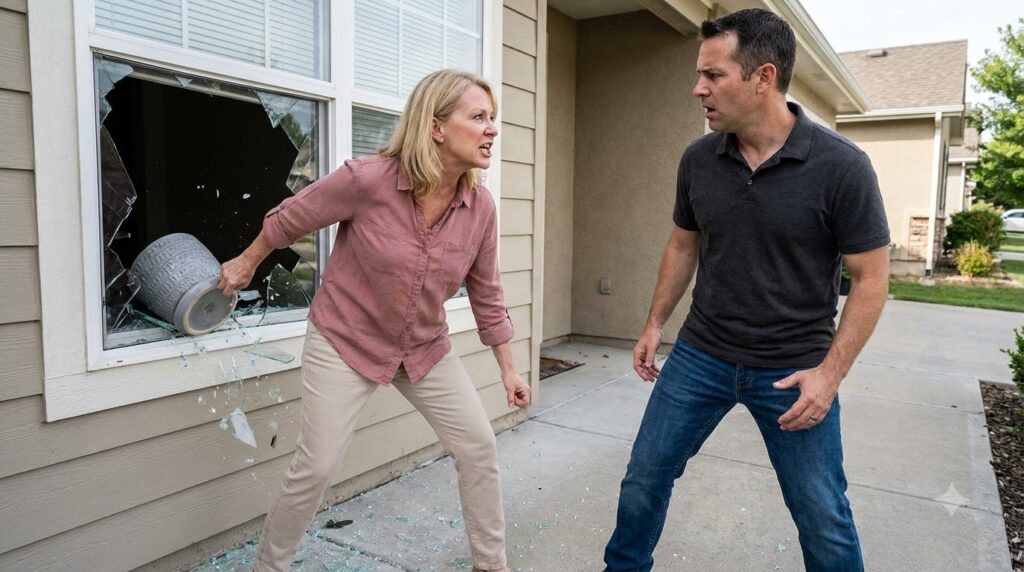
She turned without waiting for his response, her rubber-soled shoes squeaking against the porch steps as she descended to the walkway. She didn’t walk toward the street. She walked directly along the northern edge of his house, her eyes fixed on the gray ceramic planter sitting beside his side window.
Mark stepped onto the porch, watching her back. He reached into his pocket, his fingers wrapping around the cool, heavy metal of his phone. He unlocked the screen silently.
Near the corner of his house, half-hidden beneath the drooping leaves of a hosta plant near the property line, sat a square piece of rusted iron—a secondary boundary marker half-sunk into the dirt, its brass cap missing, its surface flaking away in reddish-brown scales. Evelyn stopped beside it, her shoe coming down squarely on top of the rusted iron, grinding it deeper into the dry earth.
She looked back over her shoulder at him, the brittle paper still clutching tightly in her hand, her expression completely bare.
“Five o’clock, Mark,” she said.