
The Line We Draw in the Gray Concrete of Home

CHAPTER 1: THE DUST ON THE CURB

The paper didn’t flutter; it had been folded thrice and wedged tightly between the rubber seal of the mailbox and the cold galvanized steel.

Mark Vance didn’t unfold it immediately. He stood at the edge of his driveway, feeling the midday sun baking the asphalt beneath his boots, smelling the dry, metallic tang of suburban dust mixed with cut grass. He knew the typescript before he even smoothed the creases against his thigh. Crisp, eleven-point Arial. No header. No signature. Just the cold, self-important cadence of someone who believed the earth beneath another man’s house belonged to whoever complained loudest about it.

FINAL NOTICE REGARDING EASEMENT ENCROACHMENT AND UNAPPROVED LANDSCAPING STRUCTURES.

A shadow fell across the sun-warmed concrete before he heard the footsteps.

“You didn’t answer the door on Tuesday, Mark.”

Evelyn Higgins stood planted on the curb line where his driveway met the street. She wore a dusty-pink button shirt, stiff beige slacks, and held a yellow plastic clipboard tucked like a shield against her ribs. Her blonde bob was unmoving in the light breeze, her face set in the hard, dry lines of a woman who spent her afternoons measuring other people’s property with her eyes.

Mark turned the paper over in his hands. The charcoal polo he wore absorbed the heat of the noon sun. He kept his shoulders loose, his feet spaced evenly apart on the brushed concrete. “I was at work, Evelyn.”

“Work doesn’t pause community maintenance,” she said. Her voice had the dry, rasping quality of fine sandpaper on wood. She took half a step forward, her shoe crossing the expansion joint that separated the public street asphalt from his private concrete apron. “That planter tub near your side walkway sits six inches over the easement boundary. It obstructs drainage.”

“It sits three feet inside my survey line,” Mark said calmly. His voice didn’t rise; it stayed low, grounded in the quiet weight of the man who cleared his own gutters and paid his own mortgage. “The county survey stakes are still under the soil at the corner.”

“Surveys from ten years ago are outdated guidelines,” she snapped, her knuckles whitening around the edge of the clipboard. “The neighborhood association recognizes the functional access path. You’re blocking a shared drainage corridor, Mark. If you don’t move the ceramic tub by five o’clock, I will ensure the county code officer inspects it.”

She stepped back onto the asphalt, her eyes darting toward the eave of his roof, then back to his face, searching for the crack in his composure. She wanted a shout. She wanted a threat.

Mark simply folded the paper back into three equal parts and slipped it into his back pocket. He didn’t answer. He turned his back to her and walked up the incline of his driveway toward the quiet shade of his garage, his boots making a steady, measured crunch against the stray gravel. Behind him, the faint click of a pen top snapping open signaled that she was still standing on the asphalt, writing down the time.

Inside the cool, concrete-scented dark of his garage, Mark reached up to the wall unit beside the door. He tapped the small digital screen mounted to the drywall. The feed flickered to life—a wide-angle, crisp 1080p view from the eave camera overlooking the side walkway, capturing the exact spot where Evelyn stood, the yellow clipboard in her hand, and the heavy gray ceramic planter sitting squarely on his private concrete.

He didn’t erase the footage. He saved the clip to a local hard drive, locked the file, and watched the small blue LED pulse silently in the dark.


CHAPTER 2: THE DEED AND THE IRON

The steel tape measure snapped back into its ABS housing with a sharp, metallic clack that echoed in the quiet kitchen.

Mark didn’t look up from the kitchen table. Spread across the worn butcher-block surface were three distinct layers of paper: the original county plat map printed on blue-lined heavy stock from twelve years ago, the title insurance policy from his closing binder, and a faded yellow legal pad containing his handwritten measurements from the corner monuments.

He rubbed the pad of his thumb against the brass casing of his pocket knife. Outside, the afternoon wind whipped the branches of the neighbor’s silver maple, casting frantic, fractured shadows across the property boundary lines drawn in India ink on the plat.

His fingers followed the surveyor’s notes. N 89° 14′ 22″ E, 114.50 feet to a set 5/8-inch iron pin with yellow plastic cap.

He knew where the pin was. He had spent forty minutes on his hands and knees two summers ago with a hand trowel, scraping away three inches of compacted clay and thick crabgrass near the sidewalk until the spade struck solid metal. It sat three feet north of the concrete walkway that serviced his side door. Not on the line. Not near the line. Well within his deeded parcel.

A heavy, deliberate thud sounded against the front storm door, followed by the rattle of the aluminum handle. Not a knock. An assertion.

Mark closed the closing binder, leaving the plat map open on the table. He stood up, his knee joints making a faint popping sound in the silent house. He walked down the hallway, the hardwood floors smooth beneath his socks, and opened the inner wooden door.

Evelyn didn’t wait for him to speak. She stood behind the glass of the storm door, her silhouette framed by the harsh glare of the late afternoon sun. She wasn’t holding the yellow clipboard this time. In her right hand, she held a single sheet of paper—aged, brittle at the margins, and discolored to the pale tan of dried corn husks.

“You think you’re clever because you ignore the doorbell, Mark,” she said through the screen. Her tone was flat, devoid of the performative anger she used on the driveway curb. This was the quiet, cold confidence of someone who believed they had unearthed a weapon. “I went through the neighborhood association archives from two thousand and four.”

Mark unlatched the storm door and pushed it open three inches, holding the frame with his forearm. The smell of hot asphalt and dry cedar mulch drifted inside. “There is no neighborhood association archive, Evelyn. There’s a box of old receipts in your garage.”

“It’s a written covenant,” she said, thrusting the paper toward the narrow gap. Her fingers were short, her nails cut straight across and unpolished, her knuckles white with tension. “Signed by Arthur Vance—your uncle—when he owned this parcel. He granted parcel 4B perpetual shared landscaping and access rights across the northern five feet of this lot.”

Mark didn’t reach for the paper. He looked at the signature block visible at the bottom. The ink was faded blue ballpoint, the script loose and slanting left. It looked like his uncle’s handwriting, or a fair approximation of it written forty years ago when the entire street was still an unpaved county road.

“Arthur sold this house in two thousand and eight,” Mark said slowly. His voice stayed low, measured, carrying the weight of the iron pin buried in the dirt outside. “Any informal access notes between neighbors were extinguished when the lot was formally surveyed and platted with the county clerk.”

“An agreement is an agreement,” Evelyn said, her voice dropping an octave into a harsh, rasping whisper. She stepped closer, her hip pressing against the aluminum doorframe, her eyes locked on his. “You don’t get to come in here with your new job, your charcoal shirts, and your camera lenses, and rewrite how this boundary functions. That walkway was laid for both houses.”

“The walkway belongs to this deed,” Mark said. He didn’t push the door wider, nor did he back away. He held her gaze until her eyelids flickered once, her gaze dropping to the dark polo shirt covering his chest. “If you step onto the concrete again to leave notices or measure the fence, I’m filing a formal trespass notice with the sheriff’s office.”

A thin, bitter smile touched the corner of her mouth. It didn’t reach her eyes. “You try that, Mark. You just try telling Deputy Miller that twenty years of established access doesn’t count because you have a piece of paper from a title company.”

She turned without waiting for his response, her rubber-soled shoes squeaking against the porch steps as she descended to the walkway. She didn’t walk toward the street. She walked directly along the northern edge of his house, her eyes fixed on the gray ceramic planter sitting beside his side window.

Mark stepped onto the porch, watching her back. He reached into his pocket, his fingers wrapping around the cool, heavy metal of his phone. He unlocked the screen silently.

Near the corner of his house, half-hidden beneath the drooping leaves of a hosta plant near the property line, sat a square piece of rusted iron—a secondary boundary marker half-sunk into the dirt, its brass cap missing, its surface flaking away in reddish-brown scales. Evelyn stopped beside it, her shoe coming down squarely on top of the rusted iron, grinding it deeper into the dry earth.

She looked back over her shoulder at him, the brittle paper still clutching tightly in her hand, her expression completely bare.

“Five o’clock, Mark,” she said.

CHAPTER 3: THE WEIGHT OF THE ASPHALT

The air at four o’clock smelled of unburned diesel and overheated brake lining.

Mark stepped out onto his front porch just as the air brakes of a heavy, two-axle flatbed delivery truck purged with a sharp, high-pressure hissed blast that echoed off the front gables of the surrounding houses. The truck, loaded with three pallets of dense, gray concrete pavers Mark had ordered for his rear patio project, sat idling in the center of the narrow asphalt street, its engine vibrating the air with a deep, rhythmic thrum.

Evelyn Higgins stood directly in front of the truck’s front bumper.

She didn’t stand on the sidewalk. She didn’t stand on the grass. She was planted squarely in the roadway, her feet spread shoulder-width apart on the painted center seam, her yellow clipboard raised in her right hand like a flagger stopping traffic at a quarry pit.

The driver, a young man in a dust-streaked hi-vis vest, leaned his elbow out the cab window. His face was flushed red under the bill of a faded mesh cap. “Ma’am, I have a delivery address for four-twelve. I need to back into the driveway apron.”

“This street is weight-restricted to light residential passenger vehicles,” Evelyn shouted up at the cab. Her voice cut through the diesel rumble, sharp and shrill, carrying down the entire block. Neighbors three doors down—a man holding a garden hose and a woman stepping out onto her porch—paused, their eyes drawn to the standoff. “Your axle rating exceeds four tons. You’re cracking the county curb line!”

Mark walked down his front walkway, his boots making a crisp, deliberate cadence against the concrete. The sun was dropping lower toward the tree line, casting long, stark shadows across the street—shadows that stretched like black iron bars across the asphalt.

“He’s delivering to private property, Evelyn,” Mark said, stopping at the edge of his driveway curb. He didn’t cross into the street. He stayed on his deeded apron, his charcoal polo catching the warm, low light.

Evelyn turned her head toward him, her jaw tight, the muscles in her neck pulled taut like cords. “He is operating a commercial vessel on a private easement access road, Mark! Look at his rear tires. They’re sitting directly over the storm runoff channel!”

“The road is county-maintained,” Mark said. His tone remained measured, flat, carrying the cold weight of a man who knew every ordinance number by heart. “The county weight restriction applies to commercial through-traffic over ten tons. A residential material delivery is fully permitted under Section Four-B.”

The driver looked between the two of them, his hands gripping the large black steering wheel. “Look, buddy, I just drop the pallets where the ticket says. If this lady won’t move, I’m logging a blocked access fee and taking the load back to the yard.”

“She’s going to move,” Mark said. He didn’t look at the driver. His eyes stayed locked on Evelyn’s face.

Evelyn stepped closer to the driver’s door, pointing her yellow clipboard up toward the side mirror. “I am recording this vehicle’s license plate and DOT number! The neighborhood association will be issuing a fine directly to your dispatch office for property damage!”

“There is no association, Evelyn,” Mark said, his voice dropping slightly lower, cutting under the idle of the diesel engine like a cold blade. “You know it. I know it. And the county clerk knows it.”

A subtle shift passed over her face—a quick, involuntary twitch of her lower eyelid. She didn’t lower the clipboard, but her stance narrowed by an inch. She took a half-step back toward the curb line, her eyes scanning the porches down the block where two more neighbors had gathered, watching the scene in silent, uneasy curiosity.

“You’re a rogue homeowner, Mark,” she said, her voice dropping from a shout to a tight, venomous whisper intended only for him. “You come in here with your surveys and your arrogant quiet, thinking you can tear up how this street operates. People like you destroy neighborhoods.”

“The truck is backing in now, Evelyn,” Mark said simply. He raised his hand toward the driver, signaling him to cut his wheel toward the driveway entrance.

The driver didn’t hesitate. He pulled the air brake knob with a loud clack-thud, shifted the transmission into reverse with a heavy metallic clunk, and began easing the multi-ton rig backward. The massive rear tires crushed the loose gravel along the gutter, sending small stones skittering across the pavement.

Evelyn was forced to step onto the grass verge near Mark’s property line to avoid the swinging front end of the flatbed. As the truck cleared the street and its back tires rolled onto Mark’s driveway, she stood mere inches from his shoulder, her chest rising and falling in rapid, shallow breaths.

Beside her shoe, resting half-hidden in the dense green needles of a dwarf juniper bush near the property line, sat an old, rusted metal sign post. The sign itself was long gone, but the sheared iron stub protruded four inches out of the dry dirt—a sharp, jagged remnant of a long-forgotten county marker that someone had tried to grind away years ago.

Evelyn stared at the truck’s heavy steel bed as it came to a halt on Mark’s driveway. Then her eyes darted down to the rusted iron stub near her foot, her fingers gripping the edge of her clipboard so tightly the plastic creaked.

“You think you’ve won something here today,” she said quietly, her eyes lifting to meet his with an unyielding, icy glare. “You have no idea what this ground cost.”

She turned and walked away down the sidewalk, her footsteps fast and clipped against the concrete, leaving Mark standing beside the idling diesel engine as the driver climbed down from the cab to unstrap the heavy pallets.

CHAPTER 4: THE THRESHOLD AND THE SHEETS

The late afternoon heat radiated off the tan vinyl siding of the house, thick and dry, holding the smell of baked pine needles and warm dust.

Mark was on his knees near the side foundation, a pair of heavy, stiff canvas work gloves pulling weeds from the narrow strip between the house wall and the brushed gray concrete walkway. The gravel beneath his knuckles was rough, grinding into his jeans. He didn’t hear her approach over the steady hum of a neighbor’s air conditioner down the alley, but he felt the shift in the light—a sudden shadow falling across his hands, blocking the low amber glare of the sun.

He stopped his trowel mid-scrape.

Evelyn Higgins stood planted squarely on his side walkway. Her rubber-soled shoes sat three inches past the seam where his driveway met the path—her dusty-pink button shirt bright against the muted siding, her beige slacks stiff at the knees. The yellow plastic clipboard was tucked tight under her left arm, and protruding from its top pocket was a faded blue plastic sleeve holding a piece of graph paper covered in red ballpoint grid lines.

“You’re working close to the foundation, Mark,” she said. Her voice didn’t carry the high, piercing pitch she had used in the street. It was low, raspy, and tightly controlled, like a dry leaf scraping across stone. “The setback ordinance requires a three-foot clearance for any subterranean grading.”

Mark didn’t stand up immediately. He wiped the dirt from his trowel against his gloved thigh, feeling the coarse weave of the canvas through the fabric. He looked up slowly, taking in her posture—the rigid line of her shoulders, the tense, lined corners of her mouth, the deliberate way her left foot pinned a small tuft of crabgrass right at the edge of his concrete path.

“I’m clearing clover, Evelyn,” Mark said. He stood up in one fluid movement, his boots planting firmly on the walkway two feet from her. He towered over her, his charcoal polo stretching across his chest, but he kept his hands down at his sides, the trowel held pointed toward the ground. “You’re standing on my deeded property.”

“This path is an established access route,” she insisted, her right hand reaching up to adjust the yellow clipboard, tapping the blue plastic sleeve inside her pocket. “It’s been an open corridor since nineteen ninety-eight. Your uncle Arthur gave written consent for this drainage strip to remain unblocked and accessible for maintenance of the common lot line.”

“Arthur sold this property sixteen years ago,” Mark replied smoothly, his tone flat, unyielding, carrying the weight of a man who had memorized every clause in his closing binder. “When the lot went through the formal county land division in two thousand eighteen, every informal access note was scrubbed from the title. The deed in my safe lists zero encumbrances, zero easements, and zero shared access points.”

Evelyn’s jaw twitched. Her fingers tightened around the edge of the clipboard until the yellow plastic groaned under the force. “A county clerk signing a rubber-stamp survey doesn’t erase twenty years of neighborly agreement, Mark. This street functions because people respect established boundaries, not because they hide behind legal technicalities.”

“You aren’t respecting a boundary, Evelyn. You’re trespassing on one.” Mark took half a step forward, closing the distance between them until his boots were inches from her shoes. He didn’t raise his hands, but his posture shifted—hard, square, unmoving as the foundation wall beside them. “Look down at your feet.”

She didn’t look down. Her eyes remained locked on his face, her pupils small, sharp pins in the bright sunlight. “I have a right to inspect the drainage path. If your work alters the runoff line toward parcel 4B, the association board will file a lien against your title.”

“There is no association board,” Mark said quietly. “There is no lien. And if you don’t step back onto the public sidewalk in three seconds, I’m going inside to pull the eave camera footage and hand it directly to the sheriff’s department.”

Evelyn’s breath hitched slightly in her chest. Her eyes flicked upward toward the dark, glass dome of the camera mounted beneath the roof eave ten feet above them. The small red status light inside the housing pulsed silently, capturing her dusty-pink shirt, her yellow clipboard, and her shoes planted firmly on his private concrete.

She didn’t back down with a speech. She didn’t offer a defense. Instead, her mouth set into a thin, pale line—a mask of cold, furious entitlement.

“You think a camera makes you safe in this town, Mark,” she whispered, her voice dropping into a harsh, vibrating hiss that barely carried past the siding. “You think you can come here, put up your sensors, and wipe away twenty years of history with a piece of paper.”

She stepped back one pace, her shoe clearing the concrete seam and landing back on the dry dirt of the lot line, her hand clutching the yellow clipboard so tightly that the paper sleeve inside creaked against the plastic.

Mark didn’t answer. He stayed planted on the walkway, watching her step backward down the path, his trowel heavy and cold in his gloved hand as the shadow of his house stretched long and dark across the concrete behind her.

CHAPTER 5: THE SHATTERED GLASS PLANE

The ceramic planter didn’t scraped across the concrete; it left the earth in a violent, arching heave that tore the roots of the small hosta plant straight out of the dry dirt.

Mark didn’t have time to process the movement. One second he was standing squarely on his brushed concrete walkway, his boots rooted two feet from the foundation wall, and the next, Evelyn Higgins had stepped directly into his personal space. Her face was flushed dark red beneath her blonde bob, her dusty-pink button shirt strained at the shoulders, her lined face twisted into a mask of raw, explosive entitlement.

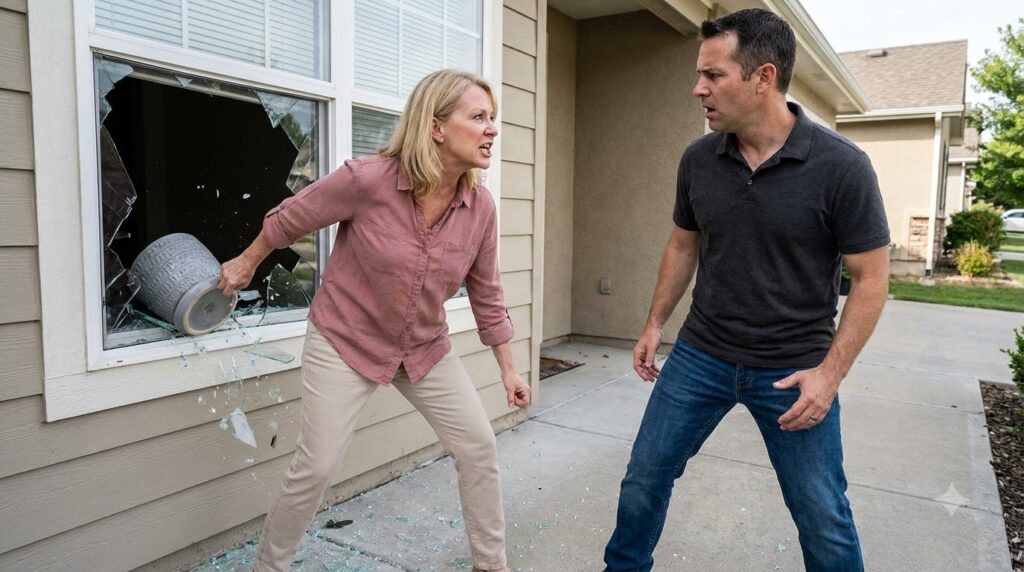
She grabbed the rim of the heavy gray ceramic planter sitting beside his side walkway—a massive, thirty-pound vessel filled with wet soil.

With a guttural, strained gasp, she hoisted the planter off the ground, pivoted on her beige-slacked heel, and hurled the entire ceramic weight directly at the wall-mounted house window three feet away.

The impact was immediate and deafening.

CRASH.

The double-pane glass plane exploded inward with a sharp, concussive report that echoed down the narrow residential alley like a gunshot. Shards of thick, tempered glass erupted outward, showering the brushed gray concrete walkway in a glittering spray of razor-sharp diamond fragments. The heavy gray ceramic planter shattered upon impact with the sill, its heavy base splitting with a sickening crunch as wet black dirt, clay fragments, and broken pottery exploded across the walkway, dusting Mark’s work boots in raw silt.

Mark recoiled one sharp, reflexive step backward. The heel of his boot crunched into a thick triangular piece of shattered glass. His forearm flew up to shield his eyes as falling debris settled onto the concrete, his pulse pounding a frantic, heavy rhythm against his ribs.

Through the cloud of dust and rising glass glitter, Evelyn didn’t step back. She didn’t look horrified. She didn’t reach for her mouth.

Instead, she aggressively closed the gap between them, stepping over the shattered pottery and freshly broken glass on his walkway until her shoe was inches from his. She thrust a trembling, soil-stained finger directly into Mark’s face, her chest heaving, her voice shrieking at a pitch that shattered the afternoon quiet.

“I told you to stay off my property, now look what you caused!”

Mark stood frozen for a single, suspended beat, his eyes wide as he looked from her shaking, pointed finger down to the gaping, jagged hole in his side wall. Cold air from the air-conditioned interior of his home poured through the ruined window, mixing with the hot, dust-laden summer air outside. The heavy ceramic planter lay in four large, jagged pieces on his concrete, its soil spilling across his deeded land.

And protruding from the torn soil inside the broken planter base was the corner of the faded blue plastic sleeve she had tucked into her clipboard pocket earlier—a sleeve now ripped open by the impact, exposing the brittle, twenty-year-old agreement note Arthur Vance had once signed.

Mark’s shock burned away in an instant, replaced by a cold, searing, diamond-hard rage that settled deep into his chest. He didn’t lift his fists. He didn’t step toward her. He stood his ground on his concrete path, his squared shoulders unyielding, his voice cutting through her screeches with the razor-sharp clarity of a cold steel blade.

“You just broke my window!”

Evelyn didn’t flinch. Her eyes were wild, unblinking, fixed on his face as she gripped her yellow clipboard with her left hand, using her right to point at the shattered frame behind him.

“You provoked this!” she screamed, her voice carrying across the lawns toward the street, where three neighbors had already stopped mid-stride on the sidewalk, their heads snapping toward the noise. “You blocked the easement! You threatened me on shared ground! You brought this destruction onto your own house!”

Mark slowly lowered his arm from his face. His fingers brushed the cool, hard casing of his smartphone in his pocket. He didn’t take his eyes off her tense, lined face. He didn’t look at the gathered neighbors, nor did he glance at the ruined glass crunching under his boots.

He slowly raised his left hand and pointed straight up—past her blonde hair, past her dusty-pink shirt, directly at the dark, glass dome of the eave camera mounted ten feet above their heads. The small red status LED was flashing rapidly, recording every shard of glass, every line of her face, every inch of her shoes planted squarely on his private walkway, and the torn paper resting in the shattered dirt at her feet.

“Keep talking, Evelyn,” Mark said, his voice dropping into a low, terrifyingly calm whisper. “The microphone catches every word.”

Evelyn’s breath hitched. Her finger wavered in the air. For the first time, her eyes flicked upward toward the camera lens, her mouth freezing open in a silent, rigid trap as the weight of what she had just done settled into the hot, sun-baked air between them.

CHAPTER 6: THE SIGNAL AND THE SIEGE

The silent LED on the eave camera pulsed three times in quick succession, its dark glass lens reflecting the glare of the afternoon sun like a hooded eye.

Mark didn’t pull his eyes away from Evelyn. The soles of his boots shifted an inch, the glass fragments beneath his heavy leather crunching with the sharp, brittle sound of breaking ice. The air between them was thick with the smell of wet potting soil, pulverized ceramic clay, and the sharp, metallic tang of cold air leaking through the jagged hole in his house wall.

Evelyn’s chest rose and fell in rapid, shallow hitches. Her hands trembled against the yellow plastic clipboard, her knuckles bone-white. The pale, brittle sheet of paper she had pulled from the broken planter lay half-buried in the spilled dirt between them, its edges dark with moisture.

“Call them,” she rasped. Her voice had lost its shrill shriek, dropping into a tight, vibrating threat that barely carried past the shattered window frame. “Call the sheriff, Mark. Tell them you cornered a woman on an established access corridor. Tell them you backed me against your foundation until I had to defend myself.”

Mark pulled his smartphone from his charcoal polo pocket. The cold tempered glass of the screen lit up under his thumb. He didn’t dial three digits instantly; he opened the local dispatch application, his thumb moving with deliberate, unhurried precision.

“You aren’t cornered, Evelyn,” Mark said. His tone was level, stripped of all heat, locked into the cold, pragmatic register of a man executing an operational protocol. “You’re standing three feet inside my deeded boundary line. The camera has six minutes of continuous wide-angle video showing you walking onto the concrete, lifting my planter, and hurling it through my window.”

“A video doesn’t show intent!” She took a sudden, aggressive step forward, her shoe grinding a heavy piece of ceramic into the brushed walkway, her face thrusting into his space. “It shows a hostile property owner creating a dangerous nuisance! You changed the grade! You set that planter to trap me!”

Mark tapped the screen twice. He placed the phone to his ear, his eyes never leaving hers.

“County Emergency Dispatch,” a dry, filtered voice crackled through the speaker. “Operator Forty-Two.”

“This is Mark Vance at four-twelve Elmridge Drive,” Mark said clearly, his voice carrying down the alley where two more neighbors had stepped out onto their lawn edge. “I am reporting an active residential trespass and physical property destruction in progress. My neighbor, Evelyn Higgins, has crossed my lot boundary and smashed my exterior house window with a thirty-pound ceramic vessel.”

Evelyn lunged forward—not at his throat, but at his right hand, her yellow clipboard swinging toward the phone like a spade.

Mark didn’t flinch. He absorbed the impact on his left forearm, his athletic frame absorbing the blow without giving an inch of ground. The hard plastic edge of the clipboard struck his wrist, leaving a red, stinging welt across his skin, but the phone remained firmly planted against his ear.

“She has just made physical contact with my arm on camera,” Mark added without raising his voice by a single decibel. “Please dispatch a unit immediately.”

“Unit is en route, sir. Stay clear of the individual and remain on the line,” the operator replied.

Evelyn backed up two steps, her boots skittering over the scattered glass. Her face had turned a pale, sallow shade under her blonde bob. She looked down at the yellow clipboard in her hand, then at the red-stamped paper sticking out from the clipboard’s rear panel—a official document from the county land office bearing a dark blue seal. Her hands shook as she shoved the paper deeper into the pocket, her eyes darting toward the street where a dark blue county patrol car was turning the corner, its roof lights flashing silently against the windshields of parked cars.

“You think this ends with a deputy, Mark?” Evelyn whispered, her voice laced with a bitter, desperate rage that made her lined face look suddenly old. She backed up down the walkway, her shoes clearing the concrete boundary seam and hitting the grass edge. “You think you can just clear the glass and go back to your quiet life?”

Mark lowered the phone, his thumb tapping the screen to end the call. He didn’t follow her to the lot line. He stood beside the gaping, jagged hole in his home, the cold air rushing past his ankle, his eyes fixed on the blue patrol car pulling up to his curb.

“The frame is broken, Evelyn,” Mark said, his voice flat as the concrete beneath his feet. “And so is your claim.”

CHAPTER 7: THE BADGE ON THE CURB

The patrol car door shut with a heavy, double-latch thunk that cut through the low hum of the neighborhood.

Deputy Miller didn’t hurry. He walked up the driveway apron with the measured, rolling stride of a county officer who spent eight hours a day stepping between angry people on hot asphalt. His dark navy uniform shirt was crisp, stiffened by starch, the brass buttons glinting under the harsh glare of his cruiser’s roof lights. A heavy leather duty belt creaked against his hips with every step, the black metal casing of his radio emitting a faint, intermittent crackle of static.

Evelyn didn’t wait for him to reach the walkway. She met him three paces out from the curb, her beige slacks stepping over the grass verge, her yellow clipboard raised in both hands as if offering a formal report.

“Deputy,” she began, her voice carrying a breathless, calculated tremor—a sudden, manufactured frailty that contrasted sharply with the screeching rage of three minutes ago. “Thank God you were in the sector. I was conducting a routine inspection of the easement line when Mr. Vance became physically aggressive.”

Miller stopped at the junction of the lawn and the concrete path. His eyes—pale gray, shaded by the brim of his campaign hat—didn’t lock onto her face. They swept past her shoulder, scanning the ground: the spilled black dirt, the shattered gray clay fragments, and the glittering field of broken window glass spread across Mark’s walkway.

“Ma’am, step back to the curb line, please,” Miller said. His voice was flat, low, trained to strip emotion out of a driveway argument.

“He cornered me against the foundation wall,” Evelyn pressed on, her fingers tightening around the clipboard until the yellow plastic bowed. She gestured toward Mark, who remained planted five feet away beside the jagged hole in his side wall. “He blocked my exit path along the shared corridor. I felt threatened, Deputy. I reached out to create space and the ceramic planter slipped.”

“Slipped,” Mark repeated quietly. He didn’t raise his voice. He stood with his arms relaxed at his sides, his boots planted squarely on his deeded concrete, his charcoal polo dark against the pale siding.

Miller turned his head toward Mark, his hand resting casually on his leather belt line, right beside a stiff carbon-copy field notepad secured by a silver clip. “Mr. Vance. Are you the homeowner?”

“I am,” Mark said. “Four-twelve Elmridge. The woman standing on my lawn is Evelyn Higgins from four-fourteen. She crossed my lot line, demanded I remove my property, grabbed a thirty-pound planter, and threw it through my double-pane side window.”

“That is a complete fabrication!” Evelyn snapped, her voice spiking into the high, raspy register. She turned to Miller, her face flushed red. “He altered the grade of the access path! He has been systematically encroaching on parcel Four-B’s drainage rights for six months! I brought the original nineteen ninety-eight covenant to show him—”

“Ma’am,” Miller interrupted, his hand lifting two inches from his belt—a single, unyielding boundary gesture. “I asked you to step back to the curb.”

“I am a member of the street oversight committee—”

“There is no street oversight committee recognized by the county, ma’am,” Miller said, his tone dropping half an octave into absolute, routine authority. “Step to the cruiser.”

Evelyn froze. Her mouth stayed open, her blonde bob stiff in the afternoon breeze. She looked from Miller’s unblinking gray eyes down to his shiny leather boots, then back to Mark, who stood unmoving beside the ruined window.

Two neighbors—a man in a faded gray sweatshirt and a woman holding a phone at her chest—had walked down their driveway, stopping at the property line to watch. The silence on the street was total, broken only by the low, rhythmic idle of the patrol car at the curb.

Evelyn took two slow, rigid steps backward onto the grass verge, her rubber-soled shoes digging into the lawn. She held her clipboard against her chest like armor, but her shoulders had slumped an inch, the tight, furious posture beginning to fracture under the cold weight of the deputy’s presence.

“Mr. Vance,” Miller said, turning fully toward Mark and stepping over the property line onto the concrete path. His boots made a sharp, crushing sound as they made contact with a stray shard of window glass. “Do you have video surveillance covering this walkway?”

Mark didn’t answer with words. He reached into his pocket, pulled out his phone, and unlocked the screen. He pointed his thumb straight up toward the black glass dome mounted beneath his roof eave.

“Six minutes of full ten-eighty-p HD footage, Deputy,” Mark said, his voice as steady as the foundation wall beside him. “Recorded live to local storage and mirrored on this screen.”

Miller stepped closer, his heavy uniform shadow falling over the spilled black dirt as he leaned in to look at the glass screen held in Mark’s hand.

CHAPTER 8: THE DIGITAL RECORD AND THE MAP

The high-definition video played back on the phone’s glowing glass screen with unyielding, merciless clarity.

Deputy Miller held the smartphone in his thick, gloved hand, the blue ambient light from his cruiser’s roof rack washing over his broad face every three seconds. He didn’t scrub forward. He watched the full three-minute sequence in complete, heavy silence: the wide-angle camera capturing Evelyn stepping squarely over the concrete boundary seam, her yellow clipboard gripped in her left hand, her face twisting as she reached down to hoist the thirty-pound ceramic planter. He watched her pivot, her body hurling the heavy planter straight through the double-pane glass wall, followed instantly by her lunging into Mark’s space with her finger pointed directly at his chest.

Mark reached down to his phone screen, swiped right, and brought up the second open document—a certified digital copy of the county GIS land record.

Red vector boundary lines framed the property lot down to the fraction of an inch. A prominent, highlighted text box on the margin read: COUNTY SURVEY DIVISION: ALL PRIOR INFORMAL EASEMENTS, NOTES, AND UNRECORDED COVENANTS NULLIFIED AND EXTINCTION CONFIRMED VIA SECTION 12 FORMAL PLAT RE-RECORDING.

Miller’s thumb traced the digital plat line. He looked down at the exact physical spot where he stood on the concrete walkway, then up at the yellow plastic clipboard Evelyn held pinned against her dusty-pink shirt.

“Ma’am,” Miller said, his voice dropping into a low, metallic baritone that carried straight to the curb where four neighbors now stood watching. “You told me you were standing on shared access ground when an altercation occurred.”

Evelyn didn’t move. Her posture had gone rigid as stone, her face pale and sunken under the flashing blue lights. She gripped the yellow clipboard so tightly that the plastic back frame flexed. “Deputy… there is an agreement from nineteen ninety-eight—”

“The agreement was legally extinguished eight years ago,” Miller interrupted cleanly, his tone flat, bureaucratic, and utterly final. He pointed a finger toward the torn, wet piece of paper sticking out from the broken soil on Mark’s path. “And according to the county registry seal on the plat map you pulled from the clerk’s office last week, you were formally notified of that nullification when you filed your tax assessment protest.”

The air on the walkway went completely dead.

Mark didn’t utter a word. He stood beside the gaping, shattered window frame, his charcoal polo dark, his eyes fixed on Evelyn’s face. The full, cold reality of what she had done hung in the summer air like thick smoke: she hadn’t just made a mistake about a property line. She had known the ancient paper in her hand was legally void, yet she had used it to harass, trespass, and destroy private property anyway.

“You knew,” Mark said softly, his voice cutting through the quiet like a cold chisel on iron. “You knew the paper meant nothing, and you threw the planter anyway.”

Evelyn’s lower lip trembled once—a tiny, involuntary break in her manufactured authority. Her eyes flicked toward the gathered neighbors on the sidewalk, who were staring at her in stunned, silent disgust. The man in the gray sweatshirt shook his head slowly, turning his back to her and walking back up his driveway.

“Deputy Miller,” Mark said, his voice calm, steady, and unyielding as the concrete beneath his boots. “Check the camera on the eave, Officer. She threw it while standing three feet onto my deeded land.”

Miller nodded once. He reached to his belt, unclipped a heavy, carbon-copy citation book, and pulled a heavy black pen from his chest pocket. The metallic click of the pen mechanism sounded like a hammer dropping into place.

“Ms. Higgins,” Miller said, turning his back to Mark and stepping squarely over the property boundary toward her. “Keep your hands where I can see them and step to the front bumper of my patrol car. You are being cited for criminal property destruction and intentional trespass.”

CHAPTER 9: THE CITATION AND THE QUIET BOUNDARY

The yellow carbon-copy page tore from Deputy Miller’s citation book with a sharp, fibrous rip that sounded like dry canvas splitting in two.

Miller didn’t raise his voice as he pressed the heavy paper against the roof of his cruiser, signing his name along the bottom line with a thick black ballpoint pen. He folded the summons once and held it out across the hood toward Evelyn Higgins.

Evelyn stood beside the front bumper, her shoulder pressed against the warm, white-painted steel. The yellow plastic clipboard she had brandished like an emblem of authority was lowered now, held loosely in one hand at her side, its edge resting against her beige slacks. Her face was gray, drained of color under the dying golden light of the late afternoon sun, her blonde bob disheveled from the wind.

“This is a formal criminal citation for Class B misdemeanor property destruction and criminal trespass,” Miller said, his tone devoid of heat or personal bias. “You are required to appear at the County District Courthouse on the fourteenth of next month at nine in the morning. If you step back onto Mr. Vance’s private walkway or contact him in any capacity prior to that date, you will be taken directly into custody for harassment.”

Evelyn’s hand shook as her fingers closed around the folded yellow paper. She didn’t look at the deputy. She didn’t look at the gathered neighbors across the asphalt who watched her in unyielding, silent judgment. Her eyes remained fixed on the ground—on the narrow, dark line where the asphalt road ended and the clean, brushed concrete of Mark’s driveway apron began.

“You have ten seconds to return to your residence, Ms. Higgins,” Miller added quietly. “Do not speak to Mr. Vance.”

Evelyn turned slowly. Her rubber-soled shoes made a heavy, dragging sound as she crossed the street line and walked up the incline of her own driveway. Her back was hunched, the stiff posture that had dominated the neighborhood for two decades utterly shattered. She didn’t look back as she reached her front porch, opened her door, and slipped inside, the latch clicking shut with a hollow, distant sound.

Deputy Miller turned back toward Mark, who remained planted on his walkway beside the shattered window frame. Miller pulled a official incident report card from his pocket, scribbled an eight-digit case number across the front, and handed it to Mark.

“Insurance company will need that number for the glass replacement, Mr. Vance,” Miller said, eyeing the shattered double-pane window and the spilled soil on the path. “If she steps one foot past that survey stake again, don’t argue with her. Call dispatch directly. The file is flagged now.”

“Thank you, Deputy,” Mark said, his voice low, steady, and grounded.

Miller gave a single nod, climbed back into his cruiser, and backed out into the street. The flashing blue lights shut off, leaving the residential avenue bathed in the quiet, fading amber glow of dusk.

Mark stood alone on his walkway. He looked down at his feet—at the crushed glass fragments glinting like tiny stars in the concrete seams, at the dark mound of potting dirt, and at the broken gray ceramic pieces that lay scattered across his deeded land.

He reached into his pocket and pulled out his phone. He opened the security camera application one last time. On the screen, the live 1080p feed from his eave camera showed the walkway completely clear: no yellow clipboard, no shouting, no false claims of access. Just the clean, unyielding border of his home, stretching straight and true to the iron pin buried beneath the dirt at the corner.

Mark looked out toward the street. The neighbors had dispersed, returning to their quiet homes. The neighborhood was silent, save for the evening breeze rustling the leaves of the oak tree near his driveway.

He tucked his phone into his charcoal polo pocket, stepped over the broken glass, and walked down his path to retrieve a broom and a dustpan from the garage.

“You don’t own this street, Evelyn,” Mark said softly to the cool evening air, his voice carrying the calm, absolute weight of an unbroken boundary. “And you certainly don’t own my house.”

Similar Posts

Leave a Reply

Your email address will not be published. Required fields are marked *






