
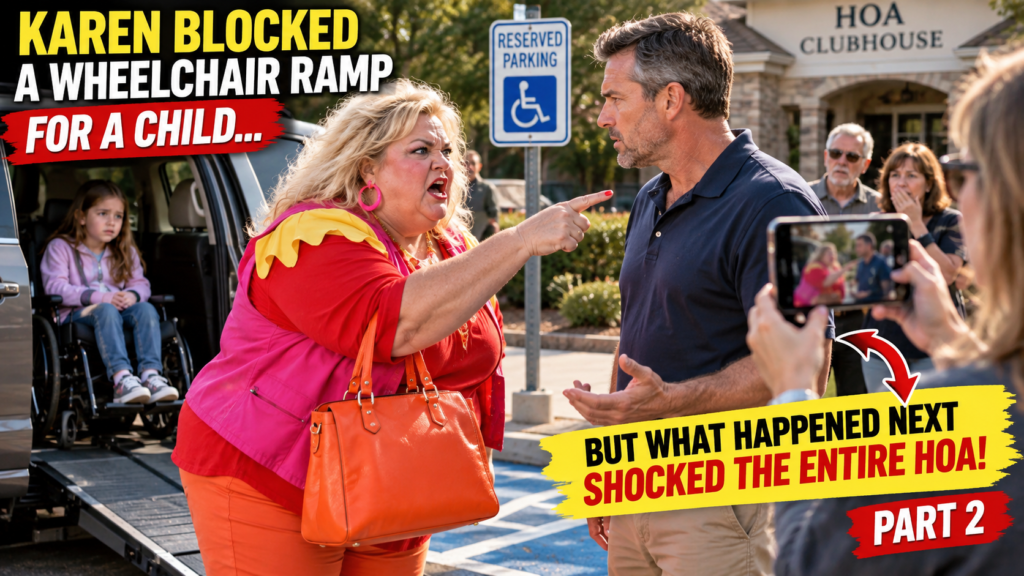
Chapter 6: The Vote
The petition forced the issue into a formal community vote.
Daniel was given the opportunity to speak.
He kept his statement short.
He explained Emily’s needs.
He explained the access aisle.
Then he talked about something broader.
“Accessibility isn’t about giving one person an advantage,” he said. “It’s about making sure a person can enter a place without having to negotiate their dignity every time.”
He didn’t mention Karen’s insults.
He didn’t show the video.
He didn’t ask the residents to punish anyone.
He simply explained what happened when the space wasn’t available.
Then Harold spoke.
He described trying to help his wife out of a vehicle while another car blocked the access aisle.
A younger resident spoke about his father.
Another resident explained that she had never complained because she didn’t want conflict with neighbors.
The room gradually became quieter.
The issue had become personal for many people.
Not because everyone had the same circumstances.
Because everyone understood what it meant to need a little space when the ordinary way of doing something no longer worked.
Karen listened.
When it was her turn, she didn’t apologize.
Instead, she argued that the community was “overreacting.”
But something had changed.
Nobody was shouting.
Nobody was insulting her.
The board had facts, measurements, security footage and documented reports.
The vote was conducted according to HOA procedure.
The accessible parking spaces remained.
The access aisles were formally designated as no-parking areas.
The HOA also adopted a written process for reporting violations without direct confrontation.
And the proposed redesign was rejected because the professional review found that it reduced both accessibility and emergency clearance.
Karen sat silently through the result.
After the meeting, she approached Daniel in the hallway.
For several seconds, neither spoke.
Finally, Karen said, “You made me look terrible.”
Daniel answered quietly.
“I didn’t make the video.”
She looked at him.
He continued.
“I didn’t make you stand in the aisle. I didn’t make you say those things.”
Karen’s expression tightened.
Then she walked away.
Daniel didn’t follow.
He didn’t need to.
The formal conflict had been resolved.
But there was still one final consequence.
Maria later informed Daniel that the HOA had contacted Karen privately about her repeated obstruction and the false statements in her complaint.
She would remain subject to the community’s rules like every other resident.
No public humiliation.
No dramatic punishment.
Just documentation, accountability and boundaries.
A week later, new pavement markings appeared in the clubhouse lot.
The accessible spaces were easier to identify.
The access aisles were brighter.
And a sign reminded residents that the striped areas were needed for wheelchair ramps and safe entry.
But Daniel noticed something unexpected.
The first person who used the newly marked access aisle correctly wasn’t Emily.
It was Harold.
He parked, stepped out carefully and smiled when he saw the fresh markings.
“About time,” he said.
Daniel laughed.
For the first time in weeks, the parking lot felt ordinary again.
Then Emily rolled beside him.
She looked at the new sign.
“Does this mean people finally understand?”
Daniel looked around the clubhouse.
He saw residents helping one another.
Someone held a door open for Harold.
Another person waited patiently while a woman unloaded a walker.
Nobody was making a speech.
Nobody was arguing.
They were simply leaving enough room for one another.
“Some of them do,” Daniel said.
“And sometimes,” he added, “that’s how change starts.”








