Chapter 2: The Complaint
By the next morning, Daniel had received an email from the HOA.
The wording was formal.
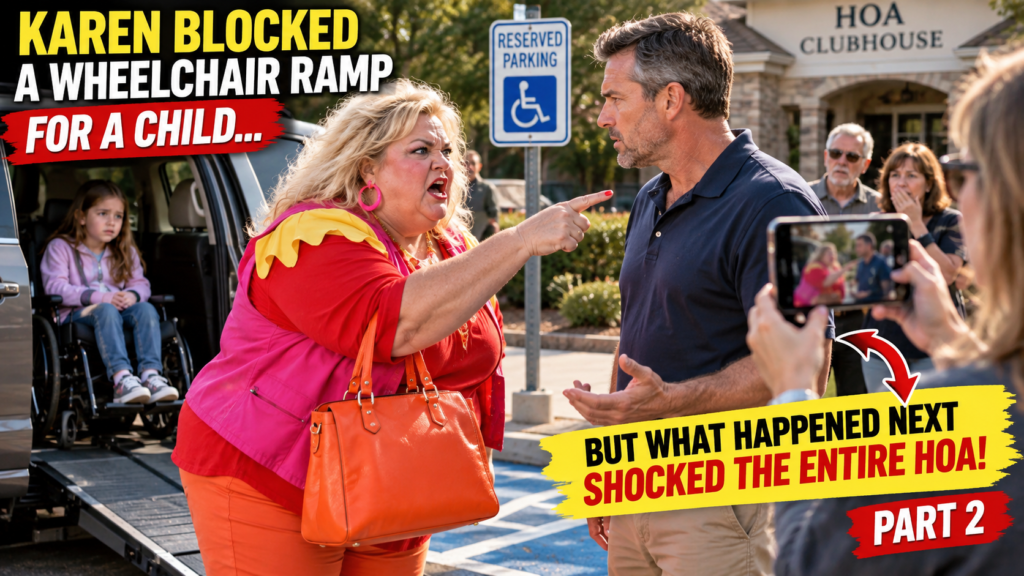
A complaint had been submitted regarding an “aggressive parking confrontation” involving a resident and a child using a wheelchair.
Daniel read it twice.
Then he saw Karen’s name.
She claimed Daniel had “intentionally obstructed her vehicle,” “confronted her aggressively,” and “used a child to pressure another resident.”
Daniel sat at his kitchen table long after he finished reading.
Emily was eating toast nearby.
She didn’t know about the complaint yet.
Daniel’s first instinct was anger.
His second was exhaustion.
He had spent years dealing with paperwork, ramps, accessible entrances, transportation arrangements and the endless small negotiations that came with raising a child who needed mobility assistance.
He didn’t want another fight.
But he also knew something important.
If he stayed silent, Karen’s version of the story could become the official version.
So Daniel wrote a short response.
No insults.
No accusations.
Just facts.
He identified the parking space, the access aisle and the approximate time of the incident.
He asked the HOA to preserve the security footage.
Maria replied within an hour.
The cameras had recorded the entire area.
She also told him something else.
The HOA board wanted both residents to attend a meeting.
Daniel almost declined.
Then Emily rolled into the kitchen.
“Are we in trouble?”
Daniel looked at her.
“No.”
“Then why do you look worried?”
He didn’t immediately answer.
Finally, he said, “Because sometimes people tell a story differently when they’re embarrassed by what actually happened.”
Emily was quiet.
She looked toward the window.
“I don’t want people fighting because of me.”
Daniel moved beside her.
“This isn’t because of you.”
He meant it.
That afternoon, Maria reviewed the footage.
The video showed Daniel arriving first.
It showed the wheelchair access aisle.
It showed Karen stepping into it.
It showed Daniel pointing toward the markings.
And it showed Karen refusing to move.
But Maria noticed something else.
Karen had arrived at the clubhouse several minutes earlier and had parked in the same accessible area.
She had left her car, walked inside, then returned when Daniel arrived.
That detail mattered.
Because it meant Karen’s claim that Daniel had “taken her parking area” was not simply mistaken.
She had deliberately returned to the space after seeing him.
Maria saved the footage.
But before she could send anything to the board, another email arrived.
Karen had requested that the HOA investigate Daniel for “harassment.”
And attached to her complaint was a photograph.
It showed Daniel standing beside his SUV.
Taken from the other side of the parking lot.
The picture had been cropped.
It made the access aisle look much narrower than it actually was.
Daniel stared at it.
Someone had gone to considerable effort to make the situation look different.
And now the board had to decide whether to believe a photograph—
or the camera that recorded everything.