
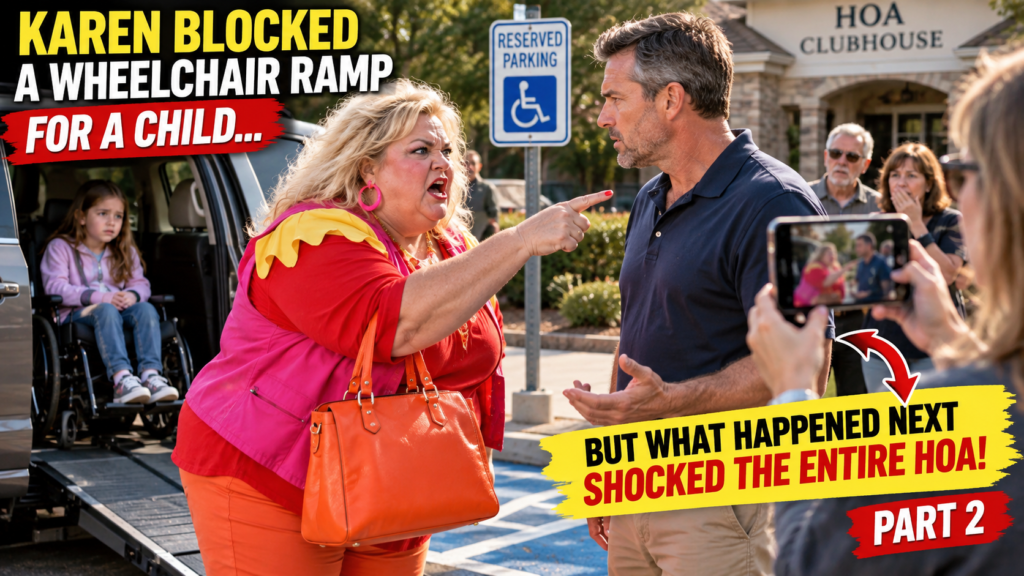
Chapter 4: The Parking Plan
Daniel initially assumed the proposal would be rejected.
The clubhouse already had limited accessible parking.
Removing one space would make things harder for several residents, not just Emily.
But Maria explained that the HOA board had to formally consider the proposal because it had been submitted through the community process.
That meant a public meeting.
Daniel attended.
So did Karen.
This time, Karen didn’t shout.
She arrived with printed diagrams showing what she called a “more efficient” parking arrangement.
Her proposal added three conventional spaces by eliminating the accessible access aisle and moving the accessible spot farther from the clubhouse entrance.
She argued that the current arrangement was inefficient.
Some residents nodded.
Others looked uncertain.
Daniel realized something uncomfortable.
The facts were on his side, but facts did not automatically prevent people from misunderstanding consequences.
So he didn’t tell anyone what to think.
Instead, he showed them what the proposed change would mean.
He parked his SUV in the new location shown on Karen’s diagram.
Then he demonstrated how Emily’s wheelchair ramp would extend.
There wasn’t enough clearance.
The ramp would open into the neighboring vehicle.
A resident named Harold, a retired contractor, walked over and studied the markings.
“That’s not going to work,” he said.
Daniel nodded.
“It won’t.”
Harold measured the distance.
Then Maria checked the original site plan.
The proposal had been drawn using the width of a standard parking space.
It had not accounted for the additional clearance required for a wheelchair ramp.
Karen insisted the layout could be adjusted.
But now the discussion had changed.
It was no longer about Daniel and Karen.
It was about whether the community’s parking plan actually worked for the people who needed accessible access.
Then Harold noticed another problem.
The proposed redesign would also narrow the route used by emergency vehicles near the clubhouse entrance.
That wasn’t something Daniel had known.
Maria immediately paused the proposal.
The HOA board requested a professional review of the parking layout.
Karen’s plan was temporarily suspended.
For the first time, she looked less angry than cornered.
But Daniel didn’t feel victorious.
He had learned something more important.
The original conflict had exposed a weakness in the community’s system.
The rules existed.
The signs existed.
The cameras existed.
But none of them mattered if residents treated accessibility as a personal favor rather than a shared responsibility.
Then Maria called Daniel privately.
“There is one more thing you should know.”
She showed him an older HOA document.
It contained several complaints from residents over the previous two years about vehicles blocking accessible aisles.
None had resulted in a formal community-wide policy.
Daniel read the names.
Karen’s wasn’t among them.
But one name was.
An elderly resident Daniel knew from the clubhouse.
Harold.
And his complaint had been dismissed as a “neighbor dispute.”
Daniel looked at Maria.
“This isn’t just about Emily.”
“No,” Maria said.
“It isn’t.”








