
Chapter 7: What Was Left Behind
Three weeks later, David returned to the same shopping center.
He pulled into the EV charging area.
The line was short.
The signage was impossible to misunderstand.
Compatible vehicles only.
Active charging only.
No holding spaces.
David plugged in and stepped out.
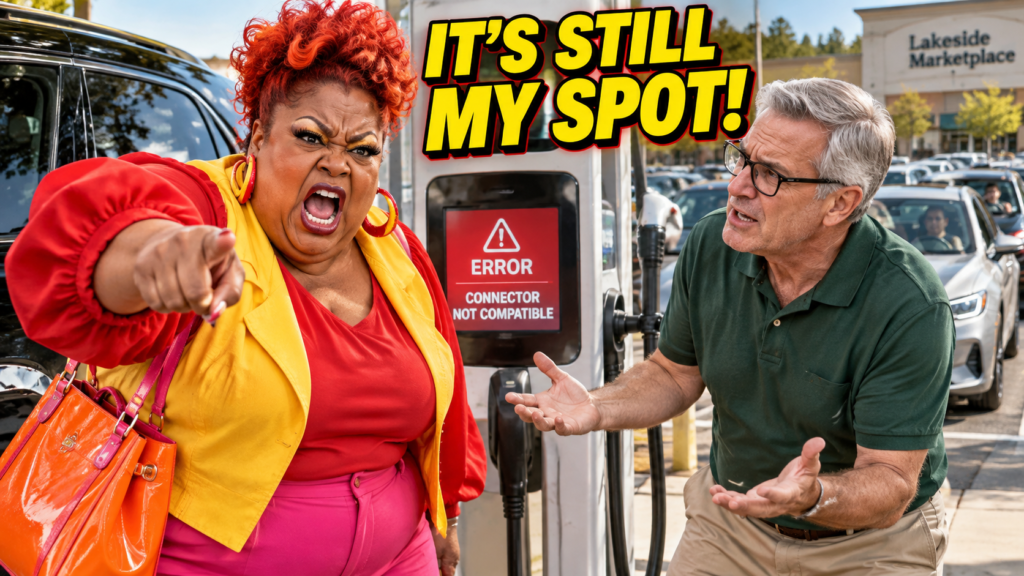
Across the parking lot, Karen was walking toward the stores.
Her bright clothes were impossible to miss.
For a moment, David wondered whether she would recognize him.
She did.
Karen stopped.
Their eyes met.
Neither spoke.
Then Karen looked toward the charging station.
She noticed the new sign.
She smiled faintly.
David nodded.
Karen walked closer.
“I use the other charger now,” she said.
David smiled.
“I figured.”
She looked at the line.
Only two cars were waiting.
Nobody was angry.
Nobody was trapped.
Nobody was arguing.
Karen shifted her handbag on her shoulder.
Then she said something David hadn’t expected.
“My daughter called me after that day.”
David waited.
“She said I sounded like my mother.”
He didn’t know what to say.
Karen looked embarrassed.
“My mother used to say that if she got somewhere first, she deserved to stay there.”
She glanced toward the charger.
“I always thought that was confidence.”
David nodded slowly.
“And now?”
Karen looked down.
“Sometimes it’s just refusing to move.”
The words hung between them.
David didn’t tell her she was right.
He didn’t tell her she was wrong.
He simply said, “Glad you found a charger that works.”
Karen smiled.
“So am I.”
She turned toward the stores.
Then stopped.
“David?”
He looked over.
“I was wrong about one thing.”
“What?”
She pointed toward the charger.
“Your spot wasn’t mine.”
David nodded.
“No, it wasn’t.”
Karen gave a small laugh.
“I still don’t like admitting that.”
David smiled.
“You don’t have to like it.”
She walked away.
David watched her disappear into the crowd.
His car continued charging.
The screen showed the rising battery percentage.
For David, the incident had started as an irritating delay.
But it had ended with something more useful.
A community had discovered a problem.
A business had fixed it.
A woman had been forced to confront a belief she had carried for years.
And David had learned that standing up for fairness didn’t always require anger.
Sometimes it required simply refusing to move aside when someone else’s entitlement pushed everyone else backward.
The new charger sign remained above him.
Clear.
Simple.
Impossible to misunderstand.
SHARING THE CHARGER MEANS EVERYONE GETS HOME.
David unplugged when his battery was ready.
Then he drove home to Linda.
This time, he wasn’t late.








