
CHAPTER 8: THE LAST COLD IRON
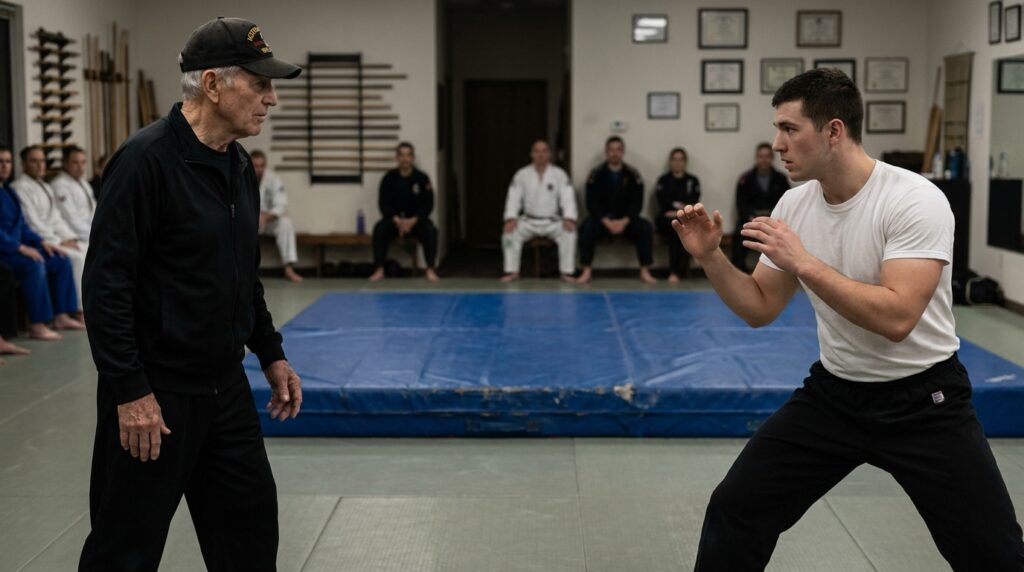
The gray morning rain did not fall softly; it rattled against the corrugated steel vents of the roof with the rhythmic, mechanical cadence of an old belt-fed receiver. The dojo had lost all its commercial warmth, the synthetic blue mats looking pale and discarded beneath the slate-gray light of the high windows. Arthur did not adjust his track jacket. He stood at the center of the doorway, his tall, straight spine unyielding against the chill that rose directly from the old foundation timbers.
Vance Senior did not pick up his silver fountain pen. He left it lying where it had fallen, his soft, pink fingers resting motionless against the edge of his leather briefcase. He looked at his son, whose head remained bowed an inch below the level of Arthur’s shoulder, then slowly turned his body back toward the open office door.
“The title cannot be altered by a field registry, Arthur,” Vance Senior said, his voice dropping into a flat, exhausted pitch that carried no corporate leverage. “The state board signed the transfer. The development funds are already allocated through the regional main.”
Arthur didn’t pull the Schlage key from the cylinder. He turned the iron bow a quarter-inch to the left, forcing the hand-filed brass strike plate to release the doorframe with a final, echoing clack. He reached beneath the heartwood desk, his fingers bypassing the gray canvas ledger to touch the loose, unpainted cedar tongue-and-groove plank that sat directly over the western sill plate.
“The state board only looked at the surface map your surveyor drew, son,” Arthur said, his gravelly voice dropping into an unhurried, heavy cadence that vibrated inside the small wooden office. He lifted the plank three inches, his weathered knuckles scraping against the coarse, split grain of the original timber. From the dark cavity beneath, he pulled a long, heavy cylinder—not a piece of modern office storage, but a three-inch ordnance document tube made of seamless, oxidized iron, its threaded cap sealed with gray graphite grease. “But the surveyor didn’t have the key to the baseline vault. They didn’t know the property was never listed as surplus.”
He unscrewed the cap, the dry, metallic crunch of the iron threads sounding like gravel under a boot heel. He didn’t pull out a sheaf of papers; he pulled a single, heavy sheet of original linen blueprint cloth, its dark indigo backing marked with the distinct white-line geometric grids of a restricted Department of Defense logistics zone. At the base of the layout sat the original state charter from nineteen eighty-one, its text explicit: The underlying acreage remains under permanent federal quarantine for the maintenance of the Forty-Fourth Special Logistics Unit, non-transferable by public or private exchange.
Vance Senior reached out, his thumb catching the edge of the blue linen. His pale eyes tracked the white lines down to the red wax seal at the margin—a seal that bore the crest of the joint chiefs and the handwritten signature of his own father, executed in the same faded ink that filled the notebook on the bench.
“He… he left it here on purpose,” Vance Senior whispered, his hand losing its grip on the leather briefcase until the handle slid through his fingers, hitting the heartwood floor with a heavy, dead thud. He looked at Arthur, his mouth working silently as the absolute final reality of the land grant completely crushed the corporate illusion he had spent three months building. “He knew we’d try to sell it. He left the tomb locked so we’d have to look at what he buried.”
“Respect isn’t given because of the years behind you, son,” Arthur said softly, his voice carrying the weight of the cold rain falling through the ceiling vents. He laid the heavy iron tube across the center of the desk, right next to the blinking blue light of the corporate laptop. “It’s given because of what those years left inside you. Your father left his name on the dirt because he knew the business would eventually forget the bloodline. He wanted to see if you’d look at the names on the wall or just the valuation.”
Tyler Vance stepped into the office doorway, his athletic guard completely gone, his posture straight but quiet as he watched the blue blueprint cloth unroll across the heartwood. He looked at Arthur, then slowly reached down to pick up his white training shirt from the bench, folding it over his forearm so the frayed white threads where his sponsor patch had been torn away were hidden from view.
“We’re clearing the floor, Dad,” Tyler said, his voice flat, carrying the submissive, disciplined cadence of a junior practitioner who had finally found the real center of the mat. “The truck is outside. The commercial gear doesn’t belong to the building.”
Vance Senior didn’t reach for the ledger, and he didn’t check his fountain pen. He walked out of the office, his leather soles making a heavy, hollow sound as he crossed the blue boundary line for the last time, his son following two paces behind him with his chin tucked into his collarbone.
Marcus Miller walked over from the fuse panel, his large frame casting a long gray shadow across the mats as he watched the corporate car pull away from the gravel driveway outside the clerestory glass. He stopped at Arthur’s right flank, his cap held loose in his weathered left hand, his spine straight.
“The building is clear, Colonel,” Miller murmured, his voice flat within the desaturated stillness of the room. “The franchise inspectors are off the property. The county line is isolated.”
Arthur didn’t answer. He reached into his pocket, his fingers closing around the rusted brass key he had carried since the morning the gates were first locked. He laid the iron key on the center desk, right above the white lines of the old blueprint, then turned back toward the main door, his boots leaving faint, gray salt prints on the clean corporate vinyl as he walked out into the cold, silent rain.








