
The Armor of a Forgotten Lineage and the Unyielding Stance of an Unbroken Ghost

CHAPTER 1: THE FRICTION OF OLD IRON

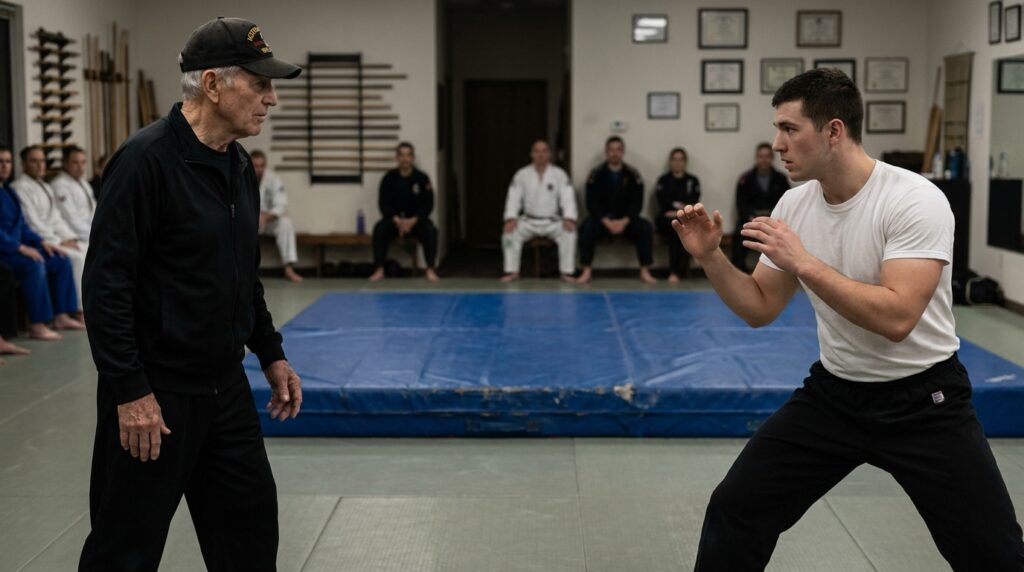
The blue vinyl mats did not give under Arthur’s boots the way the old canvas floorboards used to at Fort Bragg. This modern foam was soft, expensive, and synthetic, designed to absorb the errors of children who had never hit anything harder than a heavy bag filled with shredded rags. Arthur kept his hands inside the pockets of his black tracksuit, his fingers loosely hooked around a rusted brass key that had grown smooth from thirty years of identical mornings.

Across the room, the fluorescent lights hummed with a flat, clinical vibration that irritated the bridge of his nose.

“Hey, old timer. Benches are behind the rope line,” a voice cut through the damp heat of the room. It was sharp, slick with the easy confidence of a boy who had spent his life winning three-minute rounds under a clock.

Arthur didn’t turn his head. He watched the reflection in the polished plexiglass mirror at the back of the floor. The kid—the one the gym’s gloss-paper flyers called the regional champion—was bouncing on the balls of his feet, his white training shirt soaked through with clean, clear sweat. His dark hair was clipped short to the skin on the sides, his shoulders wide and loose. He was young enough that his skin hadn’t been split across the cheekbones yet; his knuckles were still square and white, unmarred by the gray calcium deposits that covered Arthur’s own hands.

“You’re tracking salt onto the competitive lane,” the kid said, his voice dropping an octave as he stepped closer to the blue boundary tape. The rest of the class, a dozen twenty-something students in matching branded gear, stopped their drilling. The rhythmic thwack-thwack of bare shins against leather pads died into a heavy, stagnant silence.

Arthur let his heels settle into the mat. He could smell the boy from ten feet away—the sharp, chemical stink of sports drinks and cheap laundry detergent. The kid was doing a small, lateral dance, his hips squared to Arthur’s chest, his left hand twitching near the seam of his shorts. A competitive twitch. An opening gambit designed to make an intruder lean back.

“The sign out front says public hours until noon,” Arthur said. His voice didn’t carry the volume of the room, but it had the weight of iron scraping over sandstone. It stayed low, vibrating in the corners of the concrete walls where the paint was beginning to bubble from the humidity.

“Public hours are for the weights, cap,” the kid replied, pointing a wrapped thumb toward the chrome machines in the far corner. “The mats are for active fighters. We’ve got an entry threshold here. You’re going to trip someone.”

A small, thin smirk went around the semi-circle of students behind the boy. They knew the hierarchy. They knew the gym owner was in the back office dealing with a corporate franchise inspector, and they knew the champion owned the center lane.

Arthur took his right hand out of his pocket. He didn’t drop his tracksuit top, and he didn’t adjust the worn black cap with the faded gold embroidery above the brim. His shoulder blades remained locked against his spine, creating an exceptionally straight line that seemed to alter the spatial geometry of the doorway. He took one step forward, crossing the blue tape with a dull, unhurried thud that carried no bounce.

The kid’s stance narrowed instantly. His chin dropped an inch into his collarbone, his weight shifting back onto his right heel as his hands rose to chest level—not a full combat guard, but the defensive reflex of an animal that had just realized the fence was down.

Arthur stopped exactly thirty-six inches from the boy’s lead toe, his eyes steady, unblinking, and entirely devoid of competitive interest. He looked at the kid the way a mechanic looks at a stripped bolt.


CHAPTER 2: THE BLUE BOUNDARY LINE

“You think because you’re old, people are just going to clear the lane for you?”

The kid’s voice had lost its smooth, rhythmic tournament bounce. It was thinner now, pushed out through a tight jaw while his heels remained anchored an inch behind the blue tape. His chest heaved once, the white cotton of his shirt straining against his pectorals, but his hands stayed up. Arthur could see the small, erratic pulse drumming against the side of the boy’s throat, just above the collar.

Arthur didn’t answer. He let the silence stretch until it became a physical weight in the center of the dojo, thicker than the smell of winter sweat and floor disinfectant. He looked down at the blue vinyl tape between them. It was fraying at the corners, the adhesive choked with gray dust and fibers from cheap cotton uniforms.

“I asked you a question, cap,” the kid said. He took a short, lateral step to the left, trying to find an angle, trying to force Arthur to turn his hips. It was a standard ring conversion—circle the stationary target, force the older joints to pivot, create an opening through momentum.

Arthur simply shifted his weight three inches to the right. His boots didn’t scrape; they planted. The straightness of his spine didn’t alter by a single degree. To the students watching from the benches, it didn’t look like a martial stance; it looked like a concrete piling driven into the mud before the dock was built. Arthur’s right hand stayed near his waist, his thumb still touching the cold, notched edge of the locker key inside his tracksuit pocket. He could feel the rust on the iron teeth of the key prickling his skin. It was a familiar, grounding smallness.

“Your lead shoulder is high, Tyler,” Arthur said. He used the name printed in small, faded stencil on the equipment bag sitting by the wall. “You’re leaning into your liver. If I were twenty years younger, you’d be tasting your own ribs before your heel touched the canvas.”

A sharp, collective intake of breath came from the sidelines. One of the junior students, a heavy-set kid with a blue belt tied too loose around his middle, shifted his feet, the synthetic fabric of his trousers making a dry, whispering hiss against the mat.

Tyler’s face flushed a dark, bruised purple beneath his tan. His left hand twitched, his fingers curling into a fist so tight the knuckles went yellow. “My name is Tyler Vance. I don’t take notes from people who watch through the glass. If you want to talk about ribs, step over the tape. Put your gear on.”

“I don’t need gear for a boy who finishes his entry on his toes,” Arthur murmured. His eyes didn’t track Tyler’s hands; they stayed locked on the small V of the boy’s collarbone, watching the muscles that controlled the shoulder alignment. “Your sponsor patch is gone from your chest. Ripped out yesterday, judging by the loose threads. They dropped your contract after the Chicago match, didn’t they?”

The reaction was immediate. Tyler’s lateral movement stopped dead. His guard dropped three inches, his mouth opening slightly as if the air in the dojo had suddenly turned to sand. The small micro-mystery of the torn stitching on his white shirt was a ragged white scar against the clean fabric—a detail the other students had spent the morning ignoring out of a fragile kind of locker-room loyalty.

“Who told you that?” Tyler’s voice dropped the competitive edge entirely, replaced by the raw, brittle anger of a clean-cut failure. He took a full step forward, his boot heel coming down hard across the blue boundary line, his chest nearly touching the zipper of Arthur’s black tracksuit. “Who the hell are you?”

Arthur didn’t lean back. He didn’t raise his hands. The distance between them was gone now, reduced to a single breath of cold air that smelled of old copper and Tyler’s sudden, panicked sweat. The kid was larger, broader, and his muscles were packed with the explosive density of a twenty-two-year-old athlete, but he was leaning forward, his center of gravity compromised by his own temper.

“The man who paid for the cedar under these mats,” Arthur said softly. He reached out with his left hand—not a strike, but a heavy, deliberate placement of two fingers against the center of Tyler’s chest, precisely where the sponsor patch had been torn away. The touch was light, but Arthur’s arm was locked from the shoulder down through the latissimus muscle, converting his entire skeletal weight into a rigid iron rod. “And the man who knows exactly why your franchise owner keeps the back office locked on a Tuesday morning.”

Tyler tried to shove through the contact, his shoulder dipping to initiate a standard clinch entry, but his momentum hit the locked skeletal structure of Arthur’s arm and died with a dull, flat thud. It wasn’t an exchange of blows; it was the friction of a moving car hitting a frozen guardrail. Tyler’s boots slid two inches backward across the vinyl, his balance breaking just enough to force his hands out to the sides to keep from tilting.

From the hallway near the front desk, the heavy oak door clicked open. The sound of a man clearing his throat—a wet, gravelly cough that Arthur recognized from fifteen years of administrative neglect—shattered the stillness of the room. The head instructor was coming back, and he wasn’t alone.

CHAPTER 3: THE WEIGHT OF THE CEDAR FLOOR

The heavy oak door didn’t just swing; it groaned against ungreased iron hinges that had dropped a quarter-inch into the jamb since the winter of ninety-four. The wet, ragged cough that preceded the head instructor belonged to Marcus Miller, a man whose knees had been ground down to bone meal by three decades of low-altitude deployments. But Miller wasn’t leading. He was holding the door frame back with a rigid forearm, his neck flushed a deep, structural crimson against his gray polo shirt.

Before him walked the franchise inspector—a corporate asset named Vance Senior, whose tailored wool suit looked absurdly pristine against the salt-streaked walls of the entryway.

Arthur did not remove his two fingers from Tyler’s chest. The fabric of the boy’s shirt remained bunched under Arthur’s weathered knuckles, the iron-like linkage of Arthur’s shoulder keeping the young athlete pinned against his own forward momentum. Tyler’s eyes darted toward the doorway, his mouth opening to call out to his father, but the phrase died as Arthur slightly rotated his wrist, pressing a single hardened tendon against the boy’s sternum.

“Hold your air, Tyler,” Arthur murmured, his focus never shifting from the precise millimeter where youth met old iron. “A man who calls for his bloodline before his balance is settled stays a student until he dies.”

Miller stopped dead at the edge of the blue vinyl line. His boots—well-shined leather with Vibram soles that had seen the gravel of three continents—clicked together on the concrete perimeter. The air in his lungs escaped in a sharp, dry whistle. His gaze went from Tyler’s trembling, locked guard down to Arthur’s boots, then slowly tracked upward along the straight, unyielding seam of the old black tracksuit.

“Sir?” Miller’s voice didn’t carry the standard commercial gym authority anymore. It dropped into a flat, dry cadence that caused the dozen students on the side benches to sit up, their bare heels lifting from the floorboards. “You didn’t leave a name on the schedule.”

Vance Senior stepped around Miller, his leather briefcase swinging like a pendulum. His eyes were small, pale, and entirely focused on the structural integrity of the facility he was tasked with converting into a corporate tax hedge. “Miller, what is this? Why is this vagrant on the main training surface? Tyler, get away from him. The insurance rider explicitly forbids uncertified—”

“Shut up, Vance,” Miller said. The words weren’t loud, but they carried the absolute lack of compromise found only in men who had buried their peers in dry earth. He didn’t look at the corporate executive. His eyes remained fixed on Arthur’s faded black veteran cap, tracing the faint, unraveled gold thread that formed the shape of an old operational anchor.

Tyler took advantage of his father’s presence to try a short, violent hip-twist, attempting to clear Arthur’s hand with a standard defensive frame. But Arthur had already anticipated the leverage. He didn’t fight the twist; he simply released the pressure at the exact micro-second Tyler swung, letting the boy’s own explosive force carry him two inches too far into the empty air. Tyler’s heel caught the frayed edge of the blue tape, his hips dipping as he scrambled to regain his footing on the synthetic foam.

Arthur let his hands drop back into the pockets of his tracksuit, his fingers finding the cold, notched steel of the locker key once more. He looked past the boy, his gaze locking onto the heavy deadbolt that secured the back office door. The lock was non-standard—an old five-pin Schlage with a hand-filed brass strike plate that sat half an inch out of true with the modern drywall. It was the same lock Arthur had installed when the building was nothing but a munitions storage shed behind the old rail line.

“The cedar under these mats is rotting near the western floor-joist, Miller,” Arthur said, his voice scraping through the room’s damp heat. “You let the moisture from the showers pool against the sill plate. I told your predecessor twenty years ago that the drainage was pitched toward the foundation, not away from it.”

Vance Senior’s briefcase hit the bench with a heavy, synthetic slap. “Listen to me, old man. I don’t care if you used to sweep the floors here during the previous administration. This property was legally acquired by the Vance Acquisition Group three months ago. The title is clear, the franchise conversion is signed, and the historical classification was cleared by the state board. You have thirty seconds to clear the floor before I call the county marshal.”

Arthur turned his head three degrees to the left. He looked at Vance Senior’s pristine, soft palms—hands that had never known the dry friction of an iron climbing line or the coarse weave of a heavy supply pack.

“The historical classification was cleared because you filed the paperwork under the corporate address on Second Street, not the original plot coordinates,” Arthur said. He reached down to his side, his fingers wrapping around the canvas strap of the old gym bag he had dropped near the bench. The zipper was corroded with green copper oxidation, stuck three-quarters of the way open. “You wanted the land for the rail easement, but you forgot to look at the basement charter.”

From inside the unzipped gap of the bag, a corner of oil-stained canvas protruded—a thick, grimy binding that carried the distinctive smell of dry-stored cosmoline and forty-year-old ledger paper. Tyler, still breathing hard from the encounter on the mat, caught the scent and froze. It was the exact smell of the old locker rooms beneath the stadium where his grandfather had coached—a smell that modern air fresheners and rubber flooring could never fully choke out.

Miller stepped onto the blue vinyl, his boots making no sound as he closed the distance between himself and Arthur. He didn’t offer a hand; he knew better than to break the distance with an active commander. Instead, his chin dropped into his chest, his eyes staying on the canvas bag.

“The ledger from the forty-fourth group,” Miller whispered, his voice losing its dry administrative edge entirely. “We thought that went into the incinerator when they closed the yard at Fort Meade.”

“Nothing goes into the incinerator when the ground is still registered under a sovereign name,” Arthur said. He turned back toward the locked office door, his stride deliberate, his boots leaving faint, gray dust prints on the clean corporate mats. “Miller, open the lock. Let’s see if the executive’s pen works when the ink has to match the dead.”

CHAPTER 4: THE INK AND THE DEAD

“There is no baseline file for this facility outside the corporate ledger,” Vance Senior said, his hand coming down hard onto the chrome handles of the security barrier. The gold ring on his middle finger left a sharp, brief oily smear against the polished metal. “Miller, I’m ordering you to clear this floor. The audit is unresolvable if non-entities are occupying the footprint.”

Marcus Miller didn’t reach for his keys. He didn’t check the perimeter. He walked three steps ahead of the corporate inspector, his weight shifting over the creaking timber underneath the modern vinyl. When he reached the office door, his large, calloused thumb ran along the brass strike plate, feeling the small, cold indentation where a military ordnance code had been struck into the metal with a three-millimeter stamp.

“The tumblers on this Schlage are set to a different depth than the ones corporate sent down,” Miller said. His voice was flat, devoid of its previous institutional neutrality. He looked back at Arthur, who stood perfectly still by the active lane, the green-crusted canvas bag resting against his shin. “The key we have from the buyout doesn’t clear the fourth pin, sir. We’ve been using a master override from the franchise office since December.”

“Because you don’t own the core cylinder,” Arthur said. He walked forward, his boots making a dry, rhythmic scraping sound across the synthetic blue foam. He didn’t pull his hands from his tracksuit pockets until he was within twenty inches of the wooden doorframe. When his right hand emerged, the rusted brass key sat between his index finger and thumb, its teeth dark with old zinc oxidation. “The cylinder was struck under an administrative land block. If you use a corporate override, you’re bypassing a active federal designation. That’s a felony on a military rail easement, Vance.”

Tyler Vance stepped up behind his father, his white training shirt damp, his chest still showing the slight red outline where Arthur’s two fingers had held his mass. His short dark hair was matted with salt. “Dad, he’s bluffing. He’s just an old man who used to train here before the building was listed on the exchange. Look at his gear. He’s wearing an outdated track kit from the surplus store.”

Vance Senior reached out, his soft, pink fingers grasping the handle of the door. “This is an obstruction of a commercial audit. Miller, if you don’t turn that handle right now, your franchise agreement is canceled before the end of the fiscal quarter. The title is registered under the Vance Group LLC. We have the paper.”

“Show him the paper, Miller,” Arthur murmured.

Miller turned away from the door, his eyes dark. He walked to the viewing bench, unhooked the brass latch on the gym’s main logbook, and pulled out a thin, oil-stained pocket notebook that had been tucked behind the modern laminated schedule sheets. The edges of the paper were frayed, yellowed by years of exposure to heating oil and cedar rot. The binding was held together by a single strand of heavy olive-drab thread—the same thread used to patch tactical gear before the modern franchise buyouts.

“This was in the floor cavity when we pulled the old canvas up,” Miller said, his voice dropping into a low, transactional rhythm. He opened the pages in front of Vance Senior, his thick finger resting on a hand-drawn diagram of a close-quarters combat transition. The ink was faded indigo, the handwriting precise and angular. Below the diagram, a legal description of the plot was written out, specifying the exact geographic anchors of the old munitions rail block. “The title you bought from the state wasn’t for the structural footprint, Vance. It was for the air rights above the concrete. The ground itself is listed under a sovereign operational trust. This notebook contains the original charter adjustments from nineteen eighty-one.”

Vance Senior didn’t read the diagram. His eyes fixed on the signature at the bottom of the yellowed page—a single name written in the same indigo ink, matching the exact gold embroidery on Arthur’s worn cap. The briefcase on the bench slid an inch to the left as his hand began to lose its rigid corporate tension.

“This isn’t an official state record,” Vance Senior said, though his voice had lost its dry, sharp pitch. He looked at Arthur, then at the heavy brass lock on the door. “This is a field manual. A collection of obsolete combat adjustments. It holds no standing in a modern corporate acquisition.”

“The manual is the decoy, Vance,” Arthur said softly, his voice cutting through the hum of the fluorescent fixtures. He stepped past the executive, his shoulder catching the wool of the man’s suit jacket with a rough, heavy friction that smelled of cold iron and wet canvas. He placed the rusted brass key into the Schlage cylinder. The lock didn’t slide smoothly; it required a three-degree lift to clear the dropped pin. When the iron teeth met the brass tumblers, a loud, heavy clack echoed through the dojo, the sound of ancient metal moving within an ungreased housing. “The manual tells you how to clear the room. The key tells you who owns the dirt underneath the floorboards.”

The door swung open four inches, revealing the dark, unpainted interior of the office—a space that smelled of wet wood, graphite grease, and old ledger paper. On the center desk sat a pristine corporate laptop, its blue power light blinking against the dusty surface of an original heartwood desk that had been bolted to the joists before the franchise was born.

Tyler Vance took a step backward, his boots crossing the blue line once more, his guard entirely forgotten as he watched his father’s face pale under the clinical white lights of the academy.

CHAPTER 5: THE CORE REBUKE

The dark interior of the office did not expand; it narrowed into a tight corridor of unpainted cedar planks and gray metal filing cabinets that had rusted shut during the Carter administration. Arthur did not look back at the corporate executive or his son. He kept his right hand on the heavy iron bow of the Schlage key, letting the leverage of his weight pull the door completely back until the brass knob struck the unplastered wall with a dry, hollow click.

“This is an empty box, Miller,” Vance Senior said, his voice dropping its sharp, defensive edge as he stepped across the threshold. His leather sole dragged against a raised floor nail, leaving a long, pale scar across the dark grain of the heartwood. “A desk from a state surplus depot and an outdated server node do not constitute an operational asset. The corporate land valuation remains intact.”

Marcus Miller did not step into the room. He remained under the fluorescent glare of the mat lane, his massive arms crossed over his chest, his eyes fixed on the small, grease-stained oilcloth manual tucked beneath his arm. “The valuation is based on the assumption that the building connects to the city main, Vance. It doesn’t. Look at the corner by the baseboard.”

Arthur reached down to the second drawer of the heartwood desk. The handle was a standard piece of black ordnance iron, secured by two flathead screws that had been turned so many times the slots were stripped into round gray holes. He didn’t pull the drawer outward; he pressed his thumb against a concealed spring-catch hidden inside the finger-recess underneath.

The drawer dropped two inches into its housing with a sharp, dry thud that smelled of ancient paper insulation and damp sulfur.

“The corporate office didn’t check the basement vault because they thought the concrete was poured during the city extension in eighty-eight,” Arthur said, his gravelly voice flat within the enclosed wooden space. He reached into the gap, his fingers sliding across the rough underside of the drawer until they found the coarse canvas cover of the original registry. “But the foundation wasn’t laid by a commercial crew. It was poured by the Eleventh Engineer Battalion under a restricted logistics order.”

He pulled the ledger out. It wasn’t the thin, yellowed manual Miller had carried from the mat. This was a heavy, three-inch binder bound in dark gray canvas, its corners reinforced with oxidized brass rivets that had turned green from fifty years of floorboard dampness. On the cover, a serial code—44-LOG-79—was stenciled in thick black lacquer that had begun to flake off into fine gray soot.

Tyler Vance stepped to the edge of the desk, his bare chest glistening with cold sweat, his hands twitching near his sides. His athletic confidence had vanished, replaced by the rigid, defensive posture of a fighter who had spent his career preparing for a specific weight class, only to find himself in the ring with an unlisted entity. “Dad, the surveyor’s report said the land was cleared after the rail line went cold. There shouldn’t be anything under the joists.”

“The surveyor checked the county register, son,” Arthur murmured, his eyes locking onto the boy’s collarbone with that same clinical, unblinking focus. “They didn’t check the ordnance log because the ordnance log doesn’t belong to the county. It belongs to the men who died inside the perimeter while your father was still learning how to sign a lease.”

Vance Senior’s hand went into his coat pocket, his fingers fumbling with a silver fountain pen that left a dark blue stain against the white silk of his lining. “Miller, this is a stall tactic. A collection of unnotarized logs from a defunct training group cannot override a certified state deed. The corporate buyout is locked. The sheriff’s office has the filing on record.”

“The filing is a false flag, Vance,” Arthur said. He slammed the gray canvas ledger down onto the heartwood surface, the force of the impact sending a small cloud of dry gray dust into the beam of the desk lamp. The paper split along the spine, revealing a series of technical schematics drafted in the distinctive white-line ink of military engineering drafts. “Look at page fourteen. That isn’t an easement for a commercial warehouse. That’s a structural map for an active munitions storage bunker. The land grant was never retired; it was quarantined under a permanent sovereign maintenance order.”

Vance Senior reached out, his soft, pink fingers touching the edge of the canvas page. His gaze tracked down the column of figures until it stopped at a stamped red seal that had faded to a bruised purple over forty winters. The seal did not carry the name of a state board or a local municipality; it carried the crest of the Department of Defense, accompanied by a single, handwritten signature that matched the embroidery on Arthur’s cap exactly.

The corporate executive’s hand dropped to his side, the silver pen slipping from his fingers to roll across the heartwood with a hollow, rhythmic click before falling into the dark gap behind the drawer.

“This isn’t just an asset dispute,” Vance Senior whispered, his face turning the color of old unbleached cotton under the desk light. He looked up at Arthur, his mouth working silently as he tried to find a legal counter-move within his corporate vocabulary. “This is… this entire development is inside a federal zone.”

“It’s a tomb, Vance,” Arthur said softly. He stepped around the desk, his tall, straight spine forcing both men back into the narrow doorway until their heels hit the blue tape of the training floor once more. “And you’ve been trying to sell the roof to a franchise group while the foundation is still holding the dead.”

From behind them on the mats, the collective silence of the students broke into a dry, scattering rustle as Marcus Miller walked toward the front desk, his fingers gripping the heavy brass handle of the master light switch.

CHAPTER 6: THE COMMAND RECOGNITION

The master light switch didn’t just slide; it dropped with the heavy, industrial snap of a sixty-amp breaker moving inside an ungreased steel box. Instantly, the modern fluorescent lights overhead died, taking the clinical, white glare with them. The dojo was plunged into the dull, slate-gray gloom of the late Tuesday morning filtering through the high, dirt-crusted clerestory windows near the roof joists.

Vance Senior blinked, his soft pink hands flaring out to grasp the edge of the heartwood desk as his eyes struggled to adjust to the sudden desaturation of the room. “Miller? What are you doing? Reset the panel. This is a security violation—”

“The panel is on the sovereign main, Vance,” Marcus Miller said, his voice emerging from the gray shadows of the doorway like a low, rhythmic engine. He didn’t move from his position by the fuse cabinet. His large silhouette remained square, his posture locked into an ancient military attention that the younger students had never seen him use. “The commercial line only runs the signage out front. The rest of this grid has been drawing from the substation behind the old yard since nineteen eighty-five.”

Arthur didn’t look at the corporate executive or his son. He stepped cleanly out of the narrow office doorway, his worn black tracksuit catching the faint, gray light from the northern windows. His boots came down on the cedar perimeter with a dry, unhurried thud that carried no vibration. He reached into his pocket, his calloused fingers passing over the rusted brass locker key to pull out a thin, silver chain that had remained coiled at the bottom of the lining.

At the end of the chain hung a single, heavy silver tag—not a standard piece of modern administrative plastic, but an unpolished plate of industrial ordnance steel, its stamped letters choked with dark graphite grease.

“You thought you were buying a commercial franchise location from the state liquidation board, Vance,” Arthur said, his gravelly voice flat within the sudden cold stillness of the room. He didn’t hand the chain to the executive; he laid it across the cold, zinc-riveted cover of the gray canvas ledger. “But the liquidation board only had authority over the surface structures. The ground beneath these joists was deeded under an unrestricted operational mandate after the forty-fourth group was deactivated.”

Tyler Vance took a slow step forward, his bare shoulders twitching as the chill of the unheated dojo began to settle into his skin. His dark hair was still wet with sweat, but the aggressive, lateral bounce of his stance was gone, replaced by a rigid, uncomprehending stillness. His eyes tracked the silver tag on the desk, his jaw tightening as he noticed a deep, hand-filed notch cut into the left corner of the metal—the distinct identification mark of a unit that didn’t appear on any public muster roll.

“Dad,” Tyler whispered, his voice losing its brittle tournament authority entirely. “That’s granddad’s unit number. The one from the warehouse files in Maryland. The ones they said were burned.”

Vance Senior didn’t answer. His fingers slipped from the edge of the heartwood desk, his tailored wool coat looking suddenly loose and creased in the gray twilight of the room. He looked at the silver tag, then slowly raised his eyes to meet Arthur’s unblinking, level gaze. The pale light from the window caught the faint, gray scar running along the side of Arthur’s throat—a clean, surgical track left by a fragment of mortar casing forty winters ago.

“You’re… you’re Arthur Vance,” the corporate executive said, his voice dropping into a raspy, unhurried whisper that seemed to age him ten years in a single second. He didn’t look at his son, and he didn’t look at the ledger. His palms pressed flat against his trousers, his thumbs twitching against the seam. “The name on the original foundation charter. The one my father said died at the reservoir.”

“Your father knew exactly where the line was drawn, son,” Arthur said softly. He stepped closer to the executive, his tall, straight spine forcing the younger man to tilt his chin upward to maintain eye level. The smell of old iron oil and coarse canvas insulation between them was thicker than the cold air from the floorboards. “He left his name on the ledger because he knew the Vance Acquisition Group would eventually try to trade the property when the county rail went cold. He wanted to see if the bloodline would remember the dirt, or if they’d just look at the exchange rate.”

Miller walked forward from the fuse panel, his heavy boots making a distinct, hollow clicking sound as he crossed the blue tape line. He stopped exactly forty-eight inches from Arthur’s right flank, his spine snapping straight, his chin dropping into his chest as his right hand rose to the brim of his gray cap in a sharp, unhurried military salute that had no place in a commercial tournament gym.

“The unit log is clear, Colonel,” Miller said, his voice carrying the flat, heavy cadence of an official report. “The master breaker is pulled. The commercial lines are isolated. The perimeter is secure.”

Behind them on the side benches, the dozen young trainees didn’t move. They sat frozen, their bare feet tucked close to their shins, their eyes wide as they watched the entire hierarchy of their modern, branded world dissolve into the gray shadow of a forgotten command structure.

CHAPTER 7: THE REVERSAL OF THE MARKS

The silence that followed the word Colonel did not disperse; it collected in the corners of the rafters like cold exhaust. Vance Senior didn’t move his boots. The leather soles seemed welded to the raised grain of the threshold plank, his breath catching in small, dry clicks inside his throat. He looked at Miller’s rigid hand—still locked against the brim of his cap—and then down at the three-inch gray canvas binder resting between them on the heartwood surface.

“Miller,” Vance Senior said, his voice dropping below the level of the room’s electrical hum. “Lower your arm. You’re an independent contractor for a registered LLC. There is no line of command here.”

Marcus Miller didn’t shift his chin. His arm remained locked, the knuckles of his right hand white from the muscle tension of a gesture he hadn’t executed since the decommissioning at Fort Meade. “The contract was signed under the assumption that the facility was unassigned state property, Vance. It isn’t. The master schedule is clear. I answer to the senior officer on the original registry.”

Arthur let his hands remain loose inside the pockets of his black tracksuit. He didn’t order Miller to drop the hand. He walked past the executive, his shoulder blade brushing the pristine wool of Vance Senior’s jacket with a dry, coarse rasp that left a trace of gray zinc dust on the sleeve. He stopped at the edge of the mat perimeter, his boots planted exactly on the blue vinyl line that Tyler Vance had defended forty minutes earlier.

“The tournament trophies by the mirror, Tyler,” Arthur said, his gravelly voice low but carrying effortlessly across the silent floor. “Who paid for the brackets?”

Tyler Vance didn’t answer immediately. His athletic posture had narrowed into a defensive huddle, his thumbs hooked tightly into the waistband of his black martial arts pants. His gaze shifted from Arthur’s worn cap down to the small, white white-line diagram visible on the desk page inside the office. “The franchise office provided the hardware. The regional board sanctioned the points.”

“The points don’t clear the rent on a sovereign rail easement, son,” Arthur murmured. He reached out with his left foot, his boot toe flipping the edge of a heavy, branded leather kick-pad that lay near the boundary tape. The pad rolled over twice, revealing a thick layer of original horsehair stuffing beneath the synthetic modern vinyl—the unmistakable signature of logistics equipment manufactured before the franchise buyout. “The regional board used the facility because Miller told them the space was grandfathered under a sports-development grant. He was trying to cover the utility tax before your father’s group bought the air rights.”

Vance Senior stepped out of the office doorway, his briefcase swinging low against his shin as his balance faltered on the uneven cedar planks. His face had gone from pale cotton to a mottled, bruised gray under the northern light. “Arthur… the acquisition was fully audited. The title insurance cleared the footprint. We have three years of operational tax receipts from the county clerk.”

“The county clerk records the fence, Vance,” Arthur said softly, turning his head three degrees to watch the executive’s soft palms twitch. “They don’t record the concrete underneath the foam. Your father knew that when he left the ledger in the floor cavity. He knew that if the company tried to split the plot for a rail spur, the old assignment would override the deed. He was waiting to see if you’d look at the names or just the numbers.”

Miller dropped his salute then, his arm falling back to his side with a dull, flat slap against his denim trousers. He walked to the viewing bench, unhooked a heavy iron ring holding three rusted locker keys, and dropped them onto the center of the gray canvas ledger. The metal hit the zinc binding with a heavy, structural clink that sounded like an anchor chain settling into gravel.

“The class is dismissed,” Miller said to the dozen young students still sitting frozen on the benches. His voice carried the absolute lack of negotiation found in an evacuation order. “Leave the branded gear in the lockers. Take your personal effects and clear the lane.”

The junior students didn’t scramble. They moved with a slow, uncomprehending caution, their bare heels making a light, sand-like rustle against the vinyl as they gathered their canvas bags. None of them looked at Tyler Vance. The absolute hierarchy of the championship program had dissolved into the cold gray shadow of the room within less than an hour, leaving the academy’s star practitioner standing alone near the center mat with his chin dropped into his collarbone.

Arthur watched the boy. He could see the slight tremor in Tyler’s lead thigh—the involuntary twitch of a trained athlete whose nervous system had just realized the ring had no ropes and no floor.

“You have a clean entry, Tyler,” Arthur said, his voice dropping into that transactional, instructive cadence that had no competitive edge. “But you lean your weight onto your heels when the perimeter gets tight. That’s how your grandfather lost his knee at the reservoir. He thought the fence would hold the line for him.”

Tyler looked up, his wide eyes shifting from mock confidence to an old, generational shock. He didn’t answer. He took a slow, deliberate half-step backward, his posture lowering as he bowed his head three inches—not the commercial salutation required by the tournament franchise, but the deep, submissive deference of a junior soldier accepting a structural reprimand from the baseline.

Arthur turned back toward the office, his fingers finding the iron teeth of the Schlage key still waiting in the cylinder. The absolute truth of the land grant remained locked behind the heartwood desk, but the commercial illusion had been completely stripped from the timber.

CHAPTER 8: THE LAST COLD IRON

The gray morning rain did not fall softly; it rattled against the corrugated steel vents of the roof with the rhythmic, mechanical cadence of an old belt-fed receiver. The dojo had lost all its commercial warmth, the synthetic blue mats looking pale and discarded beneath the slate-gray light of the high windows. Arthur did not adjust his track jacket. He stood at the center of the doorway, his tall, straight spine unyielding against the chill that rose directly from the old foundation timbers.

Vance Senior did not pick up his silver fountain pen. He left it lying where it had fallen, his soft, pink fingers resting motionless against the edge of his leather briefcase. He looked at his son, whose head remained bowed an inch below the level of Arthur’s shoulder, then slowly turned his body back toward the open office door.

“The title cannot be altered by a field registry, Arthur,” Vance Senior said, his voice dropping into a flat, exhausted pitch that carried no corporate leverage. “The state board signed the transfer. The development funds are already allocated through the regional main.”

Arthur didn’t pull the Schlage key from the cylinder. He turned the iron bow a quarter-inch to the left, forcing the hand-filed brass strike plate to release the doorframe with a final, echoing clack. He reached beneath the heartwood desk, his fingers bypassing the gray canvas ledger to touch the loose, unpainted cedar tongue-and-groove plank that sat directly over the western sill plate.

“The state board only looked at the surface map your surveyor drew, son,” Arthur said, his gravelly voice dropping into an unhurried, heavy cadence that vibrated inside the small wooden office. He lifted the plank three inches, his weathered knuckles scraping against the coarse, split grain of the original timber. From the dark cavity beneath, he pulled a long, heavy cylinder—not a piece of modern office storage, but a three-inch ordnance document tube made of seamless, oxidized iron, its threaded cap sealed with gray graphite grease. “But the surveyor didn’t have the key to the baseline vault. They didn’t know the property was never listed as surplus.”

He unscrewed the cap, the dry, metallic crunch of the iron threads sounding like gravel under a boot heel. He didn’t pull out a sheaf of papers; he pulled a single, heavy sheet of original linen blueprint cloth, its dark indigo backing marked with the distinct white-line geometric grids of a restricted Department of Defense logistics zone. At the base of the layout sat the original state charter from nineteen eighty-one, its text explicit: The underlying acreage remains under permanent federal quarantine for the maintenance of the Forty-Fourth Special Logistics Unit, non-transferable by public or private exchange.

Vance Senior reached out, his thumb catching the edge of the blue linen. His pale eyes tracked the white lines down to the red wax seal at the margin—a seal that bore the crest of the joint chiefs and the handwritten signature of his own father, executed in the same faded ink that filled the notebook on the bench.

“He… he left it here on purpose,” Vance Senior whispered, his hand losing its grip on the leather briefcase until the handle slid through his fingers, hitting the heartwood floor with a heavy, dead thud. He looked at Arthur, his mouth working silently as the absolute final reality of the land grant completely crushed the corporate illusion he had spent three months building. “He knew we’d try to sell it. He left the tomb locked so we’d have to look at what he buried.”

“Respect isn’t given because of the years behind you, son,” Arthur said softly, his voice carrying the weight of the cold rain falling through the ceiling vents. He laid the heavy iron tube across the center of the desk, right next to the blinking blue light of the corporate laptop. “It’s given because of what those years left inside you. Your father left his name on the dirt because he knew the business would eventually forget the bloodline. He wanted to see if you’d look at the names on the wall or just the valuation.”

Tyler Vance stepped into the office doorway, his athletic guard completely gone, his posture straight but quiet as he watched the blue blueprint cloth unroll across the heartwood. He looked at Arthur, then slowly reached down to pick up his white training shirt from the bench, folding it over his forearm so the frayed white threads where his sponsor patch had been torn away were hidden from view.

“We’re clearing the floor, Dad,” Tyler said, his voice flat, carrying the submissive, disciplined cadence of a junior practitioner who had finally found the real center of the mat. “The truck is outside. The commercial gear doesn’t belong to the building.”

Vance Senior didn’t reach for the ledger, and he didn’t check his fountain pen. He walked out of the office, his leather soles making a heavy, hollow sound as he crossed the blue boundary line for the last time, his son following two paces behind him with his chin tucked into his collarbone.

Marcus Miller walked over from the fuse panel, his large frame casting a long gray shadow across the mats as he watched the corporate car pull away from the gravel driveway outside the clerestory glass. He stopped at Arthur’s right flank, his cap held loose in his weathered left hand, his spine straight.

“The building is clear, Colonel,” Miller murmured, his voice flat within the desaturated stillness of the room. “The franchise inspectors are off the property. The county line is isolated.”

Arthur didn’t answer. He reached into his pocket, his fingers closing around the rusted brass key he had carried since the morning the gates were first locked. He laid the iron key on the center desk, right above the white lines of the old blueprint, then turned back toward the main door, his boots leaving faint, gray salt prints on the clean corporate vinyl as he walked out into the cold, silent rain.

Similar Posts

Leave a Reply

Your email address will not be published. Required fields are marked *






