
The Weight of Old Iron: A Guardian’s Last Stand Against the Rising Tide of the Concrete Dust

CHAPTER 1: THE GEOMETRY OF FRICTION

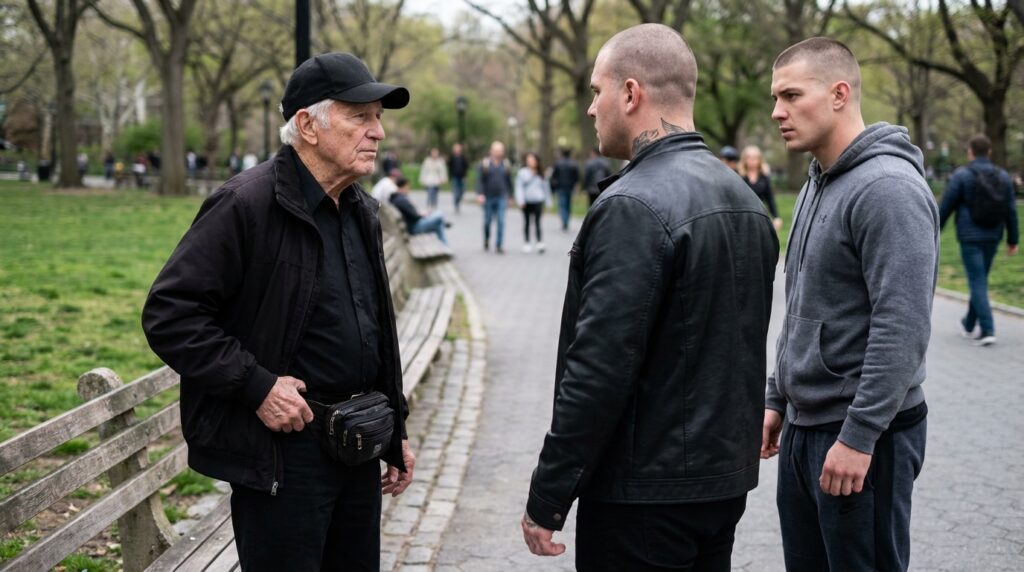
Elias adjusted the strap of the nylon pouch, feeling the familiar, heavy rectangular weight settle against his hip. It was 0700. The park smelled of wet earth and the metallic, sour tang of the city’s exhaust. He walked with a measured pace—not slow, but deliberate, the way a man moves when he knows exactly how many miles are left in his knees.

He heard the sneakers first. Squeaky rubber on damp pavement. Two sets. One heavy and flat-footed, the other light, bouncing on the balls of the feet. They weren’t joggers. Joggers had a rhythm, a cadence of breath and stride that stayed constant. These footsteps were reactive. They accelerated when he slowed; they fanned out as the path narrowed near the old oak grove.

Elias didn’t turn his head. He watched the shadows stretched long by the weak morning sun. Two silhouettes were closing the angle, a predatory triangle forming with him as the apex.

“Hey, old timer. You lost?”

The voice came from his left. Shaved head, black leather jacket that creaked with cheap tanning chemicals, neck tattoos that looked like spilled ink. He was broad, his chest puffed out with the easy confidence of a man who had never hit something that hit back. Behind him, a second man in a gray hoodie drifted to the right, cutting off the grass.

Elias stopped. He was ten feet from a weathered wooden bench with cast-iron legs. He backed himself toward it until the back of his calves felt the cold, damp wood. It was a tactical anchor. It limited their approach to a hundred-and-eighty-degree arc.

“I know exactly where I am,” Elias said. His voice was a low grate, like stones turning in a silty riverbed.

“Good. Then you know the toll for this path just went up.” The Shaved-Head stepped into Elias’s personal space. He smelled of cheap cigarettes and adrenaline. He reached out, his thick fingers hooking toward the zipper of the crossbody pouch. “We’ll take the bag. Save you the heart attack of trying to keep it.”

Elias looked the man in the eyes. He didn’t see a threat; he saw a series of structural weaknesses—a loose stance, an overextended shoulder, an ego that blinded the man to the way Elias had already shifted his weight to his rear leg.

“You’re making a mistake,” Elias said softly.

“The only mistake is you still breathing my air.” The man’s hand clamped onto the nylon strap. He yanked, expecting the frail resistance of an octogenarian.

Elias didn’t pull back. He stepped into the pull.

In one fluid, economic motion, Elias’s left hand pinned the man’s wrist against his own chest, trapping the limb. His right palm struck upward, a short, jarring burst of kinetic energy that caught the man under the chin. There was a wet thud of bone on meat. The Shaved-Head’s head snapped back, his equilibrium shattered.

The gray hoodie lunged from the flank, a desperate, swinging hook. Elias didn’t even look at him. He pivoted on his lead heel, using the Shaved-Head’s trapped arm as a lever. He swung the large man’s weight directly into the path of the newcomer. The two collided with the dull sound of a car wreck.

Elias stepped back, his breathing still rhythmic, even as a sharp ache flared in his arthritic shoulder. He watched them go down. The tattooed lead hit the concrete hard, the back of his head bouncing once. The hoodie tumbled over him, his face scraping the grit of the path.

Silence dropped over the park, heavy as a shroud. A dog walker fifty yards away froze, a golden retriever sat down, confused. Elias stood over them, his black ball cap pulled low. He reached down and adjusted the zipper of his pouch.

Inside, something shifted. A cold, hard edge of metal.

Elias looked at the man in the leather jacket, who was clutching his jaw, eyes wide and leaking tears of pure shock. He wasn’t a predator anymore. He was just a broken machine on the ground.

Elias reached into his jacket pocket and pulled out a small, laminated card—his old transit pass—and dropped it onto the man’s chest. “You looked at my age,” Elias rasped, his eyes like flint. “You should have looked at my eyes. Stay down and think about the difference.”

He turned and continued his walk. His pace was exactly the same as it had been five minutes ago, but as he reached the park gate, he felt a prickle on the back of his neck.

He glanced at a trash can near the exit. Taped to the side was a small, pulsing red LED light—a thermal sensor he hadn’t noticed on the way in. It wasn’t pointed at the path. It was pointed at the bench.


CHAPTER 2: THE ANATOMY OF LEVERAGE

The park gate didn’t swing open so much as it dragged against its own rusted hinges, screaming a short, metallic note that Elias felt in the fillings of his molars. He didn’t look back at the thermal sensor taped to the municipal green waste bin. A lesser man would have stared, would have checked his reflection in the glass of the casing, would have betrayed the exact moment the trap became visible. Elias simply kept his chin tucked, the bill of his black cap cutting the morning glare into a manageable blade of light across his vision.

His boots met the cracked asphalt of the outer avenue with a rhythmic, heavy thud. The city was waking up in unwashed gray streaks, the smell of burnt diesel and old grease rolling off the cross-town buses. Every joint in his right shoulder throbbed with a dull, sickening heat—the price of kinetic grounding. You don’t redirect two hundred pounds of moving meat without the ledger balancing somewhere in your own bones. The cartilage in his glenoid cavity was mostly gone, a dry scrape of calcified edges that reminded him he was eighty years away from being indestructible.

He didn’t head toward his apartment. If the two men on the concrete path had been an isolation test, his threshold was compromised.

Instead, he turned down an alley behind a defunct cold-storage plant where the bricks were flaking into red dust that crunched like dry cinnamon under his soles. He stopped by an electrical substation cage, its chain-link fence bowed outward by years of weeds and illegal dumping. The yellow skull-and-crossbones sign on the transformer box was pitted with rust, the paint peeling away in curled, brittle scabs.

Elias reached down, his thumb finding the heavy-duty zipper of the nylon pouch. He didn’t unfasten it. He just checked the seal. Zzzzt. The microscopic slide of the metal teeth was the only sound in the alley. Beneath the fabric, the cold, hard corner of the aluminum drive case pressed against his ribcage like an extra bone. They had targeted the bag because they thought it was cash or prescription scripts. That was the cover. But the thermal camera back there—that wasn’t a street-crew asset. That was precision tracking, configured to read skin-temperature spikes during a close-quarters threat scenario.

“Two minutes,” Elias murmured to the empty bricks. His voice was too dry, the gravel in it catching on his throat. “They were late by two minutes.”

He was calculating the transit time from the main boulevard to the park interior. If the shaved-head boy had been wired with a localized beacon, the secondary response team should have intercepted him at the gate. The fact that the street was clear meant one of two things: either they were understaffed, or they already had what they wanted from the data profile.

He caught the glint of oily water in a puddle three paces ahead. In the reflection, a black sedan drifted past the mouth of the alley, its engine a low, muffled throb that didn’t match the standard commercial fleet of the district. No license plate frame. Heavy tinting on the rear glass, the kind that didn’t just block light but absorbed it entirely, leaving the interior a featureless void.

Elias stepped back into the shadow of the transformer box, his spine pressing against the vibrating steel hull. The low-frequency hum of the electricity ran through his coat, through his vertebrae, vibrating the small silver tags tucked into the hidden lining behind the drive. They were old iron tags, not the modern stainless steel ones. They carried a five-digit serial number that didn’t exist in any database maintained by the Department of Defense since the reorganization of ninety-four.

He watched the sedan through the gaps in the chain-link fence. The vehicle didn’t stop; it crept at five miles an hour, its tires throwing up small, wet clicks as they rolled over the broken glass scattered on the margins of the gutter. It was an interrogation technique on wheels—low speed, high visibility, an invitation to run.

Elias let his hands drop to his sides, his fingers loose, the skin on his knuckles yellowed and thick from decades of labor. He didn’t have a weapon. A weapon was a liability if you got searched by a beat cop who was still young enough to have ambition. A weapon meant intent. A pair of calloused thumbs and an understanding of where the human cervical spine became brittle under ninety pounds of downward pressure was a biological reality, not an item on a police report.

The sedan cleared the alley mouth, its tail lights blooming red for a fraction of a second as it hit the corner of Elm, then it vanished into the gray soup of the morning traffic.

Elias waited forty-six seconds—the precise time it took for the local traffic light cycle to dump the next platoon of delivery trucks onto the avenue, creating a wall of noise and iron to mask his movement. When the first flatbed rattled past, its loose chains clanging against the sideboards, he stepped out of the shadow.

The grit on the pavement was shifting under a rising wind, blowing off the river with the smell of wet coal and dead carp. He checked his watch. 0714. His daily routine was off by nine minutes. To anyone else, nine minutes was a missed cup of coffee or a late bus. To Elias, nine minutes was a breach in the perimeter through which a whole column of infantry could march if the road was wide enough.

He walked toward the public library on the corner of 4th—not for the books, but because the floorboards were thick, the windows were high enough to prevent line-of-sight targeting from the roofs opposite, and the silence there was monitored by people who didn’t like loud noises. As he reached the bottom of the granite steps, his boot kicked against a discarded soda can. It didn’t roll; it was wedged between two stones, its aluminum hull crushed flat by some previous, forgotten weight, the red stencil logo half-eaten by the salt from the winter snows.

Elias looked up at the heavy bronze doors of the library. One of them was propped open with a wooden wedge. On the brass pull-bar, someone had tied a single strip of yellow surveyor’s tape. It wasn’t standard city maintenance tape. It was the heavy, reinforced nylon weave used by surveyors mapping out the boundaries of an imminent demolition.

He didn’t touch the bar. He used his elbow to push the wood further back, stepping through the gap without letting his jacket brush the frame. The air inside was three degrees cooler than the street, smelling of vinegar, wet paper, and the distinct, stale musk of old men who stayed out of the rain.

At the far end of the reading room, near the microfiche machines that hadn’t been turned on since the turn of the century, a man was sitting with his coat still on. He wasn’t reading. He was scraping a thumbnail against the edge of a plastic library card, the sound a small, rhythmic snick-snick-snick that cut through the vault of the ceiling like a cricket in an empty cistern.

Elias didn’t look at his face. He didn’t need to. He knew the cadence of that thumb.

CHAPTER 3: THE DECOY POSTURE

“The brass on that door hasn’t been polished since the winter of eighty-eight, Elias. You shouldn’t have touched the frame.”

The man by the microfiche machines didn’t turn his head when he spoke. His fingernail kept up its relentless rhythm against the plastic library card—snick, snick, snick—a sound that mimicked the cooling of a hot rifle barrel. He was smaller than Elias remembered, his shoulders sloped beneath a brown oilskin duster that had lost its waterproofing a decade ago. The fabric was stiff, coated in a fine layer of gray limestone dust from the western railyards.

Elias walked down the center aisle, his rubber soles flat against the linoleum. The floor was buckled over structural joists that were slowly rotting into pulp beneath the municipal foundation. Every stride felt like walking on a ship’s deck in low swells. He chose a chair across the oak table, the wood scarred with forty years of ink stains and deep, gouged initials from schoolboys who were probably dead or grandfathers by now.

“The tape on the door handle,” Elias said, his gravelly voice dropping into the low register that didn’t carry past the radius of the table. “You used a double-sheet bend knot. The city utility crews don’t teach that anymore. They use cheap plastic clips.”

The smaller man finally stopped his thumbnail. He placed the card flat on the table. It was a local senior transit voucher, but the name printed on the faded laminate didn’t match the face above it. The face belonged to Miller—or what was left of Miller after thirty years of breathing dry alkali in the Nevada camps. His skin was the color of old cedar, cross-hatched with fine, dry lines that gathered tightly around the corners of his left eye where a steel splinter had settled in the nineties.

“They’re tracking the profile, not the man,” Miller said. He reached down into the deep pocket of his duster, his hand returning with a small, rusted iron tin that used to hold throat lozenges. He didn’t open it. He just slid it across the oak finish, the metal base scraping against the grit with a sound that made Elias’s jaw tighten. “The two boys in the park were local talent from the South Side docks. Ten-dollar mules. They were told an old man with a black cap had a pouch full of un-stamped silver certificates. They didn’t even know what a thermal signature was.”

“The camera was set for eighty-five degrees,” Elias noted, his arms remaining loose at his sides, his eyes fixed on Miller’s collarbone. Never watch the eyes; the collarbone tells you when the weight is shifting for a draw. “It was positioned to catch the drop in core temperature during a dynamic chest strike. That’s deniable unit curriculum. The street crews don’t buy that gear at a surplus store.”

“No,” Miller agreed. He leaned forward, the smell of stale chicory coffee and damp wool rolling off his coat. “They don’t. The order came down from the regional office on 6th. They wanted to see if the machine still turned over, or if the gears had rusted solid. They got their answer. The tattooed kid is going to need three pins in his jawbone to keep his teeth from sliding into his throat.”

Elias reached down and patted the side of his nylon crossbody pouch, his fingers feeling the rigid outline of the drive. The micro-mystery of the park sensor was solved, but it left a larger, colder residue in its place. If Miller was here, the perimeter wasn’t just leaking; it had been completely dismantled.

“The drive is dead,” Elias said. “The encryption cipher was locked out when the central server in Alexandria went dark during the reorganization. It’s just old aluminum and dead copper now.”

“That’s what they think,” Miller whispered. He tapped the rusted lozenge tin with his middle finger. “They think it’s a list of the safe houses in the interior. The decoy works because it’s exactly what an old, paranoid veteran would keep if he wanted to buy his way out of a state home. They think you’re holding a retirement policy.”

“And you?” Elias asked. His hand remained an inch from the pouch zipper. Zzzzt. The mental shadow of that sound was louder than Miller’s breathing. “What do you think is in the bag, Miller?”

Miller looked up, his one good eye cloudy with cataracts but sharp enough to catch the light from the high library windows. “I don’t think anything, Elias. I know what we buried in the limestone back in ninety-one. I know the dog tags behind that drive don’t belong to a traitor. They belong to the man who signed the authorization orders for our pensions. The man they said never existed.”

A sudden draft blew through the open library doors, carrying the sharp, chemical tang of the river fog. The yellow surveyor’s tape on the brass handle rattled against the wood outside—a short, frantic tapping that sounded like code.

Elias stood up. He didn’t use the table for leverage; his legs did the work, his old thighs tightening with a dull, familiar ache that had been his companion since the crossing at the DMZ. “The sedan followed me to Elm,” he said, looking down at the cedar-skinned man. “They’re circling the block every twelve minutes. You have six left before the next pass.”

Miller didn’t move to get up. He picked up his library card and began his rhythmic scratching once more. Snick. Snick. Snick.

“They aren’t looking for me, Elias,” Miller said softly, his voice dying into the musk of the old books. “They already found me. Why do you think I’m sitting in the dark?”

Elias froze. His eyes dropped to the leg of the oak table where Miller sat. A thin, braided wire of gray steel ran from the base of Miller’s chair, tucked neatly into the seam of the linoleum floor, disappearing behind the microfiche cabinets where a small green battery pack hummed with a low, parasitic vibration. It wasn’t an explosive trigger. It was a localized jamming loom—and the indicator light on the side had just turned from steady green to an intermittent, warning amber.

The front doors of the library didn’t slam, but the air pressure in the room shifted instantly, a sudden vacuum that rattled the loose glass in the clerestory windows thirty feet above their heads. Heavy soles—not sneakers, but standard-issue tactical leather with vibram heels—hit the granite steps of the vestibule. Two men. Moving in a synchronous flank.

Elias didn’t look at Miller again. He turned toward the rear fire exit, his black cap pulled down until the brim met the line of his eyebrows. The consequence loop had closed. The park was just the prelude; the city was the trap.

CHAPTER 4: THE LIABILITIES OF ANONYMITY

The transition from stillness to velocity happened in the space between two heartbeats. Elias didn’t pivot toward the main entrance where the vibram soles were tracking across the marble vestibule; he stepped sideways, his hip checking the corner of a oak book truck. The cart rolled six inches, its rusted iron wheels squealing a brief protest against the unvarnished linoleum before he caught the frame to stabilize his momentum.

Behind him, the amber light on the battery pack behind the microfiche cabinets blinked twice, then went cold. The jamming loom was dead.

“Rear door is chained from the outside, Elias,” Miller’s voice came over the low rattle of the high windows. He hadn’t moved from his seat. His fingers had returned to the senior transit voucher, his thumbnail picking at a loose corner of the laminate with a dry, rhythmic sound. Snick. Snick. “They placed a hardened steel master lock through the links forty minutes ago. I heard the slider drop into the hasp.”

Elias didn’t waste breath on an interrogation. He redirected his weight toward the utility stack—the narrow, vertical labyrinth where the library’s obsolete pneumatic heating pipes rose through the core of the masonry. The access door was sheet iron, covered in four layers of industrial green paint that had blistered into brittle, salt-like rings around the hinges. He slipped his fingers into the recessed latch, feeling the cold friction of grease that had dried into a stiff varnish over thirty winters.

The latch clicked. A dull, heavy sound that was swallowed by the sudden slam of the inner vestibule doors fifty feet away.

“Clear the aisles,” a voice called out from the front of the reading room. It wasn’t loud. It had the flat, transactional tone of an inspector checking the weight of a commercial cargo manifest. No urgency, no theatrical aggression. That was the marker of an authorized extraction unit. “Grey profile only. Disregard the secondary asset.”

Elias slithered through the vertical opening of the utility stack, pulling the iron panel shut until the roller-catch engaged with a soft, metallic thud. The interior space was three feet wide, smelling of calcified lime dust, dead bats, and the dry iron heat radiating from the steam risers. It was dark, save for the pencil-thin beams of gray daylight filtering through the expansion joints in the brickwork.

He pressed his back against the masonry, his thumbs hooked automatically under the strap of the crossbody pouch. The rectangular edge of the drive pressed into his lower ribs. Layer 1 was intact, but its value was dropping by the minute. If the extraction unit was willing to operate inside a municipal repository during daylight hours, the profile they were running wasn’t looking for a compromise. They were executing an administrative erasure.

Through the gaps in the iron plating of the access door, Elias watched the reading room.

Two men stepped into the light between the rows of biography shelves. They wore heavy canvas utility jackets—the kind used by rail inspectors, neutral gray, no markings, no reflective strips. Their hands were low, tucked into the split seams of their pockets where the weight of short-barreled automatic frames caused the fabric to sag slightly toward the hip. They moved with a wide, lateral stance, their eyes scanning the floorboards rather than the space ahead, tracking the faint, dark tracks left by Elias’s wet rubber soles.

They stopped at Miller’s table.

The cedar-skinned man didn’t look up. He had successfully peeled the first layer of laminate away from his voucher, exposing the cheap wood-pulp paper beneath. “You’re late,” Miller said to the taller of the two gray jackets. “The light on the loom went out three minutes ago. The signal loop is already pinging the substation on 6th.”

The tall man didn’t reach for a weapon. He reached down, his leather-gloved fingers wrapping around the lapel of Miller’s oilskin duster. He pulled upward with a smooth, vertical lift that took Miller’s boots three inches off the floorboards. The movement was entirely mechanical, using the leverage of his shoulder to eliminate friction.

“The old man,” the gray jacket said. His voice was a flat level, lacking any inflection of malice or curiosity. “Where did he drop the weight?”

“He didn’t drop it,” Miller rasped, his legs dangling above the linoleum, his good eye fixed on the tall man’s collarbone. “He’s still carrying it. He’s been carrying it since the limestone in ninety-one. You think three yards of nylon and a dead battery from Alexandria is going to make him put it down?”

The secondary gray jacket shifted his stance, his boot heel grinding a fragment of fallen plaster into white dust against the floor. He glanced toward the utility stack access door. His eyes remained on the green-painted iron for four seconds—long enough for Elias to calculate the entry angle of a low-velocity round through the seam of the latch.

“The rear chain is intact,” the second man said, his hand remaining inside his utility coat. “The window frames are steel-pinned. He’s in the vertical stack or he’s behind the stacks.”

“Check the stack,” the tall man said. He didn’t drop Miller; he simply shifted his weight, slamming the smaller man sideways against the oak table. The wood split along an old ink stain, a jagged crack opening up like a dry riverbed across the initialed surface. The rusted throat-lozenge tin tumbled off the edge, hitting the floor with a sharp, hollow clink that rolled toward the access door.

Elias didn’t move. His breathing was a thin, silent draw through his nose, his diaphragm locked to prevent the lime dust from reaching his throat. He reached down into his pocket, his fingers wrapping around the object he had recovered from the park gate—the small, laminated transit pass he had dropped on the tattooed boy’s chest, which he had silently retrieved from the concrete before walking away.

It wasn’t a pass. It was a secondary decoy—a targeted data card loaded with a corrupted regional grid map that, if scanned by an automated extraction reader, would tip a false location beacon to the rail yards on the western perimeter.

He held the card between his index and middle fingers, waiting for the secondary gray jacket to reach the iron door. The distance was six feet. The friction of the door latch would give him three-tenths of a second before the gray jacket’s frame cleared the opening. It wasn’t an interrogation anymore. It was an exercise in mass and acceleration.

The gray jacket’s boot stopped twelve inches from the iron panel. The smell of his wet canvas coat came through the seam—oil, rain, and the distinct, sulfurous odor of industrial gunpowder cleaner.

CHAPTER 5: THE SANCTUARY BREACHED

The second gray jacket didn’t pull the panel; he put his boot heel against the blistered green paint and kicked. The roller-catch didn’t click—it sheared completely off its housing with a sharp, dry snap that sounded like a dry pine branch breaking underfoot. The sheet-iron door flew back against the interior masonry of the vertical stack, showering Elias with flakes of old lacquer and rust dust that tasted like copper pennies on the back of his tongue.

Elias moved before the iron hit the brick. He didn’t thrust forward with his hands; he dropped his center of gravity six inches, letting his shoulders wedge into the tight vertical masonry of the shaft, and drove his right boot directly into the seam where the gray jacket’s knee joint met the canvas trousers.

Physics is a cold master. The man was balanced on one foot, his mass carrying him forward into the dark opening. When Elias’s solid rubber heel struck the side of his patella, there was a dull, wet grinding of cartilage. The man didn’t scream—these operators were conditioned against vocal decompression—but his breath came out in a short, rhythmic grunt as his balance collapsed sideways into the oak book trucks.

“Stack is compromised,” the second gray jacket rasped into his collar mic as he rolled, his fingers already sliding into his utility coat to clear the short-barreled automatic frame from its split seam.

Elias was already moving through the shattered opening. He didn’t look at the fallen operator. His eyes were locked on the tall gray jacket who still held Miller by the oilskin collar. The tall one was fast. He dropped Miller onto the cracked oak table like a sack of dry grain and swung his right arm in a flat, horizontal arc, his fist aiming for the bridge of Elias’s nose.

The attack carried the weight of a thirty-year-old machine. Elias, at eighty, didn’t try to block the momentum with his forearms—his brittle radial bones would have splintered under that kind of mass. Instead, he slipped his head three inches to the left, letting the wind of the canvas sleeve brush his cheek, and stepped inside the operator’s guard.

He took a fistful of the stiff canvas jacket at the shoulder and drove his elbow upward into the tall man’s armpit, targeting the brachial plexus. It was like striking a stone pillar. The operator’s arm went momentarily numb, his fingers widening, but he didn’t drop his stance. He used his left hand to grab Elias by the neck, his heavy leather glove cutting off the windpipe with a smooth, closing squeeze.

Elias’s vision swam with gray spots, the smell of sulfurous gun cleaner on the glove filling his head. His heart hammered against his ribs with a dry, hollow flutter, a warning from a cardiovascular system that had run out of surplus reserves twenty years ago. He had three seconds before his knees turned to paper.

He didn’t fight the hand on his throat. He reached up with his left arm, slipping his hand through the gap between their chests, and dropped the corrupted transit card directly into the open, utility pocket of the tall man’s jacket.

At the same time, Elias used his right hand to hook the edge of the heavy oak table. With a final, desperate contraction of his latissimus muscles, he dragged his own body weight downward, using the table as an anchor to break the tall man’s balance.

The maneuver was desperate, ethically compromised by his own physical exhaustion. The table gave way first. The old wood split completely down the center with a sound like a small mortar detonation, the cast-iron legs screeching across the linoleum as three hundred pounds of combined human mass hit the floor.

Elias hit the grit hard on his arthritic shoulder. A white-hot needle of pain shot from his collarbone down to his knuckles, leaving his right arm useless and dead against the linoleum. He lay there, his breath coming in ragged, whistling gasps, his black cap gone, revealing the thin silver hair beneath.

The tall operator was already rolling to his feet, his canvas coat covered in white plaster dust from the shattered ceiling joists. He didn’t reach for his weapon. He reached into his pocket, his gloved fingers touching the card Elias had deposited there. He looked down at the plastic laminate for two seconds—long enough to read the corrupted regional grid coordinates etched into the magnetic strip.

“Target has seeded a secondary beacon,” the tall man said into his collar mic, his flat voice undisturbed by the fall. “Western railyards. Grid four-zero. He’s clearing the area toward the industrial line.”

“Negative,” the radio crackled back, a tiny, metallic wasp sound in the silence of the library. “The primary asset remains on site. Secure the bag.”

The tall man stepped over the broken oak planks, his vibram sole coming down two inches from Elias’s face. He didn’t look down. He reached out and wrapped his fingers around the nylon strap of the crossbody pouch at Elias’s waist. He didn’t unbutton the clasp; he pulled a three-inch carbon-steel blade from his sleeve and sliced through the webbing with a short, horizontal jerk. Snip.

The pouch was gone.

Elias reached out with his left hand, his fingers clawing at the grit, his fingernails tearing against the linoleum as he tried to find a purchase, any leverage to stand. For the first time in thirty years, his agency had failed him. He was a passive observer to his own extraction.

“Leave it,” Miller’s voice came from the shadow of the microfiche machines. He was sitting on the floor, his oilskin coat torn open, a thin trickle of dark, venous blood running from his nostrils down into his cedar-tinted beard. His one good eye was fixed on Elias. “Let them take the iron, Elias. It’s a dead weight anyway.”

The tall operator tucked the pouch into his duster and turned toward the front vestibule without another word. The second gray jacket, dragging his broken patella behind him like a dead weight, followed, his boots leaving a smear of dark grease across the white plaster dust on the floor.

The heavy bronze doors slammed shut in the distance. The wooden wedge that had held them open lay crushed in the gutter outside.

Elias lay in the ruins of the reading room, the silence returning like water filling a hole in the mud. Every breath felt like inhaling ground glass. The decoy secret—Layer 1—was gone, torn away by men who didn’t even know what they were protecting. And behind him, the small silver dog tags remained in the lining of his vest, hidden by the simple fact that no one had thought to search the lining of an old man’s underwear.

He had lost the bag. He had lost his anonymity. The final truth remained locked, but the perimeter was gone.

CHAPTER 6: THE RED SCRIPTURES

The bronze doors didn’t just close; the vibrations traveled through the floorboards as a dull shudder, shaking more white lime dust from the ceiling down into Elias’s mouth. He didn’t check his collarbone yet. He knew the bone was intact by the sharp, electric heat radiating into his pectorals—a green stick fracture at worst, a deep bruise against the bone marrow at best. He used his left hand to claw at the edge of a shattered oak table leg, his boots dragging through the white grit until his back found the support of the microfiche cabinet base.

“They took it,” Elias said. The words came out flat, stripped of timber by the sulfurous residue still lining his larynx. He spat once, a dark, thick glob of saliva that disappeared into the plaster dust between his knees.

“They took the decoy,” Miller answered from the shadow of the microfiche row. He hadn’t wiped the blood from his nose; it had already dried into a dark, flaking crust that split when he opened his mouth. He was leaning his skull against the rusted iron frame of a filing cabinet, his one good eye fixed on the ceiling vault. “The regional cipher on that aluminum drive will hold their software analysts for forty-eight hours before they realize the encryption key is an infinite loop that loops back to an empty server in Frankfurt. You bought two days, Elias.”

“Two days is an assumption,” Elias said, his left hand shifting down to his waistband. He didn’t touch the severed nylon straps where the pouch had lived for twelve years. He slid his fingers into the heavy canvas seam of his trousers, beneath the thermal insulation lining, until his knuckles hit the cold, thin edge of the five-digit silver tags. They were still there, sewn into the horsehair interfacing of his waistband. They hadn’t searched his clothes because they had found what they were looking for on the outside. Arrogance was the first thing they taught you to exploit in the unit, and it was the first thing they forgot when they got administrative authority.

He used his left arm to pull himself upright, his joints popping with a dry, hollow rattle like old gravel sliding down an iron chute. His right arm hung loose, the fingers numb and featureless against his thigh. He looked at the floorboards. The thin, braided wire of gray steel Miller had used for the jamming loom was still tucked into the linoleum seam, but the copper core was blackened, burned out by the surge from the extraction team’s tracking pulse.

“They had a logistics log on me,” Elias noted, his eyes scanning the shattered planks of the table. “They didn’t search the stacks. They knew the entry path. They had a spotter inside the grid before I left my room.”

“Not a spotter,” Miller said, his voice dropping into the low, mechanical rattle of a man whose lungs were filling with fluids. He reached down and picked up the rusted lozenge tin that had fallen during the struggle. The latch was broken, the top flaking away in small, orange scabs. Inside were three small cylinders of yellow wax paper—the original field logs from the Ninety-One crossing. “The order came from the interior, Elias. It didn’t come from the regional director on 6th. The director is just a pencil with a tie. It was Vance.”

The name didn’t cause Elias’s pulse to jump. At eighty, names were just labels on graves that hadn’t been dug yet. But the physics of the situation changed with that syllable. If Vance was alive, the “reorganization” of ninety-four wasn’t an administrative shift; it was a liquidation that had left a single collector on the board.

“Vance doesn’t work for the agency,” Elias said. He began walking toward the rear exit, his boots heavy, his left hand supporting the dead weight of his right elbow. “He was listed on the manifest at the railhead in Salt Lake. I signed the confirmation slip myself.”

“You signed a piece of paper that was printed on a matrix machine in an empty basement,” Miller said, his oilskin coat creaking as he stood up, using the microfiche cabinet for support. He didn’t follow Elias toward the door; he turned toward the microfiche reader, his fingers touching the glass screen where a thirty-year-old census map was still loaded. “He didn’t go into the ground, Elias. He went into the concrete. He’s the one who bought the cold-storage plant behind your avenue three years ago. Why do you think your alley always smells like industrial ammonia?”

Elias stopped four paces from the iron-pinned rear door. The consequence loop had just widened by half a mile. The sedan that had drifted past the alley mouth at 0709 wasn’t tracking his movement from the park; it was waiting for him to return to the box he had lived in for a decade. The sanctuary wasn’t just breached; it had been engineered around him from the day he took the lease.

“He wants the silver tags,” Elias said softly, his voice a low grate against the silence of the library.

“He wants the names attached to the five digits,” Miller replied. He reached into his pocket, his hand returning with a greasy box of wooden kitchen matches. He struck one against the rusted side of the filing cabinet, the sulfur head blooming into a short, greasy yellow flame that cast long, flaking shadows across his cedar face. He dropped the match into the open, broken drawer of the census registry. The old paper, dry as autumn leaves, caught instantly, a low, blue hiss of smoke rising toward the clerestory windows. “If he gets the five digits, the pensions from the deniable unit are re-routed to his commercial account in Panama. He’s cleaning the books, Elias. He’s been cleaning them for thirty years, one old man at a time.”

The smoke smelled of old glue, vinegar, and burning rags—a heavy, choking cloud that began to obscure the rows of biographies. Elias looked through the haze at Miller. The small man didn’t move away from the fire. He sat back down in his broken chair, his thumbnail returning to the edge of his library card, picking at the pulp paper while the blue flames licked at the iron base of the cabinet.

“Go to the grocery on 9th,” Miller said through the smoke. His voice didn’t have a tremor. It was the same tone he had used when they were waiting out the mortar barrages in the limestone trenches. “The girl behind the counter is his third daughter. She doesn’t know what her father does for a living, but she keeps the keys to the refrigeration basement under the cash drawer. The tunnel under the avenue connects to the plant. If you’re going to kill him, Elias, do it before the smoke clears out of this room. The fire department takes nine minutes to get down the hill.”

The iron-pinned door didn’t yield when Elias pushed it with his shoulder. The chain outside was heavy, the links clicking against the iron handle with a dull, mocking rattle. Elias didn’t hit it again. He turned toward the utility stack access door—the broken green panel he had defended five minutes ago. The shaft ran up to the roof cisterns, where an iron ladder led down into the delivery alley behind the bakery.

He slipped his frame into the dark masonry once more, the heat from the steam risers hitting his face like a dry fist. Behind him, the glass in the library window cracked from the heat, a sharp, clean ping that signaled the final collapse of his thirty-year silence.

CHAPTER 7: THE COMPROMISED SANCTUARY

The iron ladder at the top of the cistern shaft didn’t break, but three rungs from the exit, a rusted mounting bracket gave way with the dry, hollow crack of an old rifle stock. Elias’s boots slipped into the dark space below. He didn’t flail; he used his left hand to clamp around the vertical iron riser, the rusted metal flakes biting into his calloused palm as his right arm hung uselessly, an agonizing weight pulling down on his shattered collarbone. He hung there for five seconds, his breath scraping out of his throat until his boots found the rough edge of a brick ledge.

He rolled out onto the gravel roof of the bakery. The morning fog was thicker here, tasting of wet soot and flour dust.

Below him, 9th Street was a desaturated blur of delivery trucks and puddles. He didn’t wait to recover his breath. He used the side-angle fire escape, his left hand guiding his weight down the iron steps, each footfall a brief, jarring strike that vibrated straight through his calcified ribs. His world had narrowed to three square blocks, the boundaries defined by the smell of baking dough and the faint, chemical undercurrent of industrial ammonia blowing off the cold-storage vents across the avenue.

The grocery on the corner was smaller than the municipal buildings—a low-slung structure of lime-washed brick with a rusted tin roof that leaked orange streaks down the fascia. Elias pushed through the screen door, the spring screaming a short, metallic warning that cut through the low rattle of a refrigeration compressor.

A young woman stood behind the old-style manual cash register. Her hair was pulled back with a plain plastic band, her face carrying the same hard, high cheekbones Elias had seen on a topographical survey map of the Nevada interior thirty years ago. Vance’s lineage. She was counting out five-cent deposit receipts, her thumb leaving small, damp gray circles on the newsprint paper.

She didn’t look up when the door shut. “We’re out of fresh milk until the flatbed comes from the valley,” she said, her voice flat, carrying the mechanical fatigue of 14-hour retail shifts.

Elias stopped three feet from the counter, his boots tracking wet grit across the raw pine floorboards. He didn’t use a weapon. He didn’t have the leverage to clear a holster even if he carried one. He simply leaned his left hip against the counter, letting his right arm drape naturally into the shadow of his duster.

“The key under the cash drawer,” Elias rasped. His gravelly voice was barely louder than the vibration of the display cases, but it had an authority that lacked any tremor of age. “The one with the dull brass head and the two notches on the shank. Put it on the wood.”

The woman stopped her thumb. She looked at his face—at the silver stubble on his jaw, the white plaster dust clinging to his eyebrows, and the absolute stillness in his gray eyes. She didn’t reach for a panic button. People who grew up around Vance knew that panic buttons were just short-circuits that brought the cleaning crews faster.

“My father told me about an old man who walked with an iron heel,” she said softly, her hand drifting toward the recessed handle of the drawer. “He said if you ever came in here, I should give you what you asked for and then turn the lights off.”

“He was wrong about the heel,” Elias said. “The iron is in the spine. Put the brass on the table.”

She didn’t look at his dead right arm. She reached beneath the metal till, her knuckles making a dry clack against the zinc lining before her fingers emerged with a heavy, unpolished key. It was notched twice near the tip—an old industrial padlock configuration that hadn’t been manufactured since the steel mills in Bethlehem closed down.

“He’s across the avenue,” she whispered, her eyes dropping back to her deposit receipts as if she could erase her own presence by counting. “He’s been in the locker room since five. He has two men from the rail district with him. They brought a leather bag with four straps.”

Elias took the key with his left hand. The metal was cold, smelling of stale machine oil and iron filings. “Turn the lights off,” he said.

He didn’t wait for the click of the breaker. He turned toward the rear storage room where the trapdoor to the utility basement lay hidden beneath three tiers of empty potato crates. The wooden latch was rotted, the fibers pulling away in splinters as he dragged the frame upward with his single good arm. The air that rose from the hole was forty degrees colder than the shop—sharp, dry, and heavily saturated with the chemical stench of anhydrous ammonia. It was the smell of an extraction terminal.

He let himself down into the dark, his boots finding the rough concrete steps of the old beer tunnel. The tunnel didn’t have electricity; it was lit by the faint, greenish glow of municipal sewer grates twenty feet above his head. Every step down was an exercise in tactical exhaustion. His left hand kept checking his waistband, ensuring the silver tags hadn’t shifted against his ribs. Layer 1 was gone; the enemy was now running a diagnostic on a dead drive. When they realized the server loop was an administrative trap, they would return to the only physical evidence left on the board.

The tunnel ran straight beneath the avenue, the ceiling damp with condensation that dripped onto his cap like cold oil. At the far end, the masonry transitioned from old red brick to reinforced, poured concrete—the foundation of the cold-storage plant.

An iron door with three horizontal locking bars blocked the path. Elias inserted the unpolished brass key into the cylinder. It required two hands to turn the mechanism, but with his right arm dead, he had to wedge his shoulder against the concrete wall and use his forearm as a lever, throwing his entire body weight into the iron shank.

The lock turned with a heavy, wet thunk that echoed through the concrete tube behind him like a small hammer striking a anvil.

The door swung outward into the packing room.

The space was three hundred feet long, illuminated by the harsh, blue-white glare of industrial mercury vapor lamps that hung from iron chains. Racks of frozen beef carcasses hung from overhead tracks, their pale, fat-streaked flanks creating a dense, white labyrinth that restricted visibility to twelve yards in any direction. The air was a frozen fog, each breath turning into white ice crystals before it reached Elias’s nostrils.

In the center of the floor, near the massive hydraulic compressor that drove the ammonia line, three men were standing around an iron workbench.

One of them was the tall operator from the library. He had Elias’s nylon crossbody pouch open on the metal table, its contents scattered across the rusted iron surface—the aluminum drive, the dead battery, and three old transit vouchers. He was running a handheld data probe over the drive’s serial port, the small screen flashing a continuous, angry sequence of red warning lines.

Beside him stood Vance.

He was ninety years old if he was a day, but his duster was clean, the gray canvas unmarked by dust or oil. He sat on an iron stool, his hands resting on the handle of a heavy cane that was capped with a brass rail-spike. His eyes weren’t cloudy; they were the color of stagnant river water under a hard frost.

“It’s a terminal loop,” the tall operator said into the cold air, his voice flat, lacking any individual inflection. “The encryption key is a deniable security override from ninety-four. The data is empty.”

Vance didn’t look at the screen. He turned his head toward the door where Elias stood, his boots white with lime dust, his right arm pinned against his duster by a severed piece of nylon strap.

“You always were an expensive mechanic, Elias,” Vance said, his voice a low, dry rattle that carried the distinct hiss of a damaged trachea. He didn’t reach for a weapon. He didn’t need to. The third man—the secondary operator from the rail line—shifted his weight, his gloved hand already rising from his canvas pocket with a short, blued steel frame. “You spent thirty years protecting twenty-five dollars worth of scrap iron. Was the pension worth the arthritis?”

Elias stepped out from behind the carcass of a steer, his boots crunching on the frost-covered concrete. The consequence loop was down to zero. He had no leverage, no physical strength left to fight three men in an enclosed space, and his active driver agency had brought him exactly to the place where his retirement would be finalized.

“The tags aren’t in the bag, Vance,” Elias said, his voice dropping into the low, gravelly register that filled the frozen space between the racks. “They never were.”

The secondary operator didn’t wait for an authorization order. He brought the short barrel up, his alignment centering precisely on the middle of Elias’s chest. The physics of the room changed in three-tenths of a second—not through martial skill or external rescue, but through the simple law of pressure and containment.

Elias’s left hand didn’t reach for his waistband. It reached for the main safety valve of the ammonia line three inches from his elbow—a rusted iron wheel that had been painted red during the reconstruction and never turned since the plant was decommissioned.

He didn’t pull it. He threw his entire mass against the iron lever, using his weight to shear the safety pins.

The world went white.

Similar Posts

Leave a Reply

Your email address will not be published. Required fields are marked *






