
CHAPTER 5: THE ANCHOR AT THE BOUNDARY
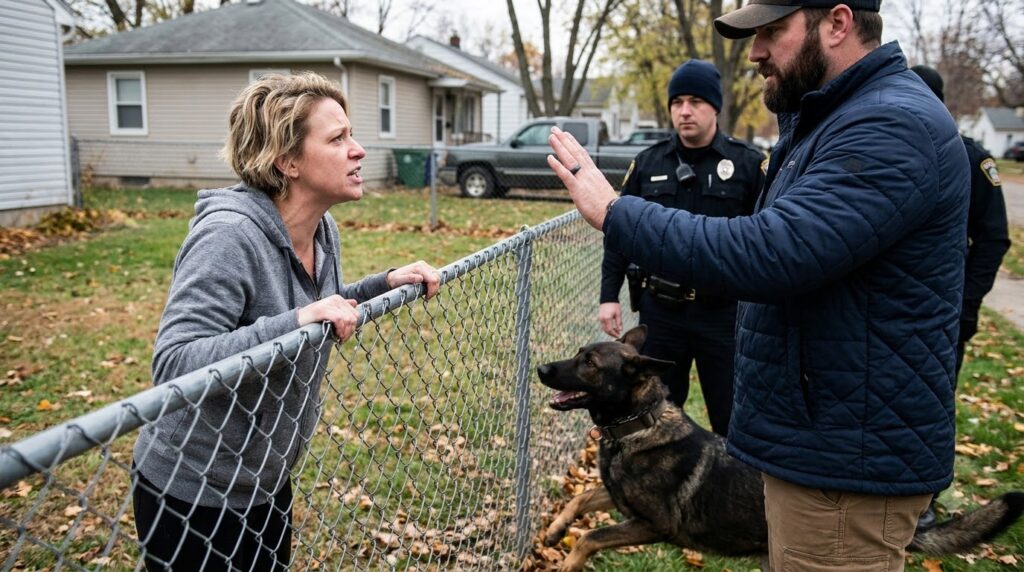
The crumpled, cream-colored cardstock dropped two inches, hovering limply near the top wire, but Brenda’s heels didn’t move. Her posture, locked in the cold morning wind, shifted from aggressive overreach to a brittle, defensive rigidity.
“That… that map is an administrative error,” she spat, her voice trembling as she clutched the fake notice against the gray zip of her hoodie. She took one short, sharp step sideways along her side of the chain link, her sneakers crushing a patch of yellowed clover. “The county contractor who poured that slab had the site plan approved by the county zoning clerk! I have the canceled checks! You think you can bring a digital tablet out here and rewrite twenty years of property lines?”
Mark didn’t drop his right hand immediately. He held the open-palm stop in the space between them for two full seconds after her paper lowered, ensuring the physical boundary hung in the air like a sheet of iron before he slowly let his arm return to his side.
Kilo remained seated at his hip, his working collar taut, dark ears pointed like twin wedges toward Brenda’s chest. The shepherd’s ears twitched at the distant whine of a delivery truck shifting gears on the main avenue, but his body remained entirely motionless—an unyielding forty-pound block of muscle anchored to Mark’s leg.
“The county recorder doesn’t work off canceled checks, Brenda,” Mark said, his voice dropping an octave, carrying the dry, unpolished rasp of a man who worked outdoors in all weather. He turned his head slightly toward Officer Davis. “And the drainage easement isn’t just a paper line.”
Davis tapped the glass of his tablet once more, the backlight casting a cold blue sheen across his dark knit cap and the black fabric of his uniform shoulder. “It’s a five-foot dedicated right-of-way for the storm overflow pipe running from the cul-de-sac down to the creek bed. If the county needs to access that pipe for maintenance or clearing, any permanent structure built inside that five-foot band is subject to immediate summary removal at the property owner’s expense.”
Brenda’s eyes darted frantically from Davis’s tablet to the low, grey concrete lip of her back patio, fifteen feet behind her. A faint hairline fracture ran down the edge of the fresh slab where it met the damp earth—a clear sign that the heavy concrete had been poured directly over loose, uncompacted drainage soil without an inspection stamp.
“You called them,” she whispered, her voice suddenly dropping into a venomous, hushed rasp that barely reached across the fence. “You had him pull those records before you even came out here today.”
“I didn’t call anyone about your patio, Brenda,” Mark said calmly. He reached down with his left hand, his thumb hooked into the heavy brass ring of Kilo’s short lead. “I requested a routine property line verification three weeks ago when I put the training posts in for the dog run. Standard procedure for any homeowner putting steel in the ground. The county surveyor flagged your encroachment on the public GIS grid before I even bought my fence wire.”
Brenda’s chest heaved. The wind caught a loose strand of her short blonde hair, blowing it across her forehead, but she didn’t brush it away. Her eyes searched Mark’s face, looking for a crack in his composure, a flicker of smug triumph, or a hint of anger she could leverage into an official complaint.
She found nothing. Mark stood on his damp grass in his quilted navy jacket and dark cap, his expression as flat and unreadable as the rusted brass survey pin buried beneath the mud at his boots.
“You knew,” she breathed, her knuckles turning white around the crumpled cardstock. “You knew the whole time I was talking about the driveway.”
“I knew where my land ended,” Mark said. “And I knew where yours began. That’s the only line that matters out here.”
Officer Davis folded the digital tablet against his thigh and stepped forward, his boots crunching on the gravel apron until he stood directly at the fence line, his presence completely shutting down any remaining space between the two properties.
“Brenda,” Davis said, his tone turning crisp and official, stripped of any casual neighborly leniency. “You are holding a forged legal notice on private property while making false claims of authority to intimidate a resident. I am advising you right now to step back to your porch, take that paper inside, and contact the county code enforcement office tomorrow morning to address your easement encroachment before a formal citation is issued.”
Brenda stared at the officer, then at Mark, her mouth working silently as if searching for a rule, a clause, or an HOA guideline that could save her from the cold reality of the boundary.
For three long seconds, no one moved. The only sound on Maple Street was the low, electric hum of the transformer mounted on the utility pole near the corner and the rustle of dry leaves scraping across the pavement.
Then, with a sudden, jerky movement, Brenda turned on her heel. She didn’t march this time; her steps were heavy, unsteady, her sneakers dragging through the wet sod as she stumbled back toward her porch steps, the fake notice clutched like a rag in her right hand.
Mark didn’t watch her reach the door. He turned to Officer Davis, offering a brief, silent nod of acknowledgment, before looking down at the young shepherd at his side.
“Free,” Mark commanded softly.
Kilo relaxed instantly, his ears lowering from their rigid working pitch as he gave a single, quiet huff of air and leaned his shoulder against Mark’s knee, his task complete.








