
CHAPTER 4: THE CROSSING AT THE GALVANIZED RAIL
The corner of the heavy cream cardstock brushed the quilted navy fabric of Mark’s jacket, its sharp paper edge stiff against his sternum.
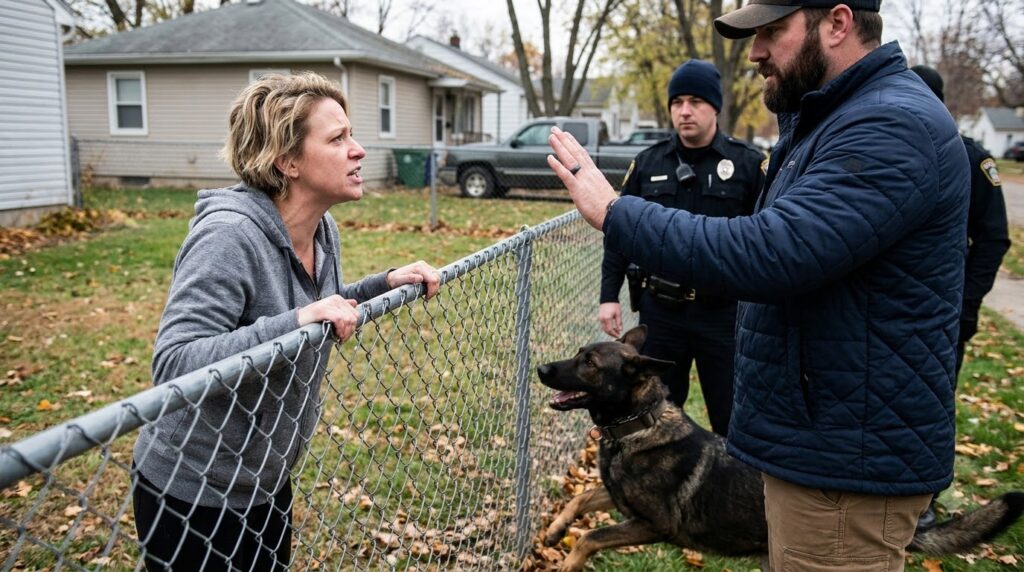
Brenda’s shoulder was thrown forward, her knuckles locked around the paper so hard the joint bones looked like polished quartz under her pale skin. Her torso hung over the galvanized top rail at a forty-five-degree angle, her gray hoodie bunching up around her throat. She had committed her weight entirely to the push, using the top wire of the chain link as a fulcrum to project her authority into Mark’s yard.
Kilo didn’t lung. Trained on high-tension scenarios where restraint was the absolute baseline, the shepherd simply dropped two inches lower into his hips, his dark muzzle perfectly aligned with Brenda’s right wrist. His front paws planted squarely in the muddy grass, his working collar humming with the quiet, vibration-heavy breath building in his ribs.
Mark didn’t flinch back from the paper. He didn’t swiping it aside, nor did he snatch it from her hand.
Instead, Mark’s right arm came up in a single, fluid arc—his elbow locked, his forearm rising like a timber brace to sit six inches in front of his chest. His broad palm opened wide, fingers spread taut, creating a flat, immovable wall of flesh and bone in the exact midair gap between her reaching arm and his body.
He didn’t touch her skin. He didn’t strike the paper. He simply established the plane.
Brenda’s hand met empty air an inch short of his jacket, her forward momentum grinding against the sheer physical presence of his open hand. The top rail of the chain-link fence creaked beneath her ribcage, the galvanized diamond mesh groaning as the tension bars absorbed her weight.
“Ma’am, step back from the fence, please,” Mark said.
His voice didn’t carry anger, heat, or triumph. It was the same flat, unyielding tone he used when commanding a seventy-pound working animal to hold a line in high-stress tracking exercises. It carried the weight of an iron anchor dropped into deep water.
Brenda’s breath hitched, her eyes widening as she stared at the flat expanse of Mark’s palm hovering inches from her knuckles. “You… you can’t block me!” she shouted, though the volume lacked its previous sharp edge, fracturing into a thin, ragged gasp. “I am serving you a legal document! You are physically obstructing a neighborhood official!”
“You’re leaning over my fence line, Brenda,” Mark replied, his palm staying perfectly static in the air. “The fence sits on my side of the survey pin. You are physical in my yard.”
Behind Mark, Officer Davis moved. His heavy leather duty boots crunched deliberately over the wet gravel, coming up to stand shoulder-to-shoulder with Mark. Davis didn’t draw a baton or reach for his holster. He simply pulled a slim black digital tablet from his jacket pocket, its screen glowing with the blue-white light of a live county geographic information system map.
“Brenda,” Davis said, his voice cutting through her frantic breathing like a cold blade. “I’m looking at the real-time county parcel overlay right now. The parcel map was updated by the county engineer’s office two years ago when the water main was replaced.”
Brenda’s eyes darted sideways toward the blue screen, her grip on the cream cardstock wavering for the first time. “That… that map doesn’t reflect the neighborhood agreement!”
“There is no neighborhood agreement on file with the city or the county,” Davis stated coldly. He tapped the screen with a gloved thumb, zooming into the boundary grid that marked the exact property division between Lot 12 and Lot 13. “And more importantly, Brenda, this document you’re holding isn’t an HOA notice. It’s a template from an online legal self-help site. The seal at the top is a stock graphic.”
The wind died down for a fraction of a second, leaving the yard in a heavy, suffocating silence. The only sound was the rhythmic, steady breathing of the shepherd sitting at Mark’s knee.
Mark didn’t drop his hand. He kept his open palm held firm in the space between them, his eyes fixed on the trembling edge of the paper.
“You printed this yourself,” Mark said quietly.
Brenda’s mouth opened, but no sound came out. Her cheeks, previously flushed with rage, went entirely gray. The paper in her hand began to rattle—not from the autumn breeze, but from the uncontrolled tremor running through her forearm.
“The easement you’re talking about,” Davis continued, turning the tablet slightly so the high-contrast parcel lines were clearly visible in the pale daylight, “doesn’t run along Mark’s driveway at all. The four-foot municipal drainage easement sits entirely on the eastern edge of your lot, Brenda. Right beneath that concrete back patio you poured last spring without a city building permit.”
Mark felt a subtle shift in the air—the sudden, undeniable crack in the wall Brenda had spent weeks building. The fake notice, the claims of HOA rules, the frantic midnight measuring sessions with a tape measure—it wasn’t about his working dog, and it wasn’t about neighborhood peace.
It was about the three feet of unpermitted concrete sitting squarely on county land behind her house.
Brenda’s arm began to sink. Slowly, inch by inch, she pulled the crumpled cream cardstock back across the top rail of the chain link, her body retreating into her own yard as the weight of the truth settled over the fence line like iron weights.








