
CHAPTER 7: THE INTRANET AUDIT
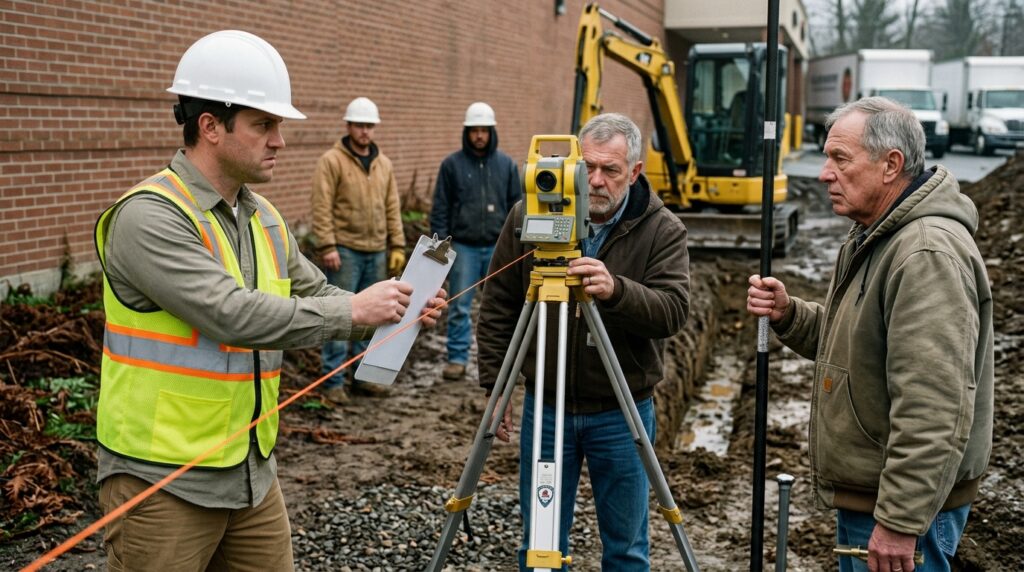
The cooling fan inside Ray’s field terminal emitted a thin, high-frequency whine that vibrated through the metal chassis of the truck’s tailgate. Outside, the gray morning fog was thickening, turning the perimeter of the pharmacy wall into a desaturated haze, but inside the narrow radius of the screen, the data packet was bleeding bright white strings of system code.
“The gateway is heavily masked, Arthur,” Ray said, his hand keeping a tight grip on the interface cable connecting his total station to the ruggedized field laptop. His thumb was stained with graphite and dark timber grease, tapping the escape key twice as the network query timed out against a secondary wall. “This isn’t a localized loop check. Every time my mapping software tries to pull the raw cadastral file from the county server, an automated proxy redirection shifts the packet back to the supermarket’s internal logistics hub. They’ve built a digital loop.”
I leaned over his shoulder, my eye following the rapid scrolling of the transaction logs. The .047 suffix wasn’t a dead passive label anymore; it was actively pulsing at the end of every data exchange line, a microscopic digital anchor keeping the corporate easement flag live on the grid. “Look at the administrative routing stamp at the top of that packet, Ray. The one right above the terminal index.”
“I see it,” Ray muttered, his fingers shifting to the keyboard pad to execute an un-masked command string. “A remote login marker. A regional administration profile accessed the root directory at 05:43 AM, right before the field crew showed up with the excavator. But the terminal signature isn’t listed under the county surveyor’s office. It’s registered to a private network terminal inside the municipal building’s basement annex.”
The realization came down like a cold sheet of iron. The corporate development group hadn’t just used an internal loophole to bypass the local checkout registers; they had secured a live physical portal inside the building infrastructure itself. Evelyn Vance’s neighborhood association wasn’t acting alone—they were the public mechanism covering a deeper, structural corruption that went straight through the county clerk’s office. A localized field audit wouldn’t clear the title if the digital ledger itself was being rewritten at the core.
“They’re locking us out of the live registry, Arthur,” Ray said, his voice flattening into the tight, defensive register he used when a load-bearing calculation came back negative. “The proxy loop is dropping a permanent hold over the coordinates of Martha’s parcel. If my system can’t pull an authenticated county master file within forty minutes, the automated state server logs the project manager’s exploratory trench as a legally uncontested infrastructure commencement.”
“They won’t log it,” I said, my voice cutting through the mechanical hum of the field laptop. I reached into my jacket pocket, my calloused fingers curling around the brass leveling tool, using its precise weight to ground the rising pressure in my chest. “The proxy loop requires a continuous validation token from a local terminal to maintain its authority. That’s why Evelyn had that specific access card in her purse at Register 2. She wasn’t just checking my bags; she was carrying the physical hardware node that keeps this network loop synchronized.”
Behind us, through the gray curtain of the timberline, the muffled roar of the mini-excavator shifted gears, the heavy steel teeth of the bucket grinding against the limestone bedrock with a grating, metallic screech. They were accelerating the excavation, pushing the structural disruption past the offset line because they knew the digital clock was running down.
Ray’s screen suddenly flared into a solid amber block, the exact color of the restriction screen from Craig’s terminal yesterday morning. Across the center of the display, the text locked into place: ACCESS DENIED – HARDWARE AUTHENTICATION TRAILING ERR .047.
“That’s it,” Ray slammed his palm flat against the tailgate liner. “The proxy just sealed the firewall. Without the root terminal key from the municipal annex, my field software can’t verify the original 1987 survey stakes. We’re blind on the line.”
The setback was absolute, a total systemic failure that threatened to wipe out our entire physical defense before we could even file the emergency injunction. The decoy was gone, but the hidden truth behind it was guarded by a digital perimeter I couldn’t cross with a standard survey target. The protagonist had to shift the vector of pursuit, forcing the confrontation away from the dirt and into the very network terminal where the loop had been forged.
“Pack the tripod, Ray,” I said, sliding the brass tool back into my pocket until it hit the lining with a dull, heavy thud. “We’re done measuring the grass. We’re going to the municipal annex.”








