
CHAPTER 6: THE BOUNDARY SURVEY
The orange poly-vinyl survey string snapped taut against my boot heel with a sharp, synthetic hum. I didn’t look back toward the supermarket parking lot, where the early morning delivery trucks were already idling against the concrete loading docks. Instead, I watched the steel tip of a four-foot boundary pin bite into the black earth of Martha’s timber lot.
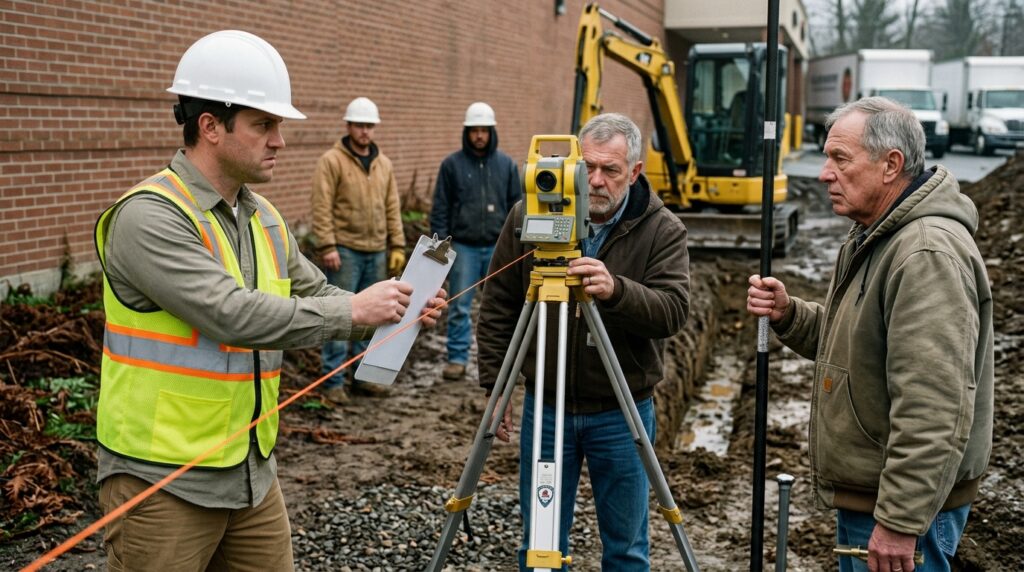
“Hold the prism steady right there, Arthur,” Ray Okafor said from behind the tripod of his total station. His voice was low, gravelly, carried on a gust of cold valley air that smelled faintly of damp pine and unburned diesel fuel. “If their field crew moved the original northwest section corner, the laser’s going to catch the discrepancy within two millimeters. The county’s public database won’t be able to buffer the error line.”
I kept both hands flat on the cold carbon-fiber survey rod, my palm absorbing the low-frequency vibration of the automated leveling motor inside the housing. Twenty yards into the treeline, the low, wet thud of a mini-excavator’s track assembly rumbled through the floor of the valley. The regional development group hadn’t waited for Monday morning. A yellow machine with no corporate decals was already idling beside the pharmacy’s rear retaining wall, its bucket teeth dripping with fresh, grey clay from an un-permitted exploratory trench.
“They’re crossing the structural offset line by twelve feet, Ray,” I said, my eyes tracking the path of a fresh tire rut that had crushed a row of wild ferns near the old limestone boundary marker. “They aren’t just clearing brush. They’re dropping stone for a heavy vehicle access lane.”
“They can drop whatever they want,” Ray muttered, his thumb clicking the mechanical dial on the optical alignment lens. The red laser diode inside the device emitted a faint, high-pitched whistle as it locked onto the glass target above my fingers. “Until they produce a stamped cadastral map signed by a licensed state engineer, every yard of gravel they dump on this side of the ditch is legally classified as criminal trespass with environmental degradation factors. Hold…”
The terminal on Ray’s console beeped—a short, dual-tone confirmation that indicated a successful coordinate lock. But before he could record the data into his field book, the thick brush near the pharmacy wall parted with a heavy, cracking sound.
A man in a clean white hardhat and a high-visibility surveyor vest stepped over the string line, a aluminum clip-board held like a shield against his chest. Behind him, two laborers stopped mid-stride, their iron shovels resting against their steel-toed boots as they watched Ray’s crew align the equipment.
“This is an active commercial easement zone, gentlemen,” the man in the hardhat said, his voice carrying the rehearsed, bureaucratic flatset of a project manager accustomed to clearing private opposition before the legal filings hit the public record. He didn’t look at me; he looked directly at Ray’s state license emblem mounted on the tripod leg. “The regional distribution network has a logistics variance certificate for this section. You’re interfering with a critical infrastructure layout.”
“Show me the wet seal on the variance, son,” Ray said without taking his eye off the optical sight. He didn’t adjust his posture. His right hand remained loosely curled around the brass leveling screw on the base plate. “I’ve been running boundary lines in this county since before they poured the asphalt on the bypass. A regional logistics certificate doesn’t authorize an access corridor over a private estate title unless there’s a federal condemnation signature on page one.”
The project manager stepped closer, the heels of his clean boots digging into the wet grass, stopping exactly two inches from the bright orange poly-vinyl line. He turned his clipboard over, revealing a printed system screen with that same decimal suffix flashing in bold black text at the bottom of the ledger block: .047.
“The filing was synchronized through the county registry’s automated portal at six o’clock yesterday morning,” the manager said, his eyes narrowing into a sharp, transactional glare as he looked across the line at me. “The variance is locked, Mr. Pendelton. The corporate office doesn’t require your signature when the municipal infrastructure code classifies this parcel as an active logistics support node. If your surveyor doesn’t pack down this equipment within ten minutes, the local precinct is going to execute a civil obstruction removal.”
I let my right hand drift to my jacket pocket, my thumb rolling over the cool, small face of the brass leveling tool I’d carried away from the checkout register. The decoy secret—the simple store-level easement—was falling away, but the technical reality behind it was growing heavier by the second. The development crew wasn’t operating on a mistake. They were using a live administrative backdoor inside the county’s digital registry to rewrite the physical boundaries of the valley while the court offices were still locked for the weekend.
“Craig’s store terminal couldn’t validate that signature yesterday, manager,” I said, keeping my pitch perfectly level against the rising rumble of the excavator engine behind him. “And neither can you. If you look at the yellow plastic survey cap your crew drove into the corner stake by the pharmacy wall, you’ll see the serial number belongs to a water-district drainage profile from nineteen-eighty-four, not a commercial logistics expansion.”
The project manager’s thumb slipped against the aluminum edge of his clipboard, his face going entirely still under the white rim of his hardhat as Ray’s laser whined across the grass, cutting a straight red line through the gray morning fog.








