
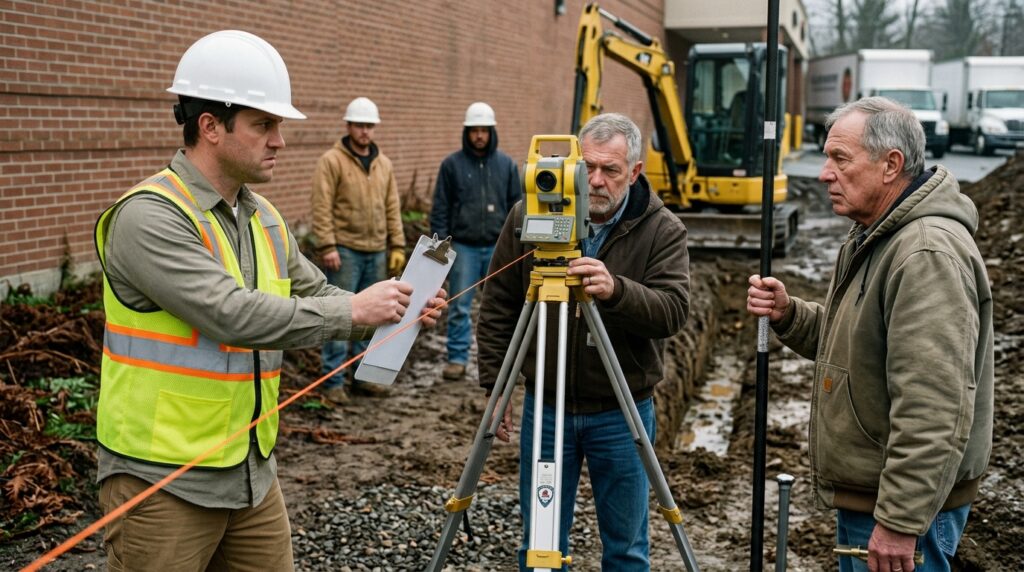
CHAPTER 5: THE CLEAR PERIMETER
“Craig, tilt that console forty-five degrees to the left,” I said, my voice cutting through the tight space between the registers like a high-tensile wire under tension.
The store manager didn’t blink. His fingers, slick with the cold sweat of a man caught between corporate parameters and public liability, shifted the terminal. The red municipal seal on the liquid crystal screen caught the hard glare of Register 2’s overhead light. The .047 suffix wasn’t a county filing index; it was a local merchant override, a specific digital routing token that required a physical administrative key card to populate the database.
Evelyn Vance’s hand went rigid against the folded paper document on the counter. Her oversized sunglasses slipped completely off her nose, hanging from the delicate gold links around her neck like a set of brass calipers. “Arthur, this document has a certified notary stamp. The logistics corridor is closed to public interference. You can’t talk your way past a municipal execution order.”
“It’s not a municipal order, Evelyn,” I said, taking my right hand out of my jacket pocket. The small brass leveling tool sat solid in my palm, its clean geometric edges catching the blue back-light of the scanner bed. I didn’t point it; I simply laid it flat on the stainless steel counter beside her paper. “Craig, look at the active barcode on the sheet she just handed you. Then look at the front tier of her shopping cart.”
Craig’s gaze dropped. He didn’t use the laser scanner. He used the flat, unblinking focus of an inspector tracking a structural fracture. Evelyn’s heavy canvas shopping bags had shifted when she threw the paperwork across the counter, and there, nestled deep within the plastic mesh basket near the toddler seat, lay three wrapped blocks of premium imported cheeses and two dark glass bottles of high-end estate olive oil. They were completely bare—un-bagged, un-tagged, and missing the small white thermal labels that indicated a completed transaction log entry.
“What is this, Ms. Vance?” Craig asked, his voice losing its administrative delay, dropping into the deep, level tone of a floor supervisor who had just found an un-recorded loss on his own inventory deck.
“Those… those are sample allocations from the regional development office,” Evelyn said, her voice dropping its sharp, piercing resonance, stuttering into a shallow, uneven rattle. She took a step back, her synthetic floral blouse catching the cold metal corner of Register 3’s conveyor belt. “They were cleared by the site logistics manager. I was instructed to bring them through the service terminal for corporate reconciliation.”
“The service terminal doesn’t process un-scanned private merchandise, ma’am,” Craig said. He raised the wireless handheld, the red laser line snapping across the glass labels of the olive oil bottles. A double-tone sounded—a short, low-frequency error code that meant the items were still active inside the local stock ledger. They had never crossed a scanner bed. “Our regional logs show Register 3 closed its transaction matrix exactly four minutes ago. These items aren’t on your balance sheet. And store policy requires every piece of corporate inventory to be scanned at the point of linear egress.”
A sudden, sharp ripple of laughter went through the queue behind us. The young man in the high-visibility vest stepped forward, his heavy boots clacking firmly on the gray tile. “Look at that. The neighborhood warden’s running a shadow audit on the high-end deli stock. Let the old man through the door, Craig. She’s the one with the un-scanned load.”
“This is an operational misunderstanding,” Evelyn hissed, her fingers twisting the leather strap of her handbag so tightly the synthetic seams began to hum under the strain. She looked around the circle of waiting shoppers, her eyes hunting for a single line of social support, but the phone screens that had been recording my bottleneck were now locked entirely onto the white edge of her knuckles. The crowd had turned. The power dynamic in the lane had completely flipped, the structural failure of her authority collapsing into the polished tile.
“I need you to step into the security office behind the service counter, Ms. Vance,” Craig said, his hand gesturing toward the gray swinging doors at the rear of the lobby. Two floor employees in matching corporate shirts moved into the perimeter, their physical silhouettes blocking her retreat toward the parking lot doors. “We’ll be running a full cart audit, and I’ll be contacting the regional compliance officer to verify why a development vendor profile is attempting to route private real estate documents through a local consumer point of sale.”
Evelyn didn’t shout. She didn’t wave the paper. Her shoulders sank three inches, her frame looking small and desaturated under the high-intensity lamps as the employees took hold of her cart handle. She walked down the long, narrow aisle toward the rear corridors, her leather purse clicking against her hip in the heavy silence of the floor.
I picked up my canvas tote, adjusting the stitched handles across my palm until the weight was perfectly balanced against my thigh. I didn’t look back at the swinging doors, nor did I check the blinking screen of my phone. I walked through the automatic glass doors, the cool morning air hitting my face with the clean, scentless clarity of an open horizon.
The gravel in the far lot crunched beneath my shoes as I reached the truck. The lot my Martha left me was still there across the asphalt, its tall oaks holding the quiet light of the early sun within their branches, completely solid, un-touched by the noise of the machinery that had tried to reshape its edges. The truth didn’t need to shout to clear a perimeter. It just needed to hold its line until the system ran out of moves.








