Chapter 6: The Space That Belonged to Everyone
Several months passed.
The neighborhood changed in small ways.
People began noticing access routes.
They stopped leaving carts across ramps.
They moved bicycles away from narrow sidewalks.
Delivery drivers received clearer instructions.
The clubhouse parking lot became easier for residents with mobility needs to navigate.
Nothing about it was dramatic.
That was the point.
Respect rarely announced itself.
It appeared in small decisions.
A driver waited.
A neighbor moved a trash bin.
Someone held a door.
Someone noticed a blocked ramp before another person had to ask.
Harold continued attending association meetings.
Karen continued serving on the accessibility committee.
They never became inseparable friends.
They didn’t need to.
Their relationship settled into something quieter.
Mutual respect.
One afternoon, Harold arrived at the clubhouse for a neighborhood luncheon.
He stopped when he saw a young delivery driver preparing to leave his van.
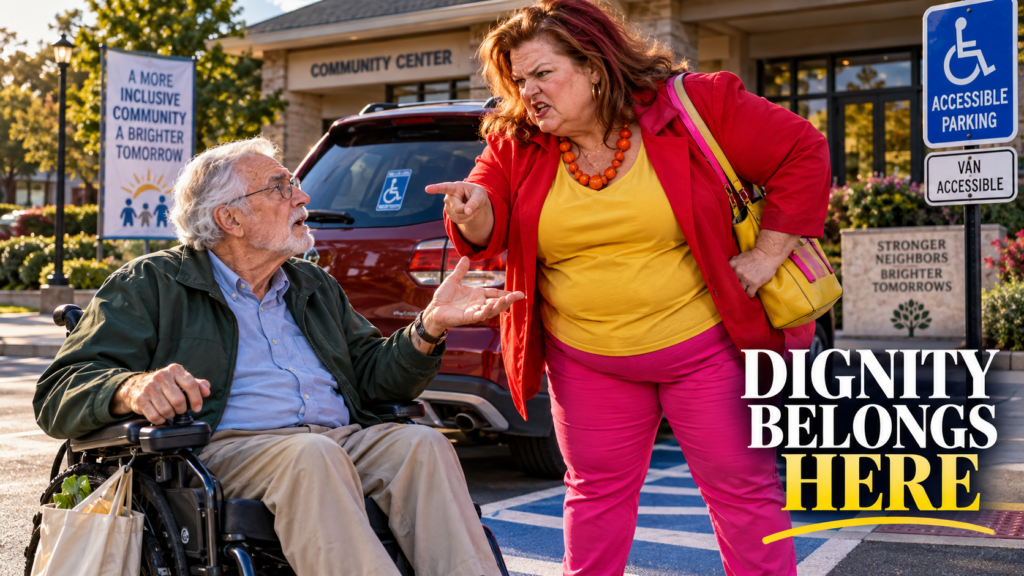
The driver had parked partly across the striped access aisle.
Before Harold could say anything, Karen approached.
For one tense second, Harold wondered whether the old Karen was about to return.
Instead, she pointed toward the pavement.
“Could you pull forward a little? This lane needs to stay clear.”
The driver apologized and moved the van.
Karen thanked him.
Then she walked back toward Harold.
He raised an eyebrow.
“That was surprisingly calm.”
Karen laughed.
“I’ve been practicing.”
Harold smiled.
They continued toward the clubhouse.
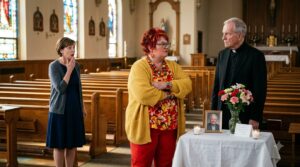
Near the entrance stood a small memorial bench.
The association had installed it in honor of residents who had passed away.
Karen had chosen the plaque.
It read:
“For those who taught us that every person deserves room to move through this world with dignity.”
Harold read it slowly.
Then he looked at Karen.
“You put Denise’s name on it?”
Karen nodded.
“And yours?”
She smiled.
“No.”
Harold looked confused.
Karen touched the edge of the plaque.
“Some lessons don’t belong to one person.”
Inside the clubhouse, people were gathering for lunch.
Harold moved through the entrance without difficulty.
The route was clear.
No one stood in his way.
No one told him to go around.
No one treated his chair as an inconvenience.
Outside, the striped access lane remained empty.
Not because everyone was afraid of the rules.
Because they had finally understood what the space meant.
It wasn’t a special privilege.
It wasn’t an empty place waiting to be claimed.
It was a promise that someone who needed a little more room would still have somewhere to go.
Harold looked back once.
Karen was standing beside the parking lot, watching the clear path.
For a moment, he remembered the first day.
Her orange sneakers planted across the stripes.
Her mocking smile.
His wheelchair stopped inches away.
He remembered how small she had tried to make him feel.
Then he looked at the open lane.
He realized the real victory had never been making Karen move.
It had been refusing to believe her insult.
Harold turned toward the clubhouse.
The wheels rolled smoothly over the repaired pavement.
Behind him, Karen quietly stepped away from the access lane.
And this time, she wasn’t blocking it.
She was making sure nobody else did.