Chapter 2: The Man Who Refused to Move
Harold had spent most of his adult life believing that dignity was something you carried quietly.
His wife, Margaret, used to tell him that dignity wasn’t about never being humiliated.
It was about deciding what you would do after someone tried to humiliate you.
Margaret had been gone for four years.
Since then, Harold had become accustomed to doing things more slowly.
Getting dressed.
Driving.
Shopping.
Crossing a parking lot.
Using his mobility chair.
He hated needing assistance, but he had never been ashamed of it.
The chair had given him something precious: independence.
That was why Karen’s behavior bothered him more than the insult.
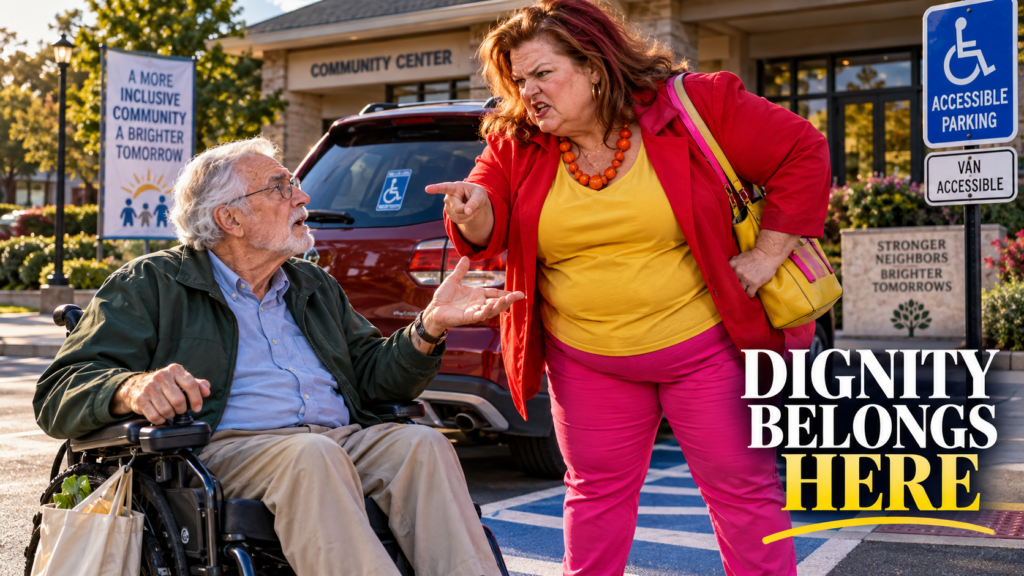
She was treating the chair as though it were evidence that he was demanding too much.
Harold remained where he was.
Karen stayed in the access aisle.
For nearly a minute, neither spoke.
Then the clubhouse door opened.
A woman in her late fifties stepped outside carrying a folder.
Her name was Linda Morales, the community association manager.
She stopped when she saw the scene.
Her eyes moved from Karen’s SUV to the painted access aisle, then to Harold’s wheelchair.
“What happened?”
Karen answered immediately.
“I’m being harassed.”
Harold almost laughed.
He didn’t.
Linda looked at him.
Harold simply said, “I need to get to the curb ramp.”
Linda looked down.
Karen was standing squarely across the striped area.
Linda’s expression changed.
“Karen, can you step aside, please?”
Karen turned toward her.
“Why is everyone acting like I did something wrong?”
Linda pointed toward the pavement.
“This area has to remain clear.”
Karen’s voice became sharper.
“I have a placard.”
“I can see that.”
“So I have every right to park here.”
“Yes,” Linda said. “In the accessible parking space. The striped access aisle is not an extension of the parking space.”
Karen stared at her.
For the first time, she seemed uncertain.
Only for a moment.
Then the anger returned.
“So now I’m being lectured because someone can’t get around my car?”
Harold quietly corrected her.
“Not around your car.”
He looked at the space between them.
“Through the access lane.”
Linda asked Harold if he could wait while she checked something inside.
He nodded.
Karen shook her head.
“This is ridiculous.”
She finally stepped aside.
Harold moved forward.
The wheelchair rolled across the stripes and toward the curb ramp.
He expected the confrontation to be over.
It wasn’t.
As he passed Karen, she leaned toward him.
“You people always make everything about yourselves.”
Harold stopped.
He looked at her, but he didn’t answer.
Linda heard the remark.
Her expression tightened.
Harold continued toward the clubhouse.
Inside, the meeting was supposed to be about cracked sidewalks and neighborhood maintenance.
Instead, everyone quickly learned what had happened outside.
There were no dramatic accusations.
No shouting.
Just a quiet shift in the room.
Several residents knew Harold.
Some had watched him regain his independence after his mobility declined.
One woman mentioned that he had helped organize a sidewalk repair petition the previous year.
Another resident said the access aisle near the clubhouse had been a problem before.
Linda opened the maintenance file.
That was when Harold noticed something strange.
The access lane had been repainted only three months earlier.
And there was a reason.
A previous resident had complained that vehicles and pedestrians repeatedly blocked it.
The association had documented the issue.
Harold leaned closer.
Then he saw the date of the complaint.
It was from six months earlier.
The name at the bottom made him pause.
Karen Whitmore.
Harold looked toward Linda.
“That’s her complaint?”
Linda nodded.
Karen had apparently complained that residents were blocking accessible routes.
Now she had been standing in one herself.
The contradiction was obvious.
But Harold wasn’t interested in embarrassing her.
He was interested in understanding why.
Because there was clearly more to the story than one parking space.