Chapter 3: What Karen Had Been Hiding
The next morning, Harold received an unexpected phone call from Linda.
She asked if he would come by the clubhouse.
There was something she wanted him to see.
When Harold arrived, Linda handed him a copy of an old association complaint.
It concerned the same accessible parking area.
Karen had filed it months earlier.
The complaint described repeated problems with blocked access.
She had written that residents needed to respect people with mobility limitations.
Harold read the document twice.
“Did she write this?”
“Yes.”
Harold looked at Linda.
“Then why would she do what she did yesterday?”
Linda didn’t speculate.
“I don’t know.”
That answer stayed with him.
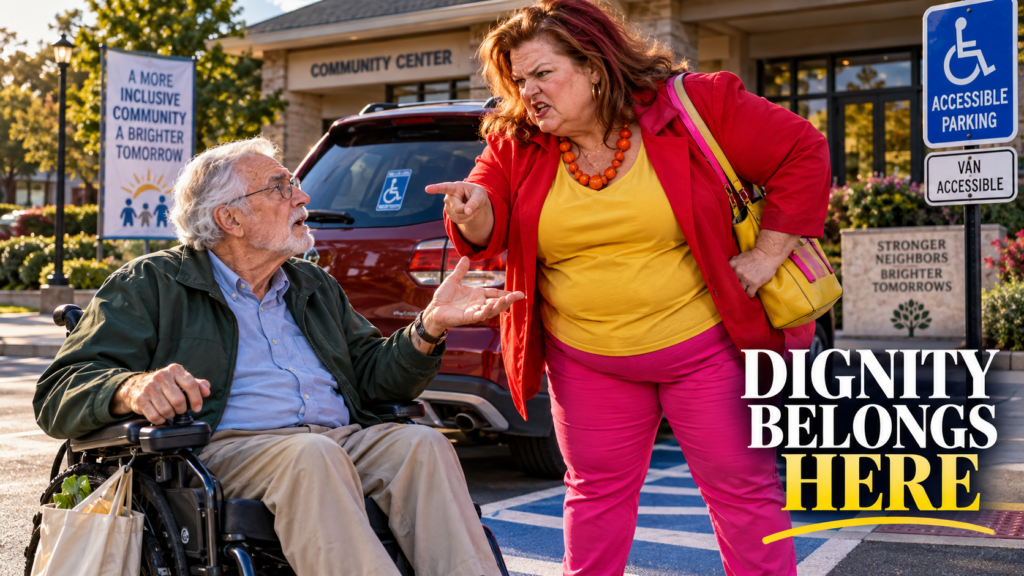
Later that afternoon, Harold saw Karen near the community mailboxes.
She was standing alone beside her SUV.
Harold almost continued walking.
Instead, he stopped several feet away.
“I saw your complaint,” he said.
Karen looked at him suspiciously.
“What about it?”
“You were right about keeping access clear.”
She seemed surprised.
Harold continued.
“That lane matters.”
Karen crossed her arms.
“So?”
“So I don’t understand why you blocked it yesterday.”
Her face tightened.
For several seconds, she said nothing.
Then she looked away.
“My sister used to use a chair.”
Harold’s expression softened slightly.
He waited.
Karen finally explained.
Her sister, Denise, had lived with a serious mobility limitation for years.
Karen had driven her to doctors’ appointments, stores, restaurants, and community events.
She had seen strangers park across access aisles.
She had watched people complain when Denise needed extra time.
She had become furious at the world.
But something had changed recently.
Denise had died the previous winter.
Karen’s anger had remained.
Harold listened without interrupting.
Karen’s voice became quieter.
“I hate people treating those spaces like they’re optional.”
Harold looked toward her SUV.
“Then yesterday?”
Karen looked embarrassed.
Only briefly.
“I thought you were judging me.”
Harold frowned.
“I asked you to move.”
“You looked at my placard.”
“Because you were blocking me.”
Karen looked down.
The truth seemed harder to face than the argument had been.
She had seen Harold’s wheelchair.
She had felt challenged.
And instead of explaining herself, she had attacked him.
Harold didn’t excuse what she had done.
But he understood something now.
The hostility hadn’t started with the parking space.
It had started somewhere much earlier.
Karen looked at him.
“I shouldn’t have said what I said.”
Harold nodded.
“No.”
It was not forgiveness.
Not yet.
Just acknowledgment.
Then Karen said something that changed the situation again.
“My placard isn’t mine.”
Harold looked at her.
“It belonged to Denise.”
Karen explained that she had kept it in the car because she couldn’t bring herself to throw it away.
She had been using it even though Denise was no longer with her.
Harold immediately understood why the situation had become more complicated.
But he also knew something important.
Grief could explain behavior.
It couldn’t erase consequences.
Linda later confirmed that the placard had indeed belonged to Karen’s late sister.
The association could not simply ignore what had happened.
There were rules.
There were records.
And there was a larger problem.
The clubhouse access lane was not the only place being blocked.
Maintenance records showed several recent complaints from residents with mobility limitations.
Someone had repeatedly moved temporary barriers into accessible routes.
Someone had left trash containers across curb ramps.
Someone had even placed cones in front of a sidewalk entrance.
Linda had assumed these were unrelated incidents.
Now she wondered if they weren’t.
And Harold began asking the same question.