
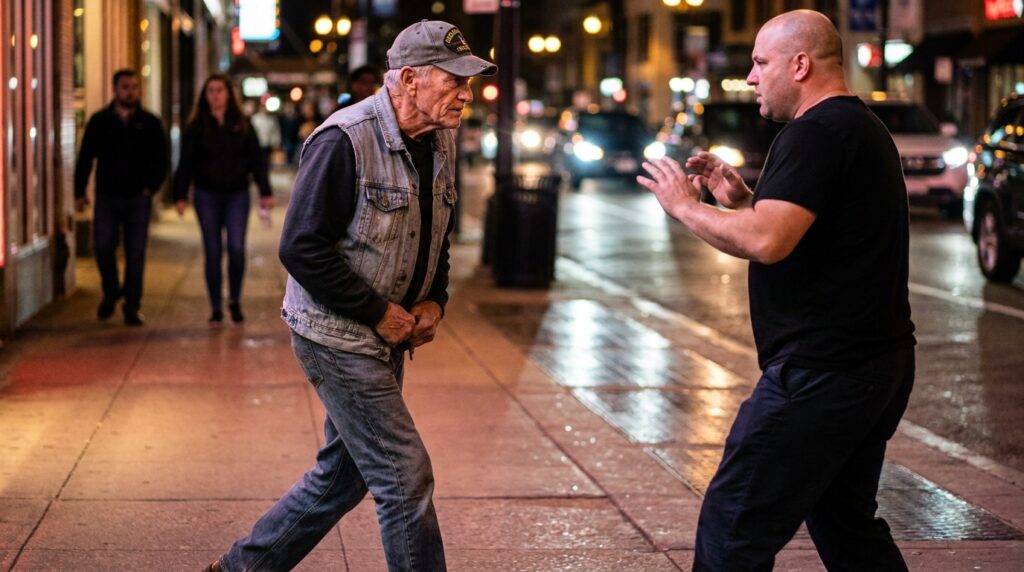
CHAPTER 4: THE INTERSECTION OF FORCE
The metallic ring of the casing against the dumpster rim had barely dissolved into the brickwork before the man in the canvas jacket committed his weight. He lunged toward the dark rear corner of the bin, his boots throwing up a spray of grit from the wet cobblestones. His right arm was tucked close to his ribs, his hand already gripping something heavy beneath his coat.
He never reached the corner. The veteran stepped down from the loading dock with a short, sliding drop that made no more noise than a wet rag hitting timber. He didn’t rush his entry. He targeted the gap left by the man’s overextended stride, closing the four-yard interval while the tracker’s focus remained locked entirely on the false trap behind the dumpster.
The second man, Miller, was still three steps behind, his boots caught in the thick puddle by the chain-link gate. He saw the old man’s gray cap cut across the dim light, but his reflexes were sluggish, corrupted by the belief that he was dealing with an octogenarian vagrant.
“Hey—” Miller started, his arm rising to point.
The veteran didn’t answer with words. He reached the first man just as the guy realized the space behind the dumpster was hollow. Before the canvas-jacketed tracker could rotate his hips, the veteran’s left hand shot forward, fingers locked into a rigid spade that drove directly into the soft meat beneath the man’s jawline. It wasn’t an anatomical strike meant for permanent damage; it was a pure physics calculation—disrupting the skull’s equilibrium to break the structural alignment of the spine.
The man’s head snapped backward, his breath leaving him in a wet, whistling grunt. His hand slipped from the heavy object inside his coat as his knees uncoupled. The veteran didn’t let him drop to the gravel where the impact would cause an unmanageable racket. He stepped into the man’s falling mass, catching the shoulder of the canvas jacket with his right hand while his left forearm hooked under the armpit, guiding the hundred-and-eighty-pound body down into the dark recess between the oil drums with a heavy, muffled slide.
“Miller!” the canvas jacket wheezed from the dirt, his fingers clawing uselessly at the cold gravel as his nervous system tried to reset. “He’s—”
Miller didn’t wait to hear the diagnosis. He pulled a short, matte-black utility iron from his waistband, his thumb hunting for the slide release as he scrambled backward toward the gate. The rusted wire of the fence rattled violently against its steel posts as his shoulder hit the frame.
The veteran didn’t chase him down the length of the brick channel. His knees were screaming, a deep, hot ache blooming behind his right kneecap from the weight of the catch. Instead, he simply reached down, his calloused fingers wrapping around the blocky radio receiver that had unclipped from the first man’s belt during the fall.
He didn’t speak into the grid. He held the small plastic box flat against his palm, his thumb resting over the transmit toggle while his eyes remained fixed on Miller’s retreating figure twenty feet away.
The radio speaker crackled, a sharp burst of static that sounded like dry gravel shifting down a chute. A voice came through—clear, institutional, and entirely devoid of street inflection.
“Unit Two, report status on the Third Avenue perimeter. Marcus is at the precinct office. He says the old man has the log.”
Miller froze at the sound of the radio. His utility iron was raised, but his head was tilted toward his own beltline, his brain attempting to process why his partner’s unit was broadcasting from the dark shadow of the loading dock. The green indicator light on the small plastic housing blinked once, casting a faint olive glare onto the veteran’s calloused thumb.
The veteran looked down at the unit, then back up at Miller. The space between them was filled with the low, rhythmic thrum of the highway overpass two blocks over—a constant reminder of the world that didn’t care about what happened in the dark spaces between the walls.
“Tell him you found it,” the veteran said to Miller. His voice was flat, devoid of the gravelly heat from the sidewalk confrontation. It was the tone of an evaluator checking an inventory sheet.
Miller looked at the utility iron in his hand, then at the dark mass of his partner groaning among the oil drums, and finally at the old man who hadn’t even raised his hands into a fighting guard. The stocky build beneath the denim vest didn’t look like an old man’s frame anymore; it looked like an obstruction that couldn’t be cleared without a caliber of force he wasn’t authorized to use on a public street.
“You’re Miller,” the veteran stated, taking one slow, measured step out of the loading dock’s shadow. The sodium light from the avenue caught the faded silver division pin on his cap, the tiny eagle’s wing gleaming for a fraction of a second against the gray wool. “Your father was in the Fourteenth Logistics out of Fort Meade. He used to handle the terminal manifests before they turned the yard into a scrap dump.”
Miller’s jaw didn’t just drop; his entire posture went rigid, his heels locking against the damp cobblestones as if he’d just been called to attention by a voice he hadn’t heard since his enlistment physical.
“Who the hell are you?” Miller whispered, the gun lowering by two inches as his fingers lost their white-knuckled grip on the polymer frame.
The veteran didn’t answer. He reached inside his vest, his fingers gliding past the rusted brass clip of the leather notebook until they touched the very back page. His fingernail traced a rough, hand-carved notch in the cardstock—a mark that didn’t belong to any corporate ledger or precinct registry. Beside that notch, written in faded purple indelible ink that had bled into the fibers over twenty winters, was a single surname: Vance.
The radio in his hand crackled again, louder this time, the static dropping out to reveal the sharp, rhythmic clicking of a teletype machine running in the background of the precinct office.
“Unit Two, acknowledge. Captain wants a visual on the target now.”








