
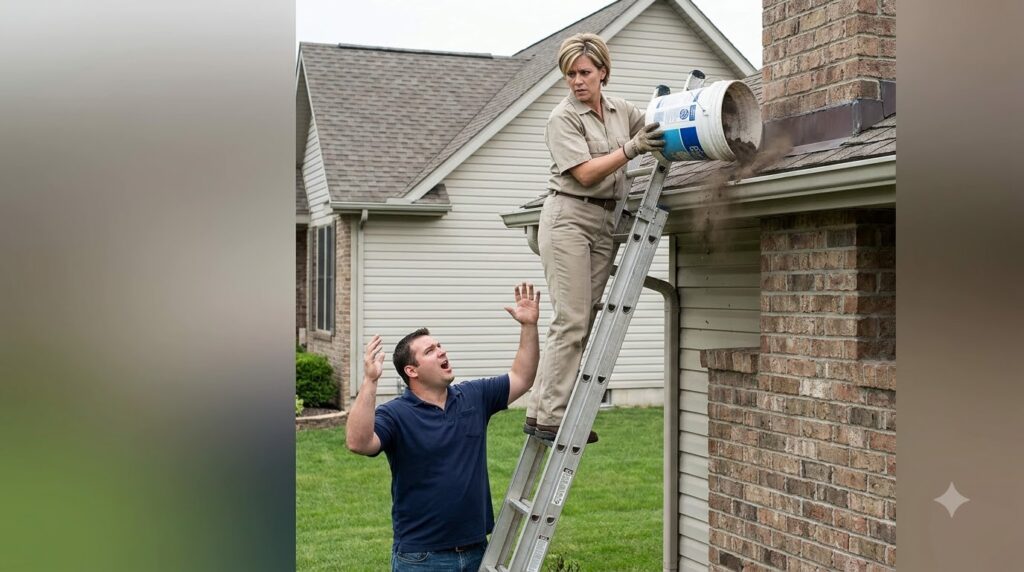
CHAPTER 8: THE REMOVAL OF DUST AND IRON
The steel latch of Deputy Enright’s handcuffs gave two sharp, metallic clicks as they closed around Brenda’s right wrist, then her left, pinning her gloved hands behind her back.
The sound was small, but across the unmowed turf of Marcus’s front lawn, it cut cleaner than a bench grinder hitting tool steel. Brenda’s chin sagged toward her collar. The stiff, beige canvas of her work shirt bunched awkwardly at her shoulders, the smudges of black creosote across her cheek catching the harsh afternoon glare. She didn’t look at the gathering neighbors along the asphalt curb; her eyes stayed fixed on the two deep, square gouges her ladder’s rubber feet had torn into the topsoil.
“You have the right to remain silent,” Deputy Enright said, his voice flat, rhythmic, reciting the Miranda warnings with the tired cadence of a man who had processed a hundred petty neighborhood disputes that turned criminal. He guided her by the elbow toward the rear door of the brown-and-gold patrol car, the rear seat door opening with a heavy latch-clack that echoed off the brick facade of the ranch house.
Marcus didn’t watch her step into the back of the cruiser. He stepped past Officer Miller, his work boots sinking into the soft turf where the white-and-blue utility bucket sat beside the bottom rung.
The wire handle was still slick with petroleum sludge. Marcus reached down, wrapped his fingers around the center grip—not with a glove, but with his bare, calloused hand—and lifted the five-gallon container off his grass. The greasy black liquid inside sloshed against the plastic walls, heavy and toxic, but he held it away from his work pants as he carried it straight to the rear bumper of Miller’s municipal Explorer.
“I’ll take the bucket into the county evidence locker, Marcus,” Miller said, taking the container and placing it upright inside the rubberized cargo liner of his trunk. “The lab will run a chemical match on the creosote. Once we tie the sulfur ratio to the industrial burner at her brother’s storage lot down on Route 4, the State’s Attorney will have everything needed for a full criminal indictment on hazardous dumping and fraud.”
“And the ladder?” Marcus asked, his gaze shifting back toward the two-story aluminum rails still resting against his roof eave.
Miller unclipped a yellow plastic tag from his belt folder and looped it around the bottom rung, cinching it tight. “It’s evidence in an active property trespass investigation. But you have the legal right to clear your structure immediately to prevent further damage to your eave.”
Marcus didn’t wait for a towing crew or a county contractor. He walked to the base of the ladder, planted his boots firmly in the turf, and grabbed the side rails four feet up. His forearms flexed, the navy polo stretching tight across his back as he lifted the two-story aluminum assembly off the brickwork. The rubber top-feet peeled away from his painted soffit with a faint sticking sound, leaving two small grey rubber marks against the white trim, but the hand-pointed red clay of his chimney stood completely untouched, straight and solid against the Virginia sky.
He walked the ladder down, stepping backward across the lawn rung by rung until the sixty-pound frame lay flat in the grass, parallel to his driveway edge.
Down at the curb, old man Miller uncrossed his arms from his chest. He took off his oil-stained yellow cap, wiped his forehead with the back of his wrist, and stepped across the drainage ditch onto Marcus’s driveway. Sarah Jenkins and her husband walked over right behind him, their retriever trailing calmly on its leash.
“We saw the whole thing from the porch, Marcus,” Sarah said, her voice quiet but clear in the warm afternoon air. “She’s been trying to issue architectural fines on three houses down on the cul-de-sac since May. We didn’t know about her brother’s real estate firm until Miller read that paper.”
“She won’t be issuing fines anymore,” old man Miller said, his voice a dry, rasping growl as he looked at the patrol car pulling away from the curb, its rear doors locked tight. “Not from a county jail cell.”
Marcus didn’t say anything for a long moment. He reached into his back pocket, pulled out his grease-stained shop rag, and wiped the thin film of soot off his thumb. Through the open garage door behind him, the cool scent of machine oil and cured concrete drifted out, covering the sour stink of the creosote.
He walked up the porch steps, stood on the threshold, and looked up at his chimney. The red clay bricks, laid by hand three winters ago and pointed with high-temp mortar, caught the full gold of the late-afternoon sun. The soot stain on the outer edge would take an hour with a stiff bristle brush and a bucket of muriatic wash, but the brick beneath was solid, square, and whole.
“Thanks, Ray,” Marcus said, turning to Miller as the code officer shut his trunk lid.
“Don’t thank me, Marcus,” Miller said, climbing into the driver’s seat of the city cruiser. “You built a good flue, and you kept your head when the pressure came down. That’s what saved your home.”
The Explorer pulled out into the cul-de-sac, its tires crunching softly over the asphalt edge before disappearing down Oakridge Court.
Marcus walked back into his garage, set his rag on the steel workbench beside his socket wrench, and looked out over his front lawn. The neighborhood was quiet again—the sound of the riding mower starting back up across the street, the wind rustling through the pine needles along the property line, and the steady, unyielding weight of the red clay chimney standing high against the sky.








