
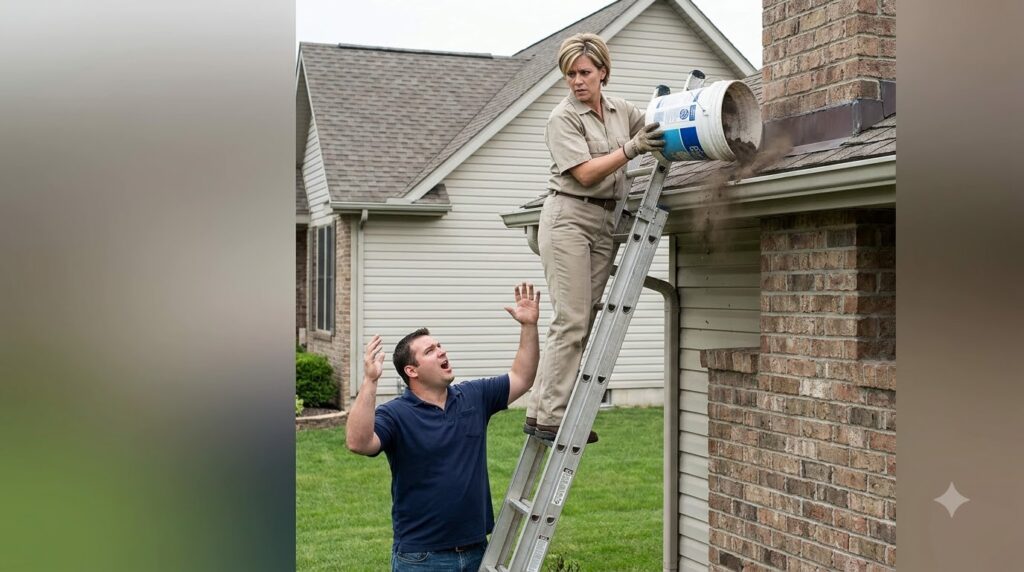
CHAPTER 3: THE LEVERAGE ON THE GRASS
Brenda’s left boot heel struck the dry sod with a dull, heavy thud. The aluminum ladder shifted an inch to the right, its upper tips grinding against the white aluminum soffit and leaving two raw, silver gouges in the paint.
She didn’t let go of the five-gallon bucket immediately. Her gloved hand remained hooked around the wire handle, the base of the plastic container resting against the outer side of her right calf. The greasy black sludge inside sloshed, a thick, tarry bubble popping at the surface and releasing a sour stench of coal ash and old fuel oil that cut straight through the heat of the driveway.
“You’re stepping into a civil lawsuit, Marcus,” Brenda said. Her voice didn’t carry the shrill edge it had on the rungs; it had settled into a flat, practiced rattle, the tone she used when reading non-compliance notices during board quorum calls. She took a half-step sideways, trying to clear the ladder’s footplate, but Marcus moved his hips six inches to the left, planting his heavy work boots directly between her and the gravel pathway leading to her crossover parked at the curb.
“The lawsuit’s already on my lawn,” Marcus said. He kept his shoulders set, his arms hanging loose at his sides, knuckles dusted with the fine grey iron powder from his garage lathe. “Along with two hundred pounds of aluminum and five gallons of illegal waste.”
“It isn’t waste.” Brenda reached up with her left hand, her thumb tucking under the collar of her light beige work shirt. Her fingers brushed against the edge of a yellow carbon-copy document folded twice and shoved deep into her breast pocket. The corner of the paper was crisp, unstained by soot, bearing the heavy, purple-inked oval stamp of the County Building and Safety Division. “It’s material evidence gathered under an official municipal abatement warrant. Section 12-B gives the HOA architectural subcommittee authority to collect flue deposits when a property owner refuses independent fire-safety certification.”
Marcus didn’t take his eyes off her face, but his mind calculated the geometry of her lie with the quiet precision of a dial caliper. “The city doesn’t issue abatement warrants to HOA vice presidents on a Tuesday afternoon without a fire marshal standing on the driveway. And they don’t use yellow carbon slips from an old building department receipt book.”
Brenda’s jaw twitched. A bead of sweat trickled from her highlighted hairline down the side of her nose, tracking through a smudge of black soot on her cheek. “The warrant was signed at eight o’clock this morning by Clerk Vance at the municipal annex,” she said, her chest heaving slightly under the stiff canvas shirt. “It’s stamped, it’s logged, and it authorizes immediate physical containment of structural fire hazards.”
“Clerk Vance is my second cousin,” Marcus said, his voice dropping into a quiet, flinty register that made Brenda’s eyes flick toward the street. “He retired to North Carolina three years ago. The only person signing papers in that annex now is a deputy clerk named Higgins, and he doesn’t touch fire abatement without a court order.”
Across the street, the idle drone of the riding mower ceased completely. Old man Miller stepped down off the mower deck, his oil-stained yellow cap pulled low over his forehead, and leaned his elbows against his chain-link fence. Beside him on the curb, Sarah Jenkins and her husband stayed motionless, their retriever panting quietly in the midday heat as they stared straight across the asphalt at the ladder planted against Marcus’s roof.
Brenda felt the weight of the silence settling over the cul-de-sac. The suburban quiet wasn’t protective anymore; it was an amphitheater, catching the scrape of every boot on the turf and every breath drawn in anger. She shifted her grip on the bucket handle, her leather glove squeaking against the plastic.
“It doesn’t matter whose name is on the ledger,” she snapped, her knuckles turning grey under the dust. “The hazard is physical. It’s right here in this bucket, and it came off your chimney rim.”
“It came off the back of your brother’s flatbed truck,” Marcus said, stepping forward until the toe of his boot touched the plastic lip of the bucket. He didn’t look down at the sludge; he kept his eyes pinned to the yellow paper sticking out of her shirt pocket. “The same truck that’s been parked behind the old brickworks on Route 4 for three weeks. You scraped that creosote out of an industrial boiler flue, Brenda. You carried it up my ladder, and you tipped it down my pipe.”
“You can’t prove that,” she whispered, her voice finally losing its administrative shield, exposing the hard, frantic pulse of a woman whose leverage was slipping through her fingers.
“I don’t have to prove it,” Marcus said, reaching his right hand into his pocket and pulling out his smartphone, the dark screen catching the sharp glare of the cloudless sky. “The camera on the ridge line already did.”
Brenda’s gaze snapped up to the eave, locking onto the tiny glass dome tucked into the shadow of the fascia board. The green status light gave a single, steady pulse, silent and unblinking in the heat.








