CHAPTER 4: THE SCREEN AND THE SEAL
Brenda didn’t take her eyes off the camera glass, but her shoulder muscles twitched, a sharp, involuntary tremor that rattled the bucket’s wire handle against her knee.
Marcus tapped the black screen twice with his thumb. The matte glass flickered to life under the bright sky, displaying a high-definition grid: four camera feeds streaming in real time from the house corners, each timestamped in bright green digits across the top edge. He swiped left, opening the event buffer, and selected the twelve-minute clip recorded at 1:42 PM.
“Take a look, Brenda,” Marcus said. His thumb stayed fixed over the playback bar, the screen casting a pale blue reflection onto the dark leather of his work boots. “1080p, optical zoom, forty frames a second. It captures a clear picture of the roofline from thirty feet out.”
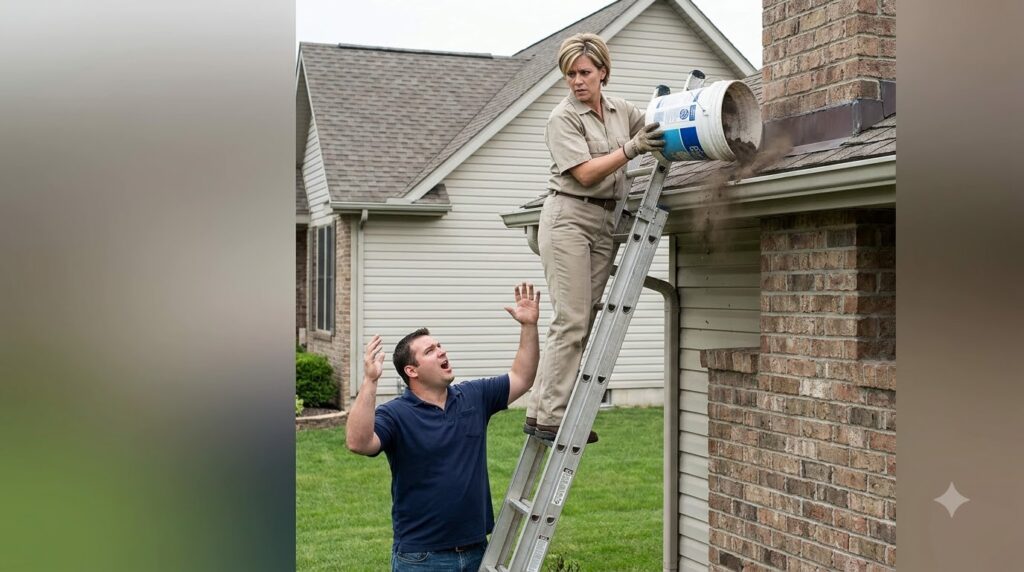
He didn’t step closer, but he angled the phone so the glare off the glass fell across Brenda’s chest. On the screen, the video played back with cold, mechanical clarity: a figure in beige canvas work pants and a light beige shirt dragging an aluminum extension ladder across the turf, setting the rubber feet three inches into the grass, and ascending with a white-and-blue bucket slung over her left shoulder. The camera caught the exact second her gloved hands tipped the bucket rim over the hand-pointed red brick, a cloud of black creosote dust mushrooming into the air before falling down the open flue pipe.
Down at the curb, Sarah Jenkins stepped off the concrete edge and onto the grass line, her husband following two paces behind. Old man Miller unlatched his chain-link gate, the rusted hinges screeching across the silence of the cul-de-sac as he walked slowly toward Marcus’s driveway, his heavy boots crunching against the dry gravel shoulder.
Brenda’s eyes darted from the phone screen to the growing circle of neighbors. Her left hand moved again toward her breast pocket, her fingers digging behind the yellow carbon paper as if trying to push it deeper out of sight.
“That clip proves nothing about legal authorization,” Brenda said, though the words lacked the hard administrative bite she had brought down from the roof rungs. Her tongue rasped against her lips, dry and coated in soot grit. “The board holds broad authority to gather evidence of structural code non-compliance. What you’re showing is an officer executing a physical inspection.”
“An inspection doesn’t involve dumping industrial sludge down a working chimney, Brenda,” Marcus said. He paused the video at the exact frame where the dark sludge spilled out over the brick rim, locking the image in place. “And an inspection doesn’t come with a fake permit from a retired clerk.”
He stepped forward, closing the two-foot gap between them until he could smell the stale sweat and engine exhaust clinging to her beige work shirt. With his free hand, he pointed a thick, calloused index finger straight at her breast pocket—specifically at the crisp corner of the folded yellow document.
“Pull that paper out,” Marcus commanded quietly. “Let’s read the header together in front of Miller and the Jenkinses. Let’s see whose stamp is at the top.”
Brenda stiffened, her spine locking straight as if he had jabbed her with a hot iron. Her right hand clamped over her pocket, flattening the canvas fabric against her chest. “This is an internal administrative record. You don’t have the right to examine board documents.”
“It’s a public abatement warrant, according to you,” Marcus countered, his voice steady as a plumb line. “If it came from the city annex, it’s a matter of public record. If it didn’t, it’s a forged instrument used to commit criminal trespass.”
Old man Miller reached the edge of the driveway, stopping three feet behind Brenda. He adjusted his oil-stained yellow cap, his sharp eyes scanning the aluminum ladder, the white-and-blue bucket on the grass, and the frozen image on Marcus’s phone screen.
“I worked forty years for county public works, Brenda,” Miller said, his voice a dry, gravelly scrape that carried across the lawn. “The city hasn’t used yellow carbon slips since ninety-eight. Everything coming out of the annex is white bond with a digital barcode. That slip in your pocket didn’t come from any municipal desk.”
Brenda turned her head slowly toward Miller, her chest rising and falling in shallow, jagged gasps. As her shirt pulled tight across her shoulder, the folded corner of the yellow paper shifted, revealing two lines of fine black print just above the purple ink oval: Halloway Real Estate Holdings & Acquisitions — Preliminary Site Survey.
Marcus caught the letters instantly. The piece of paper wasn’t a city warrant, and it wasn’t an HOA violation notice. It was an internal site-acquisition voucher from her brother’s commercial development firm, complete with a pre-printed hazard-assessment clause designed to force immediate property condemnation before municipal tax reassessments.
The decoy secret—the claim of a corrupt municipal clerk issuing a city warrant—shattered right there on the grass under the mid-afternoon sun.
“You didn’t go to the city annex at all,” Marcus said, his voice dropping into a register so dark it seemed to pull the heat out of the air. “You generated this paper in your brother’s office down on Route 4. You brought a corporate acquisition voucher onto my property and called it an HOA fire warrant.”
Brenda didn’t answer. She took a quick, panicked step backward, her boot heel catching on the bottom rung of her own ladder, sending a sharp, ringing vibration up the aluminum side rails.