
The Weight of Red Clay and Cold Iron in the Shadow of Oakridge

CHAPTER 1: THE ACCIDENT OF ALUMINUM AND ANCIENT BRICK

The sound wasn’t wind, and it wasn’t the thermal expansion of fifty-year-old pine trusses setting under the late-August sun. It was the sharp, hollow clack of painted aluminum biting into raw red brick.

Marcus Vance didn’t drop the socket wrench. He set it down on the steel lip of his workbench, grease-blackened rag tucked into his back pocket, his thumb lingering on the cold steel shaft just long enough to count two beats. Outside, the air smelled of dry turf, engine exhaust from three streets over, and the distinct, sulfurous bite of scorched creosote drifting straight down through his open garage door.

He stepped past the tailgate of his pickup onto the asphalt driveway. The sun hit the back of his neck like a flatiron.

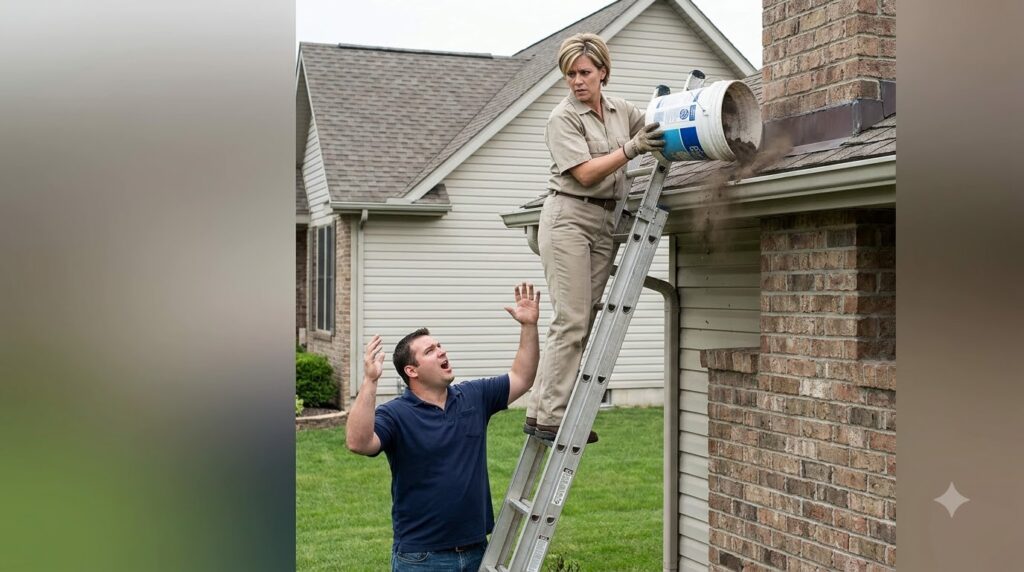
High up on the west eave, where the hand-pointed red clay of his restored chimney met the painted soffit, a pair of worn canvas work pants sagged over the rungs of a two-story extension ladder. The rubber feet of the ladder were sunk three inches into his freshly seeded side-lawn turf, chewing through the topsoil he’d spent three weekends grading by hand.

Above the rungs, balanced on the narrow ledge near the flashing, Brenda Halloway leaned her hip against the brickwork. She wore heavy leather gloves—the cheap yellow cowhide kind from the hardware store down on Route 4—and both hands were locked around the wire bale of a five-gallon white-and-blue bucket.

Marcus didn’t yell. He walked across the turf until the toes of his work boots were six inches from the ladder’s steel base plates. He looked straight up past the aluminum side rails.

A dark, greasy plume of crushed mortar and industrial soot was pouring out over the brick lip, falling like black rain into the open flue pipe. Dust drifted down through the sunlight, settling on the white soffits in greasy streaks.

“Brenda,” Marcus said. His voice was low, rasping from thirty years of inhaled cast-iron dust and rust-remover fumes, but it carried across the open lawn to where a riding mower sat idling two houses down. “Get off my roof.”

Brenda froze. Her body went rigid against the masonry, the bucket tilted at a forty-five-degree angle over the open brick pipe. The short, highlighted blonde hair at the nape of her neck was plastered down with sweat, her beige work shirt dark between her shoulder blades. She didn’t look down immediately; her knuckles just tightened on the bale until the plastic handle groaned.

“This is an emergency structural assessment, Marcus,” she said, her voice strained as she tried to pull the bucket back against her ribcage without slipping on the pine-needle drift along the shingle edge. “The board received notice of an uncertified flue hazard. I have administrative right-of-way under Section 4.”

“You’re dumping creosote into an active hearth,” Marcus said. He didn’t move his feet. He reached out with his left hand and laid his palm flat against the cold aluminum rail of the ladder, anchoring it into the dirt. “You’re standing on private grass, you’ve got five gallons of waste in your hands, and you’re three seconds away from taking the short way down. Get off the ladder.”

Above him, the bucket scraped against the brick edge—a sharp, metallic screech that made the porch watchers down the block turn their heads. On the underside of the eave, just six inches above Brenda’s left shoulder, the small glass lens of the solar-powered ridge camera blinked once, its tiny green status light gleaming cold in the shadow of the fascia board.


CHAPTER 2: THE ANCHOR IN THE TURF

“The board doesn’t sign warrants for criminal trespass, Brenda,” Marcus said, his palm remaining clamped over the corrugated aluminum rail like a C-clamp locked on cold channel iron. “And the city code doesn’t let an HOA officer climb a ladder with a bucket full of chimney sweepings.”

Brenda’s boots—heavy leather composite work boots with scuffed rubber toes—hovers on the fifth rung from the bottom. The extension ladder flexed under her hundred-and-forty-pound frame, the aluminum side-rails groaning against the mortar joints of the chimney breast. Dust, fine as powdered graphite and smelling of old coal tar, drifted out from the seam between the brick and the gutter fascia, coating her beige canvas trousers in grey streaks.

“You’re obstructing an architectural compliance review,” she spat out, her vocal chords tight, vibrating with the sharp, reedy pitch of a bureaucrat whose authority had just hit a physical wall. She lowered her right foot down one rung, her boot heel catching on the metal lock latch. The white-and-blue five-gallon utility bucket swung against her knee, the wire handle creaking in her gloved grip. “Step back from the ladder, Marcus. I have the structural report in the truck.”

“Show me the county seal on it,” Marcus said. He didn’t shift his weight. He felt the vibration through his boots—the subtle, rhythmic thud of a riding mower engine dying across the cul-de-sac. Down at the edge of his property line, near the mailboxes, two neighbors had stopped walking their dogs. They stood on the concrete curb, shadows long and dark across the sun-baked asphalt, watching the roofline. “Show me the signature from the building department. Because unless Ray Miller put his ink on a warrant, you’re standing on four hundred square feet of private turf with five gallons of toxic creosote.”

Brenda’s jaw worked silently. The sweat on her forehead caught the harsh glare of the late-afternoon sun, highlighting the deep creases around her mouth. She didn’t reach for her back pocket or the clipboard that usually sat wedged between her driver’s seat and the center console of her crossover. Instead, her knuckles turned white through the cheap cowhide gloves as she pulled the bucket closer to her ribs.

Around the lower rung of the ladder, just above the steel footplate sinking into the torn turf, a thin strip of faded oiled leather dangled from a brass ring. It wasn’t standard safety equipment for an extension ladder. It was an old lineman’s tool tether, stamped with a serial number that had been ground down with an emery wheel—just enough to leave a raw, bright groove in the brass.

Marcus caught the metallic glint of the brass ring out of the corner of his eye, but he didn’t lower his gaze. He kept his eyes locked on Brenda’s face as her boot finally found the second rung above the lawn.

“I don’t need Ray Miller to tell me when an unlined flue is throwing sparks into a dry tree line,” she said, her voice dropping an octave, trying to find the smooth, practiced cadence she used during monthly board meetings in the elementary school cafeteria. “The entire neighborhood is at risk. If you won’t allow a voluntary remediation inspection, the board exercises its right of emergency abatement.”

“You’re not inspecting,” Marcus said. He slid his left hand two inches up the rail, blocking the narrow clearance between the ladder and the brick pillar. “You’re dumping. I saw the soot come out of the bucket, Brenda. I felt it hit my face.”

He reached into his navy polo pocket with his right hand, his fingers skimming the smooth glass face of his smartphone. On the screen, locked under the matte screen protector, the solar camera’s live-feed buffer was already saving the ten-second loop to the local storage bridge inside his garage.

Brenda’s left foot hovered six inches above the turf. She looked at his hand on the rail, then at the gap between his shoulder and the garage door frame. Her posture shifted—a quick, defensive stiffening of her shoulders that told Marcus everything he needed to know about the paper trail she claimed to have in her vehicle.

“If you don’t take your hand off this rail,” she whispered, her voice barely carrying past the scrape of her leather gloves against the metal, “I’m calling the county sheriff for physical intimidation.”

“Call ’em,” Marcus said, his voice flat, heavy as a slab of cast iron dropped on a wooden floor. “Tell ’em to bring Ray Miller with ’em.”

CHAPTER 3: THE LEVERAGE ON THE GRASS

Brenda’s left boot heel struck the dry sod with a dull, heavy thud. The aluminum ladder shifted an inch to the right, its upper tips grinding against the white aluminum soffit and leaving two raw, silver gouges in the paint.

She didn’t let go of the five-gallon bucket immediately. Her gloved hand remained hooked around the wire handle, the base of the plastic container resting against the outer side of her right calf. The greasy black sludge inside sloshed, a thick, tarry bubble popping at the surface and releasing a sour stench of coal ash and old fuel oil that cut straight through the heat of the driveway.

“You’re stepping into a civil lawsuit, Marcus,” Brenda said. Her voice didn’t carry the shrill edge it had on the rungs; it had settled into a flat, practiced rattle, the tone she used when reading non-compliance notices during board quorum calls. She took a half-step sideways, trying to clear the ladder’s footplate, but Marcus moved his hips six inches to the left, planting his heavy work boots directly between her and the gravel pathway leading to her crossover parked at the curb.

“The lawsuit’s already on my lawn,” Marcus said. He kept his shoulders set, his arms hanging loose at his sides, knuckles dusted with the fine grey iron powder from his garage lathe. “Along with two hundred pounds of aluminum and five gallons of illegal waste.”

“It isn’t waste.” Brenda reached up with her left hand, her thumb tucking under the collar of her light beige work shirt. Her fingers brushed against the edge of a yellow carbon-copy document folded twice and shoved deep into her breast pocket. The corner of the paper was crisp, unstained by soot, bearing the heavy, purple-inked oval stamp of the County Building and Safety Division. “It’s material evidence gathered under an official municipal abatement warrant. Section 12-B gives the HOA architectural subcommittee authority to collect flue deposits when a property owner refuses independent fire-safety certification.”

Marcus didn’t take his eyes off her face, but his mind calculated the geometry of her lie with the quiet precision of a dial caliper. “The city doesn’t issue abatement warrants to HOA vice presidents on a Tuesday afternoon without a fire marshal standing on the driveway. And they don’t use yellow carbon slips from an old building department receipt book.”

Brenda’s jaw twitched. A bead of sweat trickled from her highlighted hairline down the side of her nose, tracking through a smudge of black soot on her cheek. “The warrant was signed at eight o’clock this morning by Clerk Vance at the municipal annex,” she said, her chest heaving slightly under the stiff canvas shirt. “It’s stamped, it’s logged, and it authorizes immediate physical containment of structural fire hazards.”

“Clerk Vance is my second cousin,” Marcus said, his voice dropping into a quiet, flinty register that made Brenda’s eyes flick toward the street. “He retired to North Carolina three years ago. The only person signing papers in that annex now is a deputy clerk named Higgins, and he doesn’t touch fire abatement without a court order.”

Across the street, the idle drone of the riding mower ceased completely. Old man Miller stepped down off the mower deck, his oil-stained yellow cap pulled low over his forehead, and leaned his elbows against his chain-link fence. Beside him on the curb, Sarah Jenkins and her husband stayed motionless, their retriever panting quietly in the midday heat as they stared straight across the asphalt at the ladder planted against Marcus’s roof.

Brenda felt the weight of the silence settling over the cul-de-sac. The suburban quiet wasn’t protective anymore; it was an amphitheater, catching the scrape of every boot on the turf and every breath drawn in anger. She shifted her grip on the bucket handle, her leather glove squeaking against the plastic.

“It doesn’t matter whose name is on the ledger,” she snapped, her knuckles turning grey under the dust. “The hazard is physical. It’s right here in this bucket, and it came off your chimney rim.”

“It came off the back of your brother’s flatbed truck,” Marcus said, stepping forward until the toe of his boot touched the plastic lip of the bucket. He didn’t look down at the sludge; he kept his eyes pinned to the yellow paper sticking out of her shirt pocket. “The same truck that’s been parked behind the old brickworks on Route 4 for three weeks. You scraped that creosote out of an industrial boiler flue, Brenda. You carried it up my ladder, and you tipped it down my pipe.”

“You can’t prove that,” she whispered, her voice finally losing its administrative shield, exposing the hard, frantic pulse of a woman whose leverage was slipping through her fingers.

“I don’t have to prove it,” Marcus said, reaching his right hand into his pocket and pulling out his smartphone, the dark screen catching the sharp glare of the cloudless sky. “The camera on the ridge line already did.”

Brenda’s gaze snapped up to the eave, locking onto the tiny glass dome tucked into the shadow of the fascia board. The green status light gave a single, steady pulse, silent and unblinking in the heat.

CHAPTER 4: THE SCREEN AND THE SEAL

Brenda didn’t take her eyes off the camera glass, but her shoulder muscles twitched, a sharp, involuntary tremor that rattled the bucket’s wire handle against her knee.

Marcus tapped the black screen twice with his thumb. The matte glass flickered to life under the bright sky, displaying a high-definition grid: four camera feeds streaming in real time from the house corners, each timestamped in bright green digits across the top edge. He swiped left, opening the event buffer, and selected the twelve-minute clip recorded at 1:42 PM.

“Take a look, Brenda,” Marcus said. His thumb stayed fixed over the playback bar, the screen casting a pale blue reflection onto the dark leather of his work boots. “1080p, optical zoom, forty frames a second. It captures a clear picture of the roofline from thirty feet out.”

He didn’t step closer, but he angled the phone so the glare off the glass fell across Brenda’s chest. On the screen, the video played back with cold, mechanical clarity: a figure in beige canvas work pants and a light beige shirt dragging an aluminum extension ladder across the turf, setting the rubber feet three inches into the grass, and ascending with a white-and-blue bucket slung over her left shoulder. The camera caught the exact second her gloved hands tipped the bucket rim over the hand-pointed red brick, a cloud of black creosote dust mushrooming into the air before falling down the open flue pipe.

Down at the curb, Sarah Jenkins stepped off the concrete edge and onto the grass line, her husband following two paces behind. Old man Miller unlatched his chain-link gate, the rusted hinges screeching across the silence of the cul-de-sac as he walked slowly toward Marcus’s driveway, his heavy boots crunching against the dry gravel shoulder.

Brenda’s eyes darted from the phone screen to the growing circle of neighbors. Her left hand moved again toward her breast pocket, her fingers digging behind the yellow carbon paper as if trying to push it deeper out of sight.

“That clip proves nothing about legal authorization,” Brenda said, though the words lacked the hard administrative bite she had brought down from the roof rungs. Her tongue rasped against her lips, dry and coated in soot grit. “The board holds broad authority to gather evidence of structural code non-compliance. What you’re showing is an officer executing a physical inspection.”

“An inspection doesn’t involve dumping industrial sludge down a working chimney, Brenda,” Marcus said. He paused the video at the exact frame where the dark sludge spilled out over the brick rim, locking the image in place. “And an inspection doesn’t come with a fake permit from a retired clerk.”

He stepped forward, closing the two-foot gap between them until he could smell the stale sweat and engine exhaust clinging to her beige work shirt. With his free hand, he pointed a thick, calloused index finger straight at her breast pocket—specifically at the crisp corner of the folded yellow document.

“Pull that paper out,” Marcus commanded quietly. “Let’s read the header together in front of Miller and the Jenkinses. Let’s see whose stamp is at the top.”

Brenda stiffened, her spine locking straight as if he had jabbed her with a hot iron. Her right hand clamped over her pocket, flattening the canvas fabric against her chest. “This is an internal administrative record. You don’t have the right to examine board documents.”

“It’s a public abatement warrant, according to you,” Marcus countered, his voice steady as a plumb line. “If it came from the city annex, it’s a matter of public record. If it didn’t, it’s a forged instrument used to commit criminal trespass.”

Old man Miller reached the edge of the driveway, stopping three feet behind Brenda. He adjusted his oil-stained yellow cap, his sharp eyes scanning the aluminum ladder, the white-and-blue bucket on the grass, and the frozen image on Marcus’s phone screen.

“I worked forty years for county public works, Brenda,” Miller said, his voice a dry, gravelly scrape that carried across the lawn. “The city hasn’t used yellow carbon slips since ninety-eight. Everything coming out of the annex is white bond with a digital barcode. That slip in your pocket didn’t come from any municipal desk.”

Brenda turned her head slowly toward Miller, her chest rising and falling in shallow, jagged gasps. As her shirt pulled tight across her shoulder, the folded corner of the yellow paper shifted, revealing two lines of fine black print just above the purple ink oval: Halloway Real Estate Holdings & Acquisitions — Preliminary Site Survey.

Marcus caught the letters instantly. The piece of paper wasn’t a city warrant, and it wasn’t an HOA violation notice. It was an internal site-acquisition voucher from her brother’s commercial development firm, complete with a pre-printed hazard-assessment clause designed to force immediate property condemnation before municipal tax reassessments.

The decoy secret—the claim of a corrupt municipal clerk issuing a city warrant—shattered right there on the grass under the mid-afternoon sun.

“You didn’t go to the city annex at all,” Marcus said, his voice dropping into a register so dark it seemed to pull the heat out of the air. “You generated this paper in your brother’s office down on Route 4. You brought a corporate acquisition voucher onto my property and called it an HOA fire warrant.”

Brenda didn’t answer. She took a quick, panicked step backward, her boot heel catching on the bottom rung of her own ladder, sending a sharp, ringing vibration up the aluminum side rails.

CHAPTER 5: THE ARRIVAL OF COLD MEASURE

The metallic ring of Brenda’s boot hitting the lower rung hadn’t even faded from the air before the low, steady rumble of a V8 engine rolled around the corner of Oakridge Court.

A white Ford Explorer with dark steel wheels and the blue-and-gold municipal seal of the County Building and Safety Division painted across the driver’s door pulled to a stop at the edge of Marcus’s driveway. The driver’s side door opened with a heavy hydraulic click, and Officer Ray Miller stepped down onto the asphalt. He wore a crisp, dark navy utility shirt with high-visibility yellow bands across the shoulders, a silver badge pinned over his left breast pocket, and a heavy leather clip-board holder slung under his arm.

Miller didn’t rush. He was fifty-eight years old, with thick grey eyebrows that hooded eyes that had spent thirty years measuring roof pitches, footings, and unpermitted electrical drops across three townships. He took off his sunglasses, tucked them into his front pocket, and took in the scene in a single, practiced sweep: the extension ladder planted in the churned turf, the dark soot streak running down the red clay brick from the chimney eave, Brenda Halloway pinned against the aluminum rungs, and Marcus Vance standing four feet away with his phone screen held high.

“Afternoon, Brenda. Marcus,” Miller said. His voice was a flat, dry drawl that carried no heat, only the weight of code books and municipal ordinances. He walked past old man Miller and the Jenkinses, his heavy work boots making a crunching sound on the stray gravel near the grass line. “Dispatch got a call about a disturbance involving an unpermitted structural intervention at this address. Mind telling me why there’s two stories of aluminum leaning on an uncertified eave?”

Brenda’s shoulder muscles tightened under her light beige shirt. She tried to adjust her posture, lifting her chin to project the smooth authority of an HOA officer, but her hand stayed reflexively pinned over her breast pocket, covering the yellow corporate slip.

“Officer Miller,” Brenda said, stepping off the rung onto the grass, though she kept the five-gallon utility bucket positioned between her legs like a shield. “I’m executing an emergency hazardous-flue containment under the subdivision’s architectural covenants. Mr. Vance has been operating an unlined, uninspected masonry hearth that presents an immediate fire risk to adjacent structures.”

Miller looked at her for a long three seconds. Then his eyes drifted down to the white-and-blue bucket resting in the turf. A dark, greasy smudge coated the wire bale, and around the plastic rim, a thick crust of black creosote glinted oily and wet in the harsh sunlight. Nestled in the notch where the wire bale met the bucket’s rim was a small, brass-ringed keytag stamped with Unit 4B – Industrial Park.

Marcus didn’t wait for Brenda to offer another administrative excuse. He turned his phone screen toward Miller, tapping the glass to restart the twelve-second clip.

“Ray,” Marcus said, keeping his tone as measured as a steel scale. “She didn’t come to inspect. She set this ladder up while I was in the garage, carried five gallons of industrial boiler waste up to the roofline, and dumped it straight down my open chimney pipe. I’ve got twelve seconds of 1080p video showing her tipping the bucket over the brick, timestamped twenty minutes ago.”

Miller stepped closer, leaning his broad frame over Marcus’s forearm to study the video screen. His eyes narrowed as he watched the digital playback: the figure in beige canvas pants reaching the top of the ladder, lifting the white-and-blue container, and tipping the heavy black sludge over the hand-pointed red clay rim.

“Pause that at frame eight, Marcus,” Miller said quietly.

Marcus tapped the screen. Miller reached out with a thick, calloused thumb, zooming in on the bucket in the video, then looked down at the physical bucket sitting on the turf between Brenda’s boots. His gaze moved slowly up to the chimney, where a fresh, wet line of greasy black residue ran down the red brick face like a stain of dark oil.

“That’s not residential wood ash, Brenda,” Miller said, his voice dropping into a register that made the surrounding neighbors go completely still. He reached into his leather clipboard folder and pulled out a small stainless-steel sample spatula. “Wood ash from a seasoned oak fire in a residential hearth is dry, light grey, and friable. What’s dripping down Marcus’s brick is heavy industrial creosote mixed with fuel-oil residue. The kind of waste you pull out of an unmaintained commercial burner.”

“I… I was collecting a sample from the flue lip!” Brenda stammered, her voice cracking as she took a half-step sideways, her boot heel scraping against the ladder’s bottom plate. “The material was already backing up in the masonry! I was transferring it to a secure container!”

“You don’t transfer flue samples with a five-gallon hardware bucket and a pair of cowhide work gloves,” Miller said. He crouched down on one knee on the lawn, unmindful of the dirt, and dipped the tip of his steel spatula into the dark sludge inside the bucket. He brought the blade up to his eye level, sniffing the heavy, sulfurous fumes rising off the grease. “And you don’t collect samples using a bucket that’s got a keytag from her brother’s commercial storage yard down on Route 4.”

Marcus’s chest tightened. He looked at the brass-ringed tag sitting on the bucket rim. “Route 4,” Marcus repeated, his mind clicking the pieces together with cold, ruthless speed. “That’s where her brother keeps his demolition equipment.”

Miller stood up smoothly, wiping the spatula clean on a piece of shop towel from his pocket. He looked directly at Brenda’s breast pocket, where the yellow carbon document was still partially visible under her hand.

“Hand over that paper, Brenda,” Miller commanded, his voice devoid of any departmental courtesy. “Let’s see what kind of authority you claim you were operating under.”

Brenda’s fingers trembled against the canvas fabric of her shirt, but she didn’t move. She looked around the circle—at Marcus standing like an iron post beside his garage, at Miller holding the steel spatula, at old man Miller and the Jenkinses watching from the curb with cold, unyielding eyes.

When she didn’t reach into her pocket, Officer Miller unclipped the radios on his shoulder strap, clicked the transmission switch, and spoke into the microphone: “Dispatch, this is Unit 4. I need a county sheriff’s deputy dispatched to this address for an active property trespass and fraudulent municipal document investigation. Immediate response required.”

The radio squawked twice in response, a voice crackling through the quiet afternoon air: Copy, Unit 4. Deputy Enright is two minutes out.

Brenda’s face went completely pale, the flush of heat and arrogance vanishing from her cheeks, leaving only the dark streaks of soot smeared across her skin.

CHAPTER 6: THE HEARTH AND THE ASH

The radio mic on Ray Miller’s shoulder had barely clicked silent when the inspector turned toward Marcus, gesturing with his clipboard toward the dark oak front door of the ranch house.

“Marcus,” Miller said, his voice flat as cold iron. “I need to see the bottom of that flue. I need to inspect the hearth firebox before Deputy Enright gets here.”

“Door’s unlocked,” Marcus said. He didn’t look back at Brenda, who stood frozen between the ladder base and the bucket, her leather-gloved hands trembling as she pressed her knuckles against the canvas fabric over her breast pocket. “Follow me.”

Marcus led the way across the sun-scorched driveway, his heavy work boots crunching on the stray gravel before stepping onto the cool concrete of the front porch. Miller followed two paces behind, his heavy leather clipboard holder tucked under one arm, his steel sample spatula held flat between his fingers. Behind them, old man Miller stayed at the driveway edge, his arms crossed over his chest like a sentinel, keeping his eyes fixed on Brenda and the extension ladder.

Inside, the living room was dark and cool, insulated by eight-inch brick walls and the shadow of the overhang. The smell of cedar oil polish and dry pine wood smoke hung in the quiet air, a stark contrast to the sour, chemical stench drifting down the chimney structure.

Marcus knelt on the red-tile hearth in front of the brick fireplace. He had personally laid every single one of those clay pavers three winters ago, buttering the mortar joints with a quarter-inch trowel and leveling them against a brass straightedge. He reached out and unlatched the heavy cast-iron screen, pulling the mesh doors back with a dull, metallic slide.

Inside the firebox, resting on the clean iron grate, was a pile of thick, black, tarry sludge.

It hadn’t burned. It sat there like a lump of wet grease, oozing slowly through the cast-iron bars and dripping onto the firebrick floor below. A thin, greasy film coated the lower throat of the chimney, running down from the damper blade in dark, viscous streaks.

Miller dropped heavily to one knee beside Marcus, his utility pants stretching tight over his knees. He clicked a heavy aluminum flashlight onto the hearth floor, casting a hard, white beam straight up into the throat of the chimney.

“Look at that damper blade,” Miller muttered, pointing the beam at the iron plate inside the flue.

The cast-iron damper handle was fully closed. The heavy metal plate had blocked ninety percent of the waste Brenda had poured from the roofline, holding the thickest portion of the sludge in the upper throat while letting only the liquid petroleum runoff leak past the iron edges.

“She didn’t even check if the flue was open,” Marcus said, his voice quiet, vibrating with the deep, resonant anger of a man whose labor had been intentionally targeted. “She just climbed up and dumped it.”

“She didn’t care if the flue was open,” Miller said, lowering his flashlight and scraping the tip of his spatula along the edge of the damper plate. “If this damper had been open, Marcus, and if you’d had a pilot fire lit or even warm embers from last night, this petroleum sludge would have flashed instantly. It would have filled this room with thick black carbon monoxide and ignited the cedar mantle within ninety seconds.”

Marcus didn’t speak. He reached out and touched the cast-iron damper handle. The iron was cold, wet with greasy residue, but unbroken. His restoration work—the heavy iron casting he had salvaged from the old ironworks down in Richmond and fitted into the brickwork with high-temp mortar—had held the line.

Miller pulled a small plastic evidence bag from his clipboard case, scraped a three-gram sample of the wet sludge off the damper plate, and sealed the ziplock top with a sharp, plastic snap.

“This isn’t a code violation, Marcus,” Miller said, rising slowly to his feet, his knees cracking in the quiet living room. “This is attempted arson and reckless endangerment under Title 18. That paper in her pocket isn’t just a fake permit—it’s a premeditated attempt to create an actual structure fire.”

Through the front window glass, the sharp, warbling pulse of a county sheriff’s siren echoed down Oakridge Court, growing louder as the cruiser pulled into the cul-de-sac.

CHAPTER 7: THE REVOCATION ON THE LAWN

Marcus stepped through the front door frame onto the porch porch just as the brown-and-gold County Sheriff’s patrol car came to a stop beside Miller’s municipal Explorer. The strobe lights threw red-and-blue flashes across the white aluminum soffits and the red clay chimney.

Deputy Enright stepped out of the driver’s door, his campaign hat pulled low, hand resting casually on his gun belt. He took in the entire lawn in three seconds: the two-story ladder leaning against the brickwork, the bucket sitting on the turf, the half-dozen neighbors lined along the curb, and Brenda Halloway standing backed against her own front bumper.

“Officer Miller,” Enright said, adjusting his belt as he walked up the driveway. “Dispatch said you had an active trespass and document fraud in progress.”

“We do,” Miller said, stepping down off the porch steps with his heavy clipboard locked under his arm. He didn’t look at Brenda; he looked straight at Enright. “Under County Code Section 14-8, I am exercising administrative override. As senior code enforcement officer for this district, I am issuing an immediate, binding revocation of any and all HOA architectural notices, hazard citations, or structural abatement claims filed against parcel 402.”

Miller pulled a thick, carbonless form from his ledger, unclipped a red-inked rubber stamp from his pocket, and pressed it hard against the page with a sharp, heavy thud. He signed his name across the red ink in three jagged strokes, tore the top copy from the pad, and handed it directly to Marcus.

“That voids the five-thousand-dollar escrow demand, Marcus,” Miller said, his voice echoing across the driveway so clearly that Sarah Jenkins nodded from the curb. “It voids any board-level right of entry. If anyone sets foot on this parcel claiming architectural authority without a signed court order from a circuit judge, they are operating outside the law.”

Brenda’s breath hitched. She took a half-step toward Enright, her leather-gloved hands opening and closing at her sides. “Deputy, this is an internal covenant dispute! He refused an architectural inspection—”

“Quiet, Brenda,” Deputy Enright interrupted, his voice dropping into a flat, practiced tone. He turned to Miller. “Ray, what do we have on the paper in her pocket?”

Miller walked over to Brenda, stopped two feet away, and held out his hand. “Hand it over, Brenda. Or Deputy Enright takes it under suspicion of felony forgery and attempted arson.”

Brenda looked at the deputy’s face, then at Miller’s outstretched palm. The stiff, administrative posture she had maintained for months collapsed entirely. Her shoulders slumped under her light beige work shirt. Her gloved fingers reached into her breast pocket, pulled out the folded yellow document, and dropped it onto Miller’s hand as if the paper were scorching her skin.

Miller unfolded the sheet, smoothing the creases across the flat wood of his clipboard. He pointed his pen at the header for Deputy Enright to see.

“It’s an acquisition site-voucher from Halloway Real Estate Holdings,” Miller told the deputy. “Her brother’s firm. She used corporate letterhead, stamped it with a retired clerk’s seal, and brought it here to manufacture a structural hazard. The goal wasn’t neighborhood safety. The goal was to place a mandatory condemnation lien on Marcus’s deed before the county’s August tax reassessment.”

The truth lay exposed on the grass under the midday sun. It wasn’t about HOA rules, unlined chimneys, or subdivision fire hazards. It was a cold, predatory land grab designed to strip a working craftsman of his home before the property value spiked.

Marcus stepped off the porch, his heavy work boots landing on the turf near the ladder base. He looked Brenda straight in the eye, his voice low, steady, and unyielding as a steel beam.

“You brought your brother’s paperwork onto my grass,” Marcus said. “You brought a bucket of industrial sludge onto my roof. And now you’re going to pay for every inch of damage you caused.”

Deputy Enright stepped behind Brenda, pulling a pair of steel handcuffs from his belt with a sharp, double-click.

CHAPTER 8: THE REMOVAL OF DUST AND IRON

The steel latch of Deputy Enright’s handcuffs gave two sharp, metallic clicks as they closed around Brenda’s right wrist, then her left, pinning her gloved hands behind her back.

The sound was small, but across the unmowed turf of Marcus’s front lawn, it cut cleaner than a bench grinder hitting tool steel. Brenda’s chin sagged toward her collar. The stiff, beige canvas of her work shirt bunched awkwardly at her shoulders, the smudges of black creosote across her cheek catching the harsh afternoon glare. She didn’t look at the gathering neighbors along the asphalt curb; her eyes stayed fixed on the two deep, square gouges her ladder’s rubber feet had torn into the topsoil.

“You have the right to remain silent,” Deputy Enright said, his voice flat, rhythmic, reciting the Miranda warnings with the tired cadence of a man who had processed a hundred petty neighborhood disputes that turned criminal. He guided her by the elbow toward the rear door of the brown-and-gold patrol car, the rear seat door opening with a heavy latch-clack that echoed off the brick facade of the ranch house.

Marcus didn’t watch her step into the back of the cruiser. He stepped past Officer Miller, his work boots sinking into the soft turf where the white-and-blue utility bucket sat beside the bottom rung.

The wire handle was still slick with petroleum sludge. Marcus reached down, wrapped his fingers around the center grip—not with a glove, but with his bare, calloused hand—and lifted the five-gallon container off his grass. The greasy black liquid inside sloshed against the plastic walls, heavy and toxic, but he held it away from his work pants as he carried it straight to the rear bumper of Miller’s municipal Explorer.

“I’ll take the bucket into the county evidence locker, Marcus,” Miller said, taking the container and placing it upright inside the rubberized cargo liner of his trunk. “The lab will run a chemical match on the creosote. Once we tie the sulfur ratio to the industrial burner at her brother’s storage lot down on Route 4, the State’s Attorney will have everything needed for a full criminal indictment on hazardous dumping and fraud.”

“And the ladder?” Marcus asked, his gaze shifting back toward the two-story aluminum rails still resting against his roof eave.

Miller unclipped a yellow plastic tag from his belt folder and looped it around the bottom rung, cinching it tight. “It’s evidence in an active property trespass investigation. But you have the legal right to clear your structure immediately to prevent further damage to your eave.”

Marcus didn’t wait for a towing crew or a county contractor. He walked to the base of the ladder, planted his boots firmly in the turf, and grabbed the side rails four feet up. His forearms flexed, the navy polo stretching tight across his back as he lifted the two-story aluminum assembly off the brickwork. The rubber top-feet peeled away from his painted soffit with a faint sticking sound, leaving two small grey rubber marks against the white trim, but the hand-pointed red clay of his chimney stood completely untouched, straight and solid against the Virginia sky.

He walked the ladder down, stepping backward across the lawn rung by rung until the sixty-pound frame lay flat in the grass, parallel to his driveway edge.

Down at the curb, old man Miller uncrossed his arms from his chest. He took off his oil-stained yellow cap, wiped his forehead with the back of his wrist, and stepped across the drainage ditch onto Marcus’s driveway. Sarah Jenkins and her husband walked over right behind him, their retriever trailing calmly on its leash.

“We saw the whole thing from the porch, Marcus,” Sarah said, her voice quiet but clear in the warm afternoon air. “She’s been trying to issue architectural fines on three houses down on the cul-de-sac since May. We didn’t know about her brother’s real estate firm until Miller read that paper.”

“She won’t be issuing fines anymore,” old man Miller said, his voice a dry, rasping growl as he looked at the patrol car pulling away from the curb, its rear doors locked tight. “Not from a county jail cell.”

Marcus didn’t say anything for a long moment. He reached into his back pocket, pulled out his grease-stained shop rag, and wiped the thin film of soot off his thumb. Through the open garage door behind him, the cool scent of machine oil and cured concrete drifted out, covering the sour stink of the creosote.

He walked up the porch steps, stood on the threshold, and looked up at his chimney. The red clay bricks, laid by hand three winters ago and pointed with high-temp mortar, caught the full gold of the late-afternoon sun. The soot stain on the outer edge would take an hour with a stiff bristle brush and a bucket of muriatic wash, but the brick beneath was solid, square, and whole.

“Thanks, Ray,” Marcus said, turning to Miller as the code officer shut his trunk lid.

“Don’t thank me, Marcus,” Miller said, climbing into the driver’s seat of the city cruiser. “You built a good flue, and you kept your head when the pressure came down. That’s what saved your home.”

The Explorer pulled out into the cul-de-sac, its tires crunching softly over the asphalt edge before disappearing down Oakridge Court.

Marcus walked back into his garage, set his rag on the steel workbench beside his socket wrench, and looked out over his front lawn. The neighborhood was quiet again—the sound of the riding mower starting back up across the street, the wind rustling through the pine needles along the property line, and the steady, unyielding weight of the red clay chimney standing high against the sky.

Similar Posts

Leave a Reply

Your email address will not be published. Required fields are marked *





