
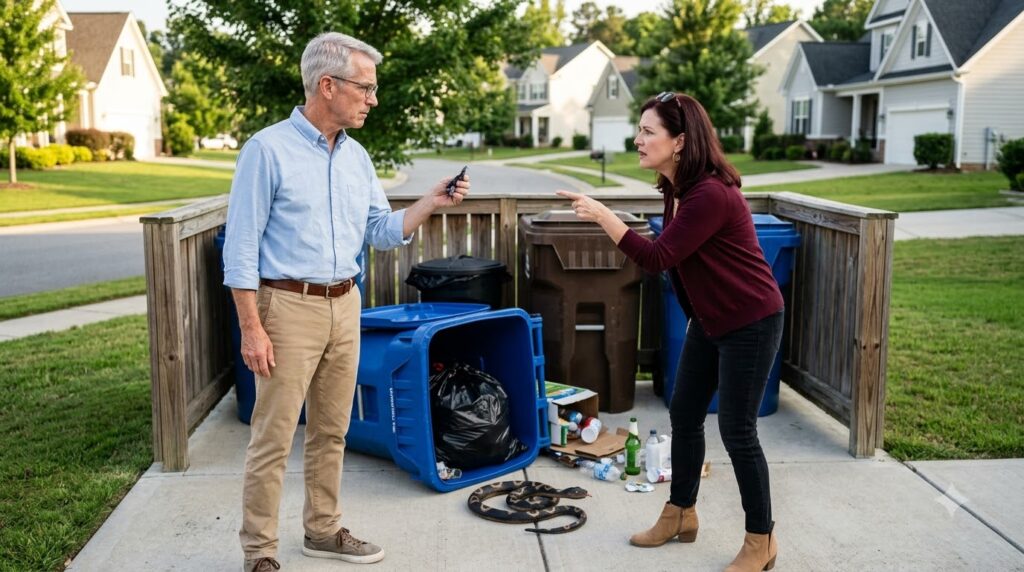
Chapter 7: What the Neighborhood Learned
The HOA called a community meeting.
For once, nobody arrived expecting an argument.
Residents filled the clubhouse.
Older couples sat together near the front.
People who had lived in the neighborhood for decades sat beside newcomers who had never heard the entire story.
David spoke briefly.
Marla spoke after him.
Neither gave a dramatic speech.
They simply explained what had happened.
The damaged bench.
The fake snake.
The torn fabric.
The accusations.
The evidence.
The eventual discovery that someone had deliberately manipulated their conflict.
Marla admitted that she had made assumptions.
David admitted that he had responded with his own assumptions.
That honesty mattered.
The room was quiet when they finished.
Then Evelyn stood.
She reminded everyone that neighborhoods were built on something more fragile than fences and property lines.
Trust.
Once trust disappeared, even ordinary things could become suspicious.
A misplaced garden tool.
A strange footprint.
A complaint.
A noise after dark.
A neighbor who looked away.
Fear could fill in the gaps faster than facts ever could.
The HOA adopted several new procedures.
Maintenance equipment would be logged.
Old access keys would be collected.
Public property inspections would be documented.
Security cameras would cover the walking path.
Most importantly, residents were encouraged to report problems without immediately accusing another resident.
It wasn’t glamorous.
It wasn’t dramatic.
But it was practical.
A few weeks later, the repaired bench reopened.
David was the first person to sit on it.
Marla approached from the path.
She stopped several feet away.
David glanced at








