
Chapter 7: The Street Belonged to Everyone
Months passed.
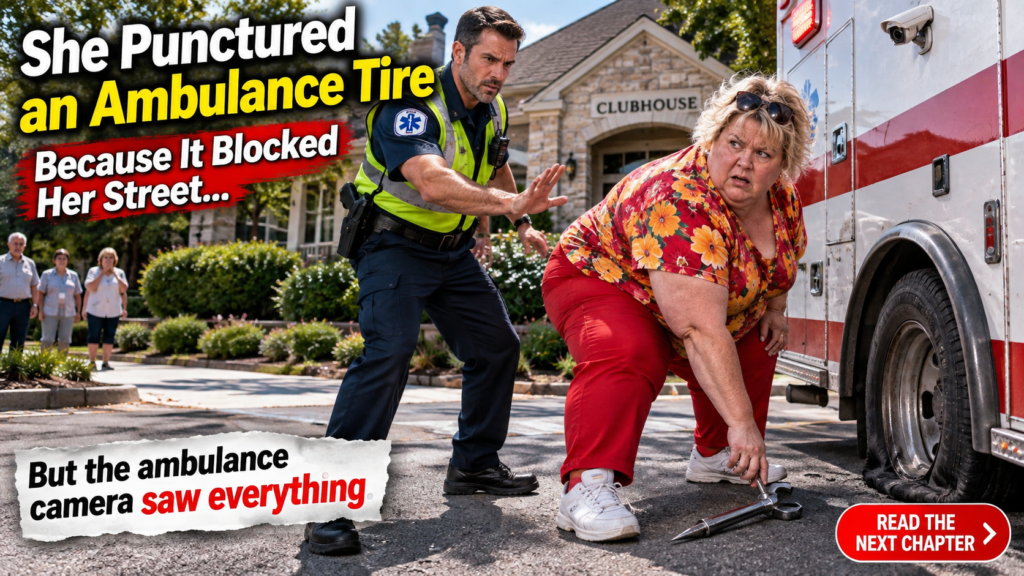
The damaged pavement where the wrench had fallen was repaired.
The ambulance company replaced the tire.
The police case was resolved.
The HOA updated its emergency-access policy.
There were new signs reminding residents that emergency vehicles had priority.
But the most lasting change couldn’t be written into a rule.
It happened quietly.
One Saturday morning, the community held a small gathering near the clubhouse.
Walter came with Emily.
The paramedic stopped by between shifts.
Karen arrived carrying a folding table.
On it were coffee, bottled water, and homemade sandwiches.
Nobody had asked her to bring anything.
She simply had.
The paramedic noticed her.
“Busy day?”
Karen smiled faintly.
“Trying to stay out of trouble.”
He laughed.
It was the first time either of them had laughed together.
Walter watched them from across the lawn.
Later, Karen walked over to him.
“I heard you’re doing better.”
“I am.”
She hesitated.
“I never apologized to you.”
Walter looked at her.
“You did.”
“At the meeting.”
“I meant personally.”
He considered that.
Then he nodded.
“Okay.”
Karen sat beside him.
For several seconds, neither spoke.
Finally, she said, “I was so focused on that street being mine that I forgot I lived in a neighborhood.”
Walter smiled.
“That happens.”
Karen looked toward the road.
Cars moved slowly past.
Children rode bicycles.
A delivery driver waved at someone.
A woman walked her dog.
And, for once, Karen didn’t see an invasion of her space.
She saw people.
People who had somewhere to go.
People who sometimes needed help.
People whose lives crossed hers whether she liked it or not.
The street had never belonged to Karen.
It had belonged to everyone.
The ambulance had not been there to disrespect her.
It had been there because someone needed saving.
And the camera she had once feared became, strangely enough, the thing that forced the truth into the open.
Not just the truth about what she had done.
The deeper truth about why she had done it.
Karen had wanted control because control felt like security.
But she had learned something harder and more valuable.
Respect could not be demanded.
It had to be given.
Privacy did not mean shutting everyone else out.
Home was not a fortress.
And fairness did not mean making sure everyone received exactly what they wanted.
Sometimes fairness meant stepping aside.
Sometimes it meant waiting.
Sometimes it meant admitting you were wrong.
And sometimes, when an ambulance needed the road, it meant understanding that for a few minutes, someone else’s emergency mattered more than your inconvenience.
Walter watched the ambulance pass several streets away.
Then he turned to Karen.
“You know,” he said, “that street looks different when you stop trying to own it.”
Karen looked at the road.
For the first time, she smiled.
“It does.”
And this time, when the ambulance lights appeared in the distance, Karen didn’t see an obstacle.
She saw a reason to move aside.








