
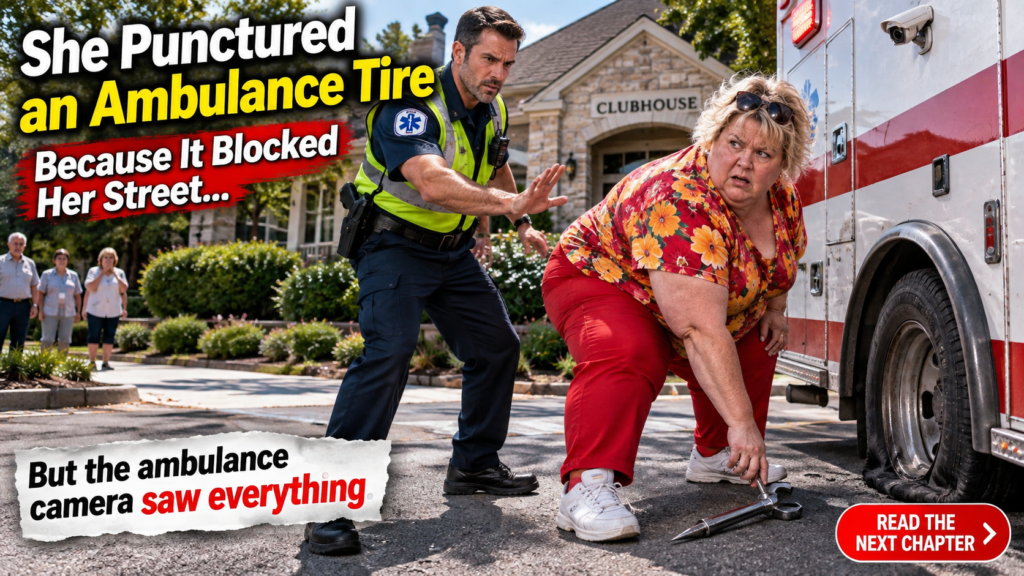
Chapter 5: What Karen Hadn’t Seen
The legal consequences came slowly.
There was a property-damage claim.
There were questions about interfering with emergency services.
There were community restrictions.
And there was the possibility that Karen could face criminal charges.
But something unexpected happened before any court decision.
Karen received a letter from the ambulance service.
She assumed it would be an invoice.
Instead, it contained something else.
A copy of the repair estimate.
And a request for a meeting.
She almost threw it away.
Then she noticed the name at the bottom.
The paramedic.
She agreed.
They met at a small café outside the neighborhood.
Karen expected anger.
He didn’t give her any.
He looked tired.
“You want to know what bothers me most?” he asked.
Karen stared at her coffee.
“You already told me.”
“No.”
He shook his head.
“The tire isn’t what bothers me.”
She looked up.
“It was what happened inside.”
Karen said nothing.
“Mr. Bennett was ready to be transported. We had to wait for another unit.”
Her face hardened.
“He was okay.”
“Yes.”
The paramedic leaned forward.
“He was lucky.”
Karen looked away.
He didn’t accuse her of trying to hurt anyone.
He didn’t call her names.
He simply described the reality.
An ambulance with a disabled tire cannot move.
A medical emergency does not wait for someone’s property dispute to be settled.
And another emergency somewhere else could have required that same ambulance.
Karen listened.
For the first time, she understood that she had never actually been arguing about parking.
She had been arguing about control.
She wanted people to acknowledge that the street outside her home belonged, in some emotional sense, to her.
She had spent months demanding respect.
Yet she had shown none.
When she finally left the café, she carried the repair estimate with her.
That evening, she sat alone in her living room.
Her house was quiet.
Too quiet.
She opened her email.
There were dozens of old complaints she had sent to the HOA.
She read them one by one.
Some were reasonable.
Many were not.
She saw the pattern.
Every inconvenience had become a personal insult.
Every disagreement had become a battle.
Every request from someone else had felt like an attack on her rights.
Karen sat back.
For years, she had believed other people were disrespecting her.
She was beginning to wonder whether she had confused respect with obedience.








